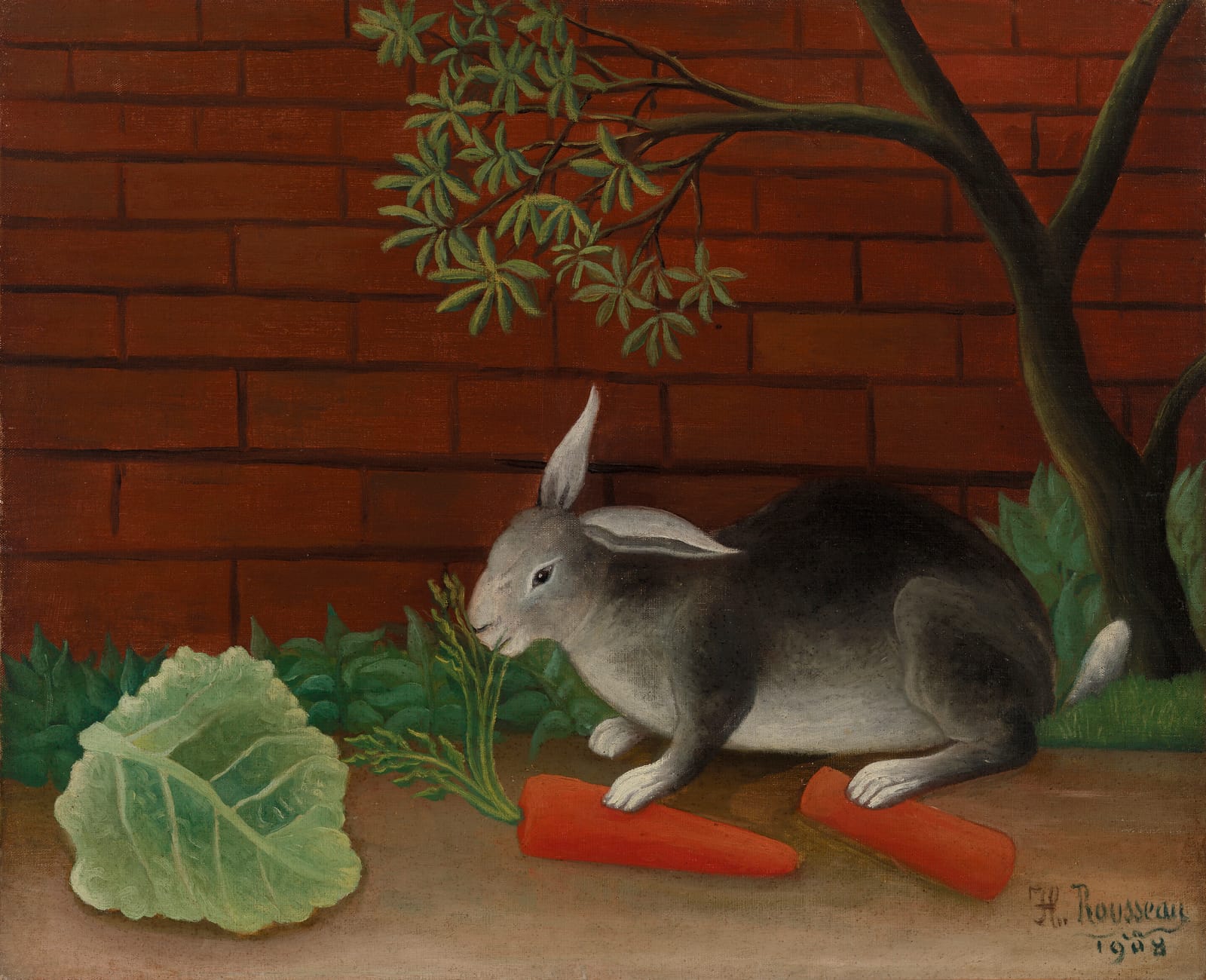
Art: Henri Rousseau.
“The Rabbit’s Meal” (1908), oil on canvas; The Barnes Foundation, Philadelphia.
In my college days, it was a treat to visit the Barnes Foundation in Marion, Pennsylvania, where Barnes’s will specified it should remain forever. He hated art experts and was as determined as one can be — considering “you can’t take it with you” — to keep his collection away from museums.
After a long conflict among many players, the collection nevertheless ended up with the Philadelphia Museum of Art, where an effort was made to maintain the groupings of works the way the will required.
The art critic who wrote today’s feature describes a recent exhibit. Writing at Hyperallergic in January, Judith Stein says, “If you’ve ever tried to puzzle out what’s happening in Henri Rousseau’s haunting ‘Sleeping Gypsy’ (1897) at the Museum of Modern Art, then you’re already familiar with the artist’s extraordinary ability to tantalize viewers. That painting of a lion and a slumbering woman is on view in Henri Rousseau: A Painter’s Secrets at the Barnes Foundation, now in the company of nearly 60 more works — many equally mesmerizing.
“Self-taught, self-confident, and inscrutable, Henri Rousseau … began painting before retiring as a toll collector for the city of Paris in 1893. It was at this point that he became a professional, though impoverished, artist.
“The title A Painter’s Secrets is not a ploy. Curators Christopher Green and Nancy Ireson freshly contextualized many artworks in the light of his personal story, and conservators conducted revelatory technical studies that, among other findings, exposed areas of long obscured, nuanced color. The grumpy-faced baby in ‘The Family’ (c. 1892–1900) is enlarged in the catalog to underscore Rousseau’s shrewd observational skills. …
“It’s startling to discover the top section of the four-year-old Eiffel Tower in the distant background of ‘Sawmill, Outskirts of Paris’ (1893–95), one of the small works that the enterprising painter sold to his neighbors. Other surprises are eerie. Sheltered within a barely visible structure in ‘Carnival Evening’ (1886), a disembodied head spies on a pair of costumed revelers.
“A Painter’s Secrets incorporates several of the Barnes Foundation’s 18 Rousseau paintings, temporarily installed alongside loans of thematically related examples. Visitors can compare their ‘Scouts Attacked by a Tiger’ (1904) with the savage animals in dramatic struggles depicted in the Fondation Beyeler’s ‘The Hungry Lion Throws Itself Upon the Antelope’ (1898–1905) and the Cleveland Museum of Art’s ‘Fight Between a Tiger and a Buffalo’ (1908). …
“ ‘Rousseau is not so much a storyteller as a story-giver,’ Christopher Green notes in his catalog essay. Will the naked damsel with knee-length blond hair in the Barnes’s ‘Unpleasant Surprise’ (1899–1901) be rescued by the hunter shooting at the ferocious bear about to maul her? Will the beautiful flute player in the Musée d’Orsay’s ‘The Snake Charmer’ (1907) be able to keep the venomous serpents at bay? …
It was Rousseau’s fellow artists who initially recognized his genius.
“An ambitious painter, he courted official patronage in vain. Picasso, who both admired and gently mocked Rousseau, first discovered his work in 1908, when he came across the ‘Portrait of a Woman’ (1895) in a bric-a-brac shop selling canvases for reuse. Framed on one side by voluptuously patterned, cinched drapery, his model stands on a balcony in front of an enfilade of potted flowers, overlooking a distant mountain range and a delicately colored sky. Unsurprisingly, Picasso bought it and kept it until his death. …
“While you’re at the Barnes, you can find other works by Rousseau from the permanent collection in nearby galleries, installed unchanged since 1951 as components of founder Albert Barnes’s provocative art ensembles. Once you’re there, prepare to be sidetracked by the abundance of work by Picasso, Cézanne, Matisse, and Renoir. A Painter’s Secrets is a rare opportunity to situate Rousseau in this lineage and, in the process, to absorb his innovative (and far from ‘naive’) use of pictorial space and color, and his enchanting imagination.”
There’s a great array of Rousseau’s paintings, here, at Hyperallergic. No firewall. Subscriptions encouraged.


 Suzanne's Mom's Blog