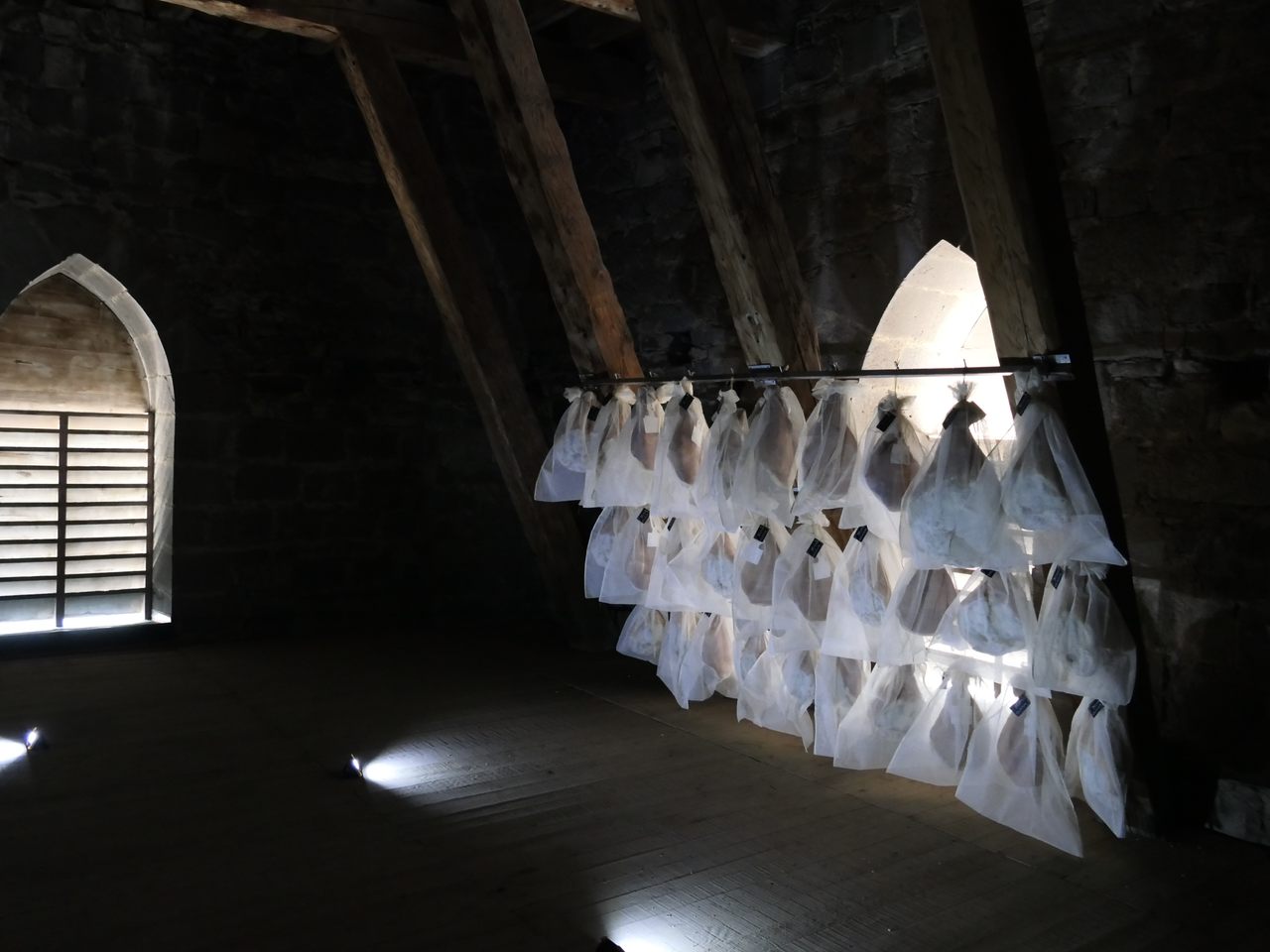
Photo: Altitude.
At Saint-Pierre Cathedral in France, winds from the surrounding plateaus create an ideal environment for curing ham in the bell tower.
I’ve read about decommissioned churches being repurposed for affordable housing or art centers, but today’s story is the first I’ve seen about providing an important service for pig farmers.
Emily Monaco writes at Atlas Obscura, “In Saint-Flour, a town in the Auvergne region of central France, the highest cathedral in Europe perches at 892 meters (nearly 3,000 feet) above sea level. Saint-Pierre sits at the confluence of the dry winds blowing across the surrounding plateaus, making it, surprisingly, the ideal place to age local hams to perfection.
“This church-aged charcuterie was the brainchild of Philippe Boyer, who became rector of Saint-Pierre in 2011. Soon thereafter, he encountered his first challenge: The 600-year-old cathedral was in need of some TLC, specifically for its 19th-century choir organ. Repairs would cost several thousand euros, money no one had. …
“Boyer was undeterred. ‘I said to myself, “Why not make a product in the spirit of the great medieval abbeys, who made their own food, which they sold to survive, to live?” ‘ he says. ‘In this case, it’s not for us to live, but to give new life to heritage.’
“Boyer began by adding beehives to the cathedral roof, and, following the success of the resulting honey, he turned his attention to one of the region’s star products: Jambon d’Auvergne, a ham boasting a protected status similar to Champagne or Roquefort.
Typically aged in drying rooms for eight to 12 months, these hams, Boyer figured, could easily be aged instead in the cathedral’s breezy north tower.
“He mentioned the idea to a reporter from local newspaper La Montagne, and the article caught the attention of farm cooperative Altitude. ‘We thought the idea was pretty original, pretty iconoclastic,’ recalls Altitude communications manager Thierry Bousseau, noting that the group also thought the project would be the ideal way of promoting the work of their farmers and salaisonniers, experts in the art of curing and aging charcuterie like sausages and hams.
“A host of bureaucratic hurdles loomed, including authorizations from French health services and the certifying board granting the hams IGP (Indication Geographique Protégée) status. And of course, the architecte des bâtiments de France, a civil servant devoted to the protection of state-owned buildings, had to be consulted. ‘He gave his OK,’ says Bousseau, and so, in June 2022, Bishop Didier Noblot officially invoked the protection of Saint Antoine, patron of charcutiers, in blessing the first hams.
“Today, hams produced by one of Altitude’s 30 farms are first aged in the cooperative’s aging rooms. Only the best are selected for sale to the Association des Amis de la Cathédrale, whose volunteers meet weekly to replenish the supply, carrying each ten-kilo (around 22 pounds) ham up the 150-odd steps of the spiral staircase to the tower. Here, they’re swaddled in bags and suspended from hooks just beneath the 19th-century bells. About 50 hams hang here at any given time, dry-aged for at least two months under the watchful eye of Patrice Boulard, a member of the Association and an expert salaisonnier with Altitude. The environment, he says, makes for a superlative ham. …
“But after just a few months, the project hit a snag. The new architecte des bâtiments de France noticed grease stains on the floor below the hams, and, Boyer recalls, ‘he started to panic.’ The stains were easily explained by the fact that the bells are greased every six months, but, fueled perhaps by the memory of Notre-Dame’s 2019 conflagration, the architect dubbed the hams a fire hazard. ‘Hams don’t catch fire, just like that,’ protests Boyer. But the group was nevertheless forced through yet another series of bureaucratic hoops. Six months after adopting new protocols, things seemed to have settled, Bousseau recalls. ‘And then in October 2023, we got a letter.’
“By this point, Boyer had been transferred to nearby Aurillac, so it was the new vicar, Jean-Paul Rolland, who received the news: The changes had been deemed insufficient, and effective immediately, the hams had to be removed.
“But Rolland took advantage of the bureaucratic tangle in forming his response. ‘He decided that the diocese, as the renter of the space, was not responsible for what happened in the cathedral,’ says Bousseau. ‘He got the message across that basically, the hams weren’t going anywhere.’
“These days, the status of the project is ‘a bit convoluted,’ admits Bousseau. ‘Officially, aging the hams is illegal, but the reality is that they’re still there.’ And despite their novelty, they’ve become beloved among locals. ‘Saint-Florins have appropriated them,’ he says, ‘as though they had always been.’ …
“According to Bousseau, ‘There’s a contradiction regarding the announcements made by the state. “We can’t finance our heritage.” And then we, at the local level, find solutions, and there’s a civil servant putting a wrench in the works.’ …
“In late October, the Minister of Culture voiced her official support of the hams.”
Wondering what blogger and farmer Deb has to say about all this.
More at AtlasObscura, here.

 Suzanne's Mom's Blog