Feeds:
Posts
Comments

Posts Tagged ‘bike path’

Covid Murals

Photos: John.

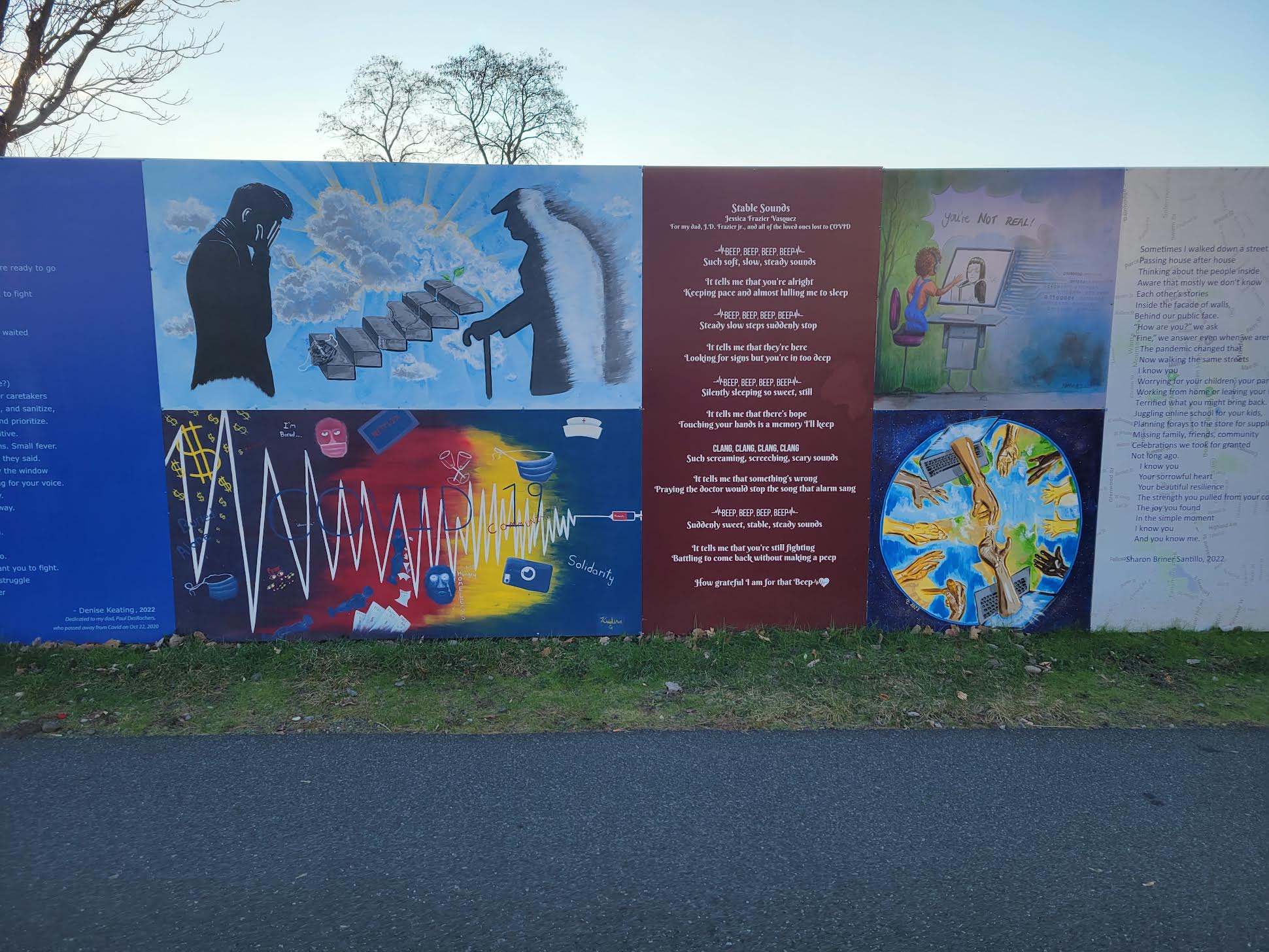
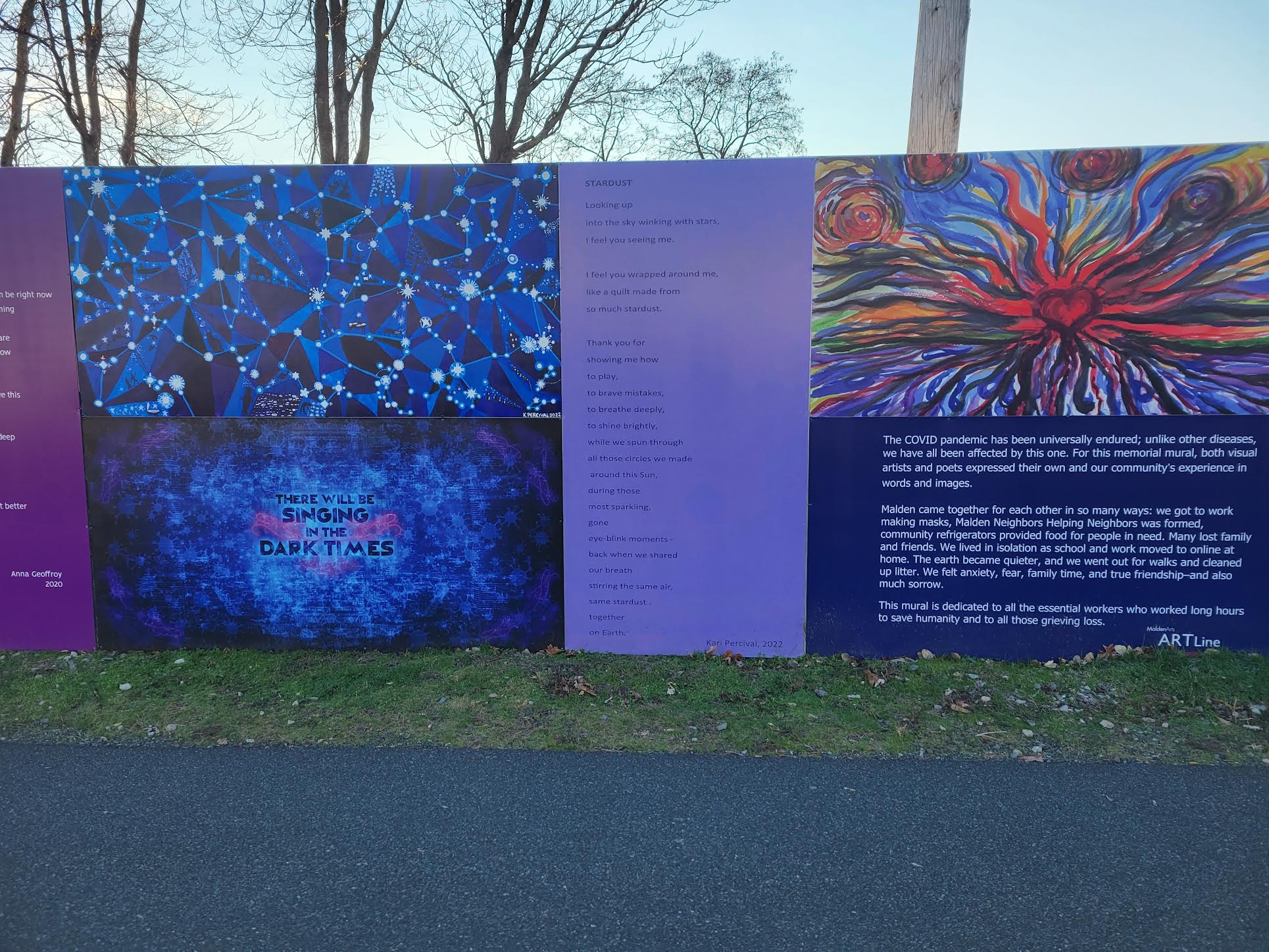
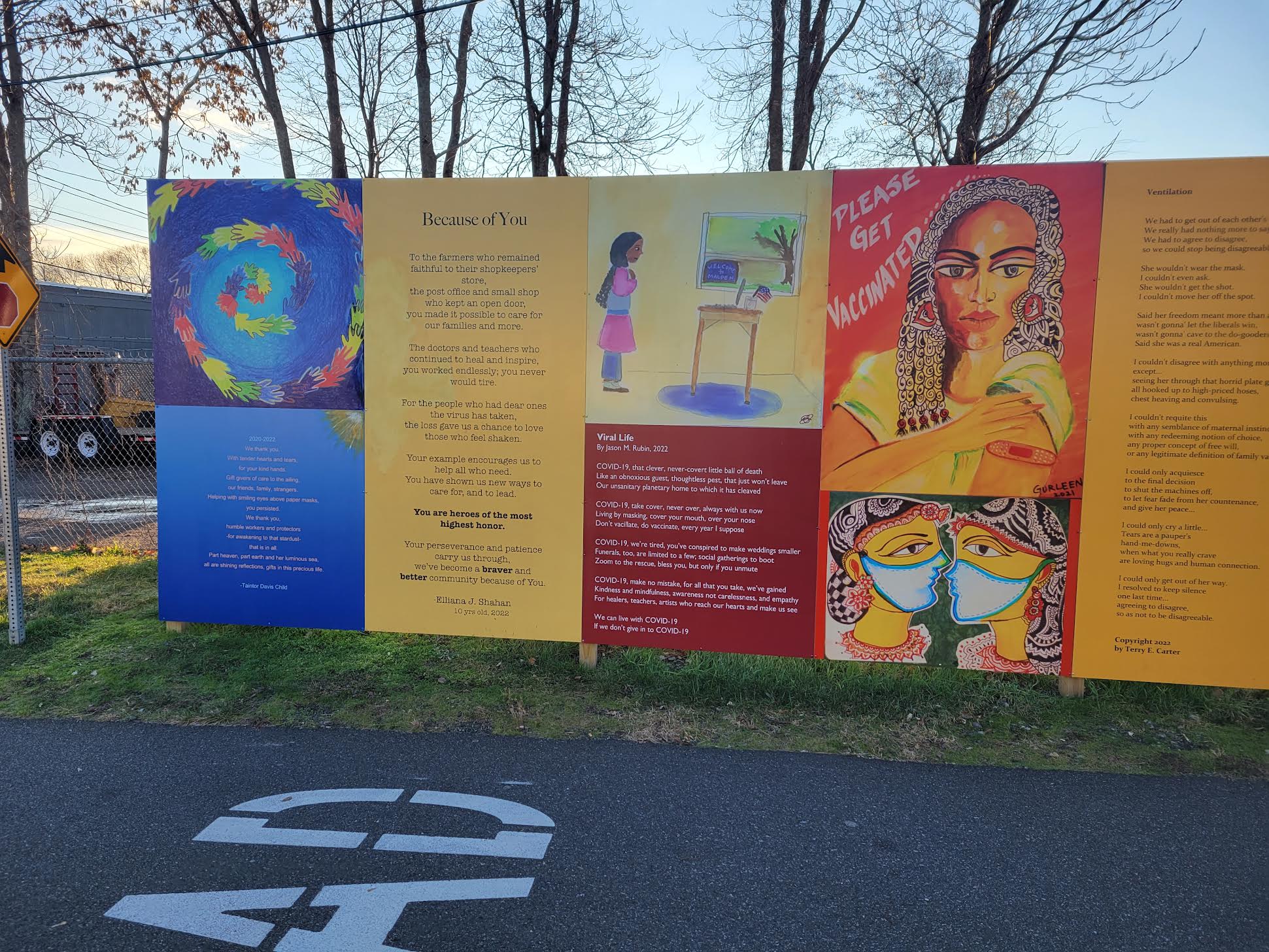
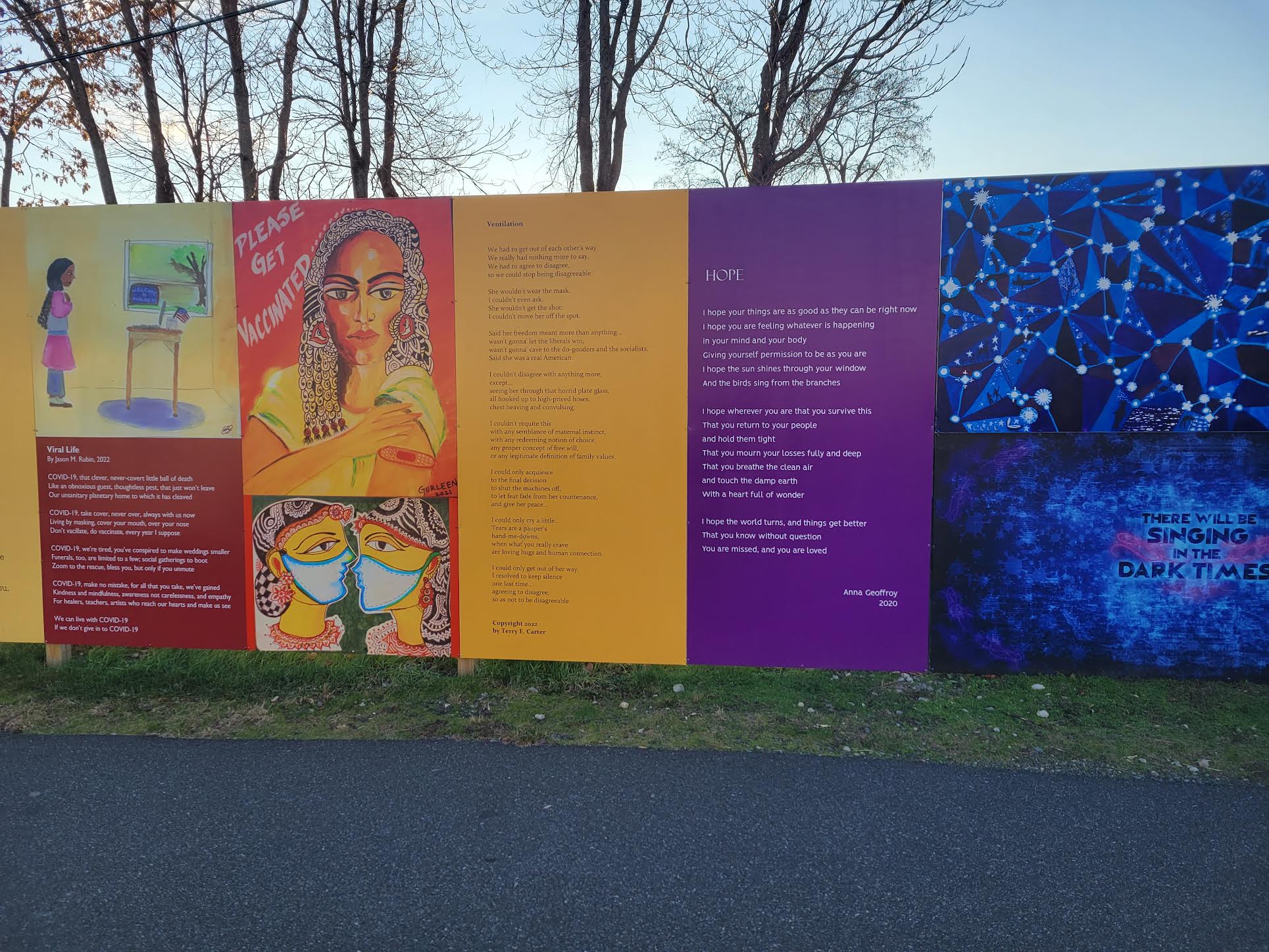
John was in Malden yesterday and saw the Covid murals on the bike path. He was stunned. I tried to find a descriptive article about them online but ended up having to copy lines of poems from the photos on Flickr. I hope I got all the punctuation right. Poets care about such things.

How soon we forget what it was like to be deep in the midst of this! When we thought protecting ourselves meant wiping down the groceries with bleach. When doctors and nurses were having to reuse masks and were sending out pleas for people to find old masks in their garage workshops and take them to emergency rooms. When there were few test kits and no vaccines. How soon we forget it was all about breath and breathing!

The memorial to lost lives in Malden features both art and written words. These are excerpts from the poems.

Terry E. Carter wrote a poem about his mother called “Ventilation.”

“She wouldn’t wear a mask.
“I couldn’t even ask. …
“Said her freedom meant more than anything —
“wasn’t gonna let the liberals win.”

Ten-year-old Elliana J. Shahan’s poem “Because of You” honors farmers, shopkeepers, postal workers, doctors, teachers, and all who kept the world running in the dark times.

Jessica Frazier Vasquez’s is poem about the beep beep beep of her dad’s ventilator showing he was at least still alive: “It tells me that you’re still fighting/Battling to come back.” At least for a while.

Sharon Briner Santillo’s poem noted how one never used to know what was going on behind a neighbor’s windows and how one may feel more connected now.

“I know you
“Your sorrowful heart
“Your beautiful resilience …
“I know you
“And you know me.”

There is another by Dina Stander called “Breath”: “May her memory be for a blessing.” And one by Denise Keating called “A Slow Goodbye” about her father, who had already been paralyzed by a stroke for 10 years.

“We hovered by the window
“Moths fluttering for your voice
“We went away.
“You slipped away.
“And now.
“Guilt-stricken.
“Paralyzed.
“We let you go.
“We didn’t want you to fight.
“But we still struggle
“To remember
“To breathe.

More at MaldenArts, here. Be sure to look at the Flickr pictures, here: you can zoom in to read the words. Most of the poems are not literary, but all are heartfelt.
Read Full Post »

Along the Minuteman Bikeway, one finds a variety of art exhibits that stay up about a year.

There are some really good bike paths in my neck of the woods, although they don’t all connect yet because some property owners fear them. But where they do exist, they give delight to all kinds of people, not just bikers. In many sections, artists have put up temporary displays, which add to the delight.

As I showed, here, the Bruce Freeman Trail currently has imaginatively painted doors by Umbrella Arts Center artists.

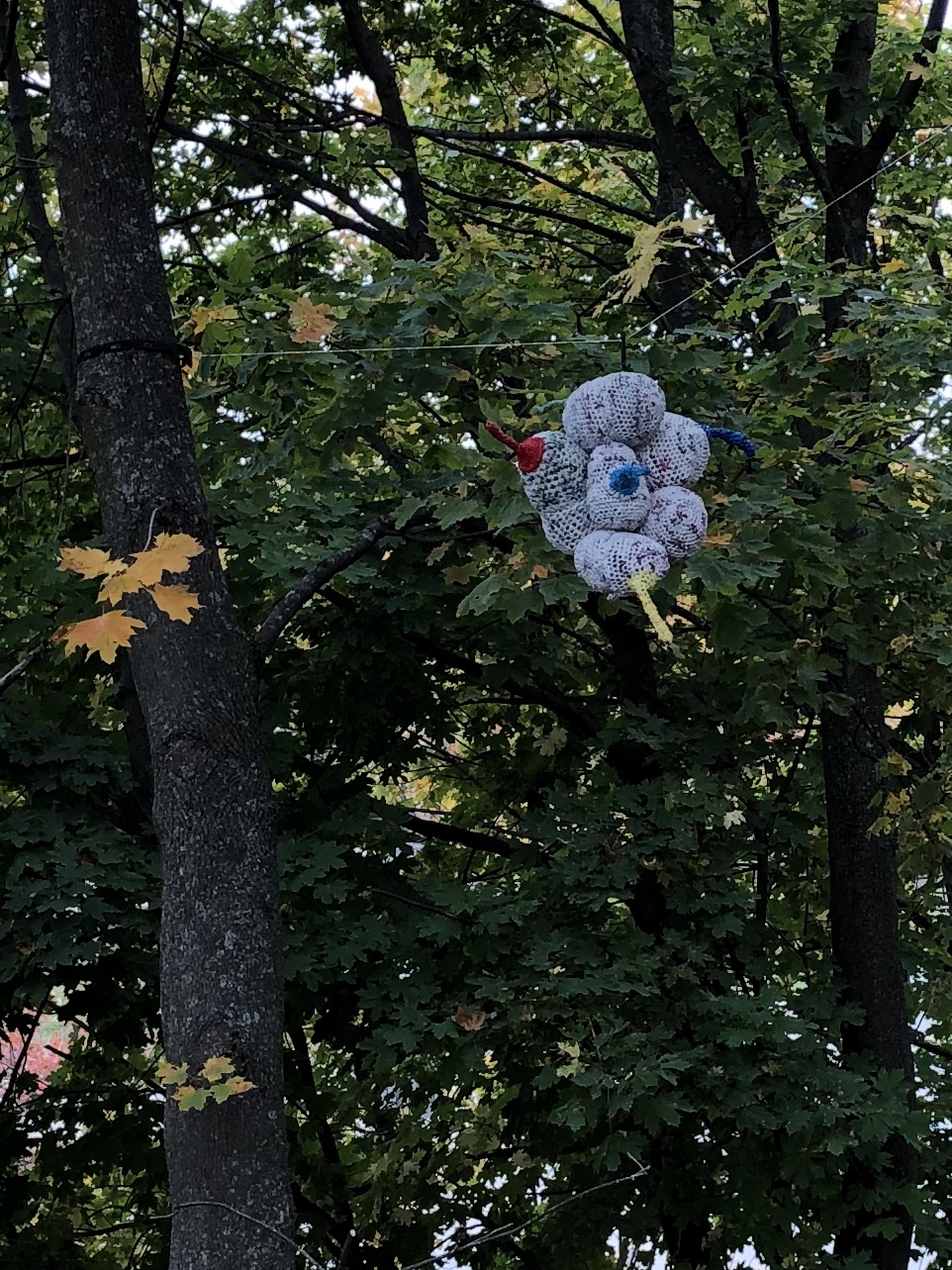
And when Cate McQuaid reported in the Boston Globe about crocheted plastic-bag art in the Arlington section of the Minuteman Trail, I knew I had to check it out. Three good things at once: a pretty walk, art, and volunteers fighting to end plastic litter!

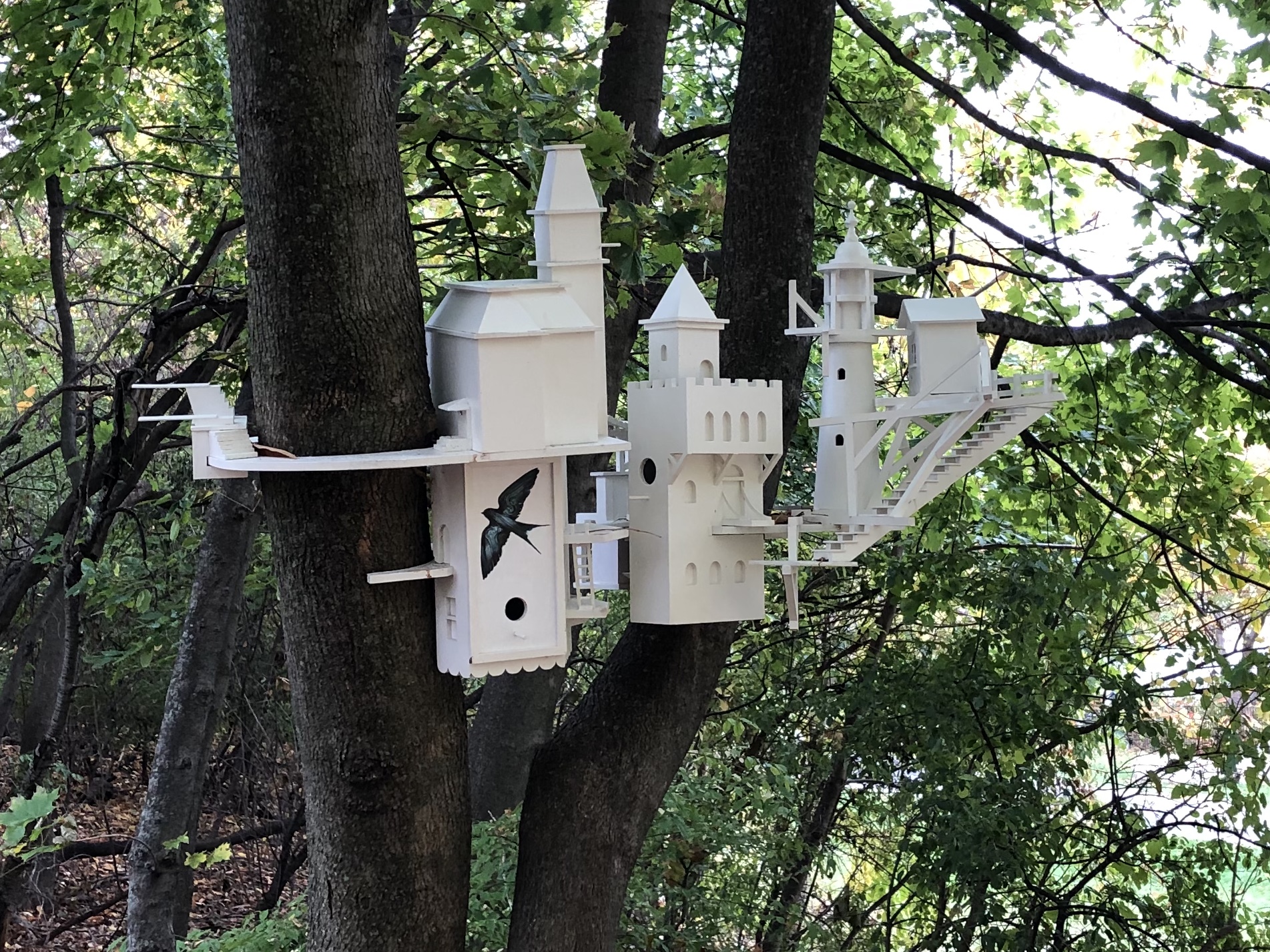
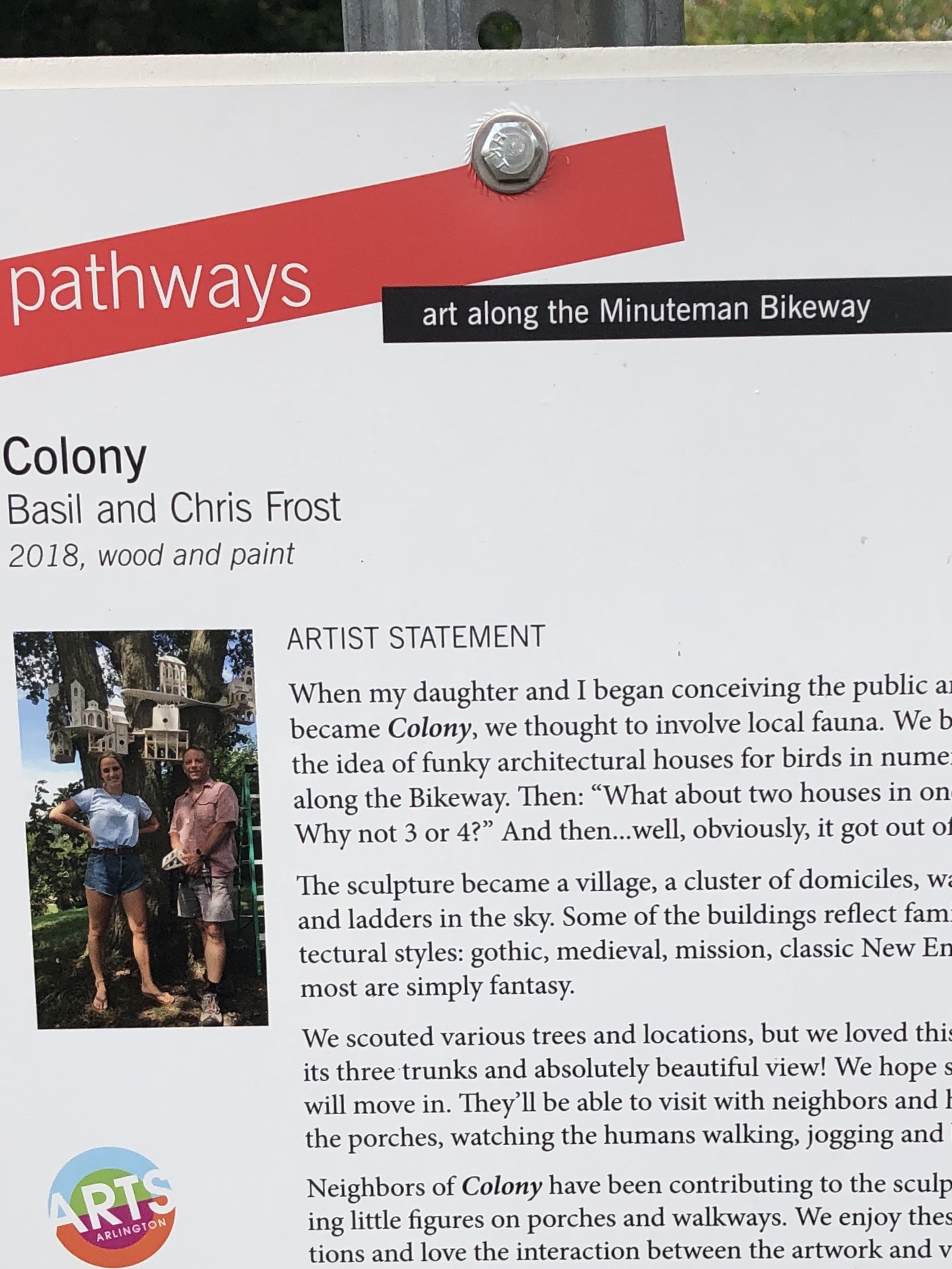
While hunting the location of “Persistence: A Community Response to Pervasive Plastic,” I also got to see the Colony installation, which was scheduled to come down. It consisted of castle-like architecture that invited visitors to add their own little elements — for example, Fisher-Price “Sesame Street” figures.

About the crocheted creations, McQuaid wrote, “Plastic persists, breaking down into microplastics, which fish eat — and if we eat fish, we also eat plastic. But there’s another reason ‘Persistence: A Community Response to Pervasive Plastic,’ an installation by Michelle Lougee along the Minuteman Bikeway, got its title.

“ ‘It’s also the persistence it took everyone to get through this time, and who helped our project persist,’ said organizer Cecily Miller, public art curator for the Arlington Commission of Arts & Culture.

“The project kicked off late last year, with rosy hopes of community crafters coming together to crochet plastic bags. Lougee would turn the components they made into sculptures of aquatic microorganisms and suspend them from trees along the Bikeway overlooking Spy Pond. Workshops and meetups kept the momentum going. Miller says more than 100 people were collecting plastic, flattening, and folding it into plastic yarn, and doing the needlework. Then came the fog of COVID-19.

“ ‘Do the plastic bags hold the virus? Can we quarantine them? Nobody really knew the answers,’ Miller said.

“Miller and Lougee forged ahead with plastic the sculptor had in storage. The social element of the project came to a halt. They posted online resources for volunteers at home. …

“ ‘We had people who did more than they would have done without the pandemic,’ Lougee said. ‘Some people were happy to have this to focus on.’ “

They persisted. The display will be up through Halloween of next year. See www.artsarlington.org/artist-in-residence. And read more from Cate McQuaid at the Globe, here.

Read Full Post »

Germany is opening a 62-mile bike path. That’s what I call a long ride.

See what Charlie Sorrel (“previously found writing at Wired.com, Cult of Mac and Straight No filter”) has to say about it at Fast Company.

“Germany, the country famous for its speed-limit free stretches of Autobahn, is building car-free Autobahns for bikes. The Radschnellweg (‘fast bike path’) RS1 runs 62 miles between the cities of Duisburg and Hamm, passing through eight other cities along the way.

“Cycling is big and growing in Germany. In Berlin, the school run is more likely to consist of a parent on a bike with two child seats than in an SUV. Cycling is done for pleasure, but also as just another way to get around. Cities already have extensive cycling infrastructure, and in the countryside, you can find wide, smoothly-paved bike highways.

“According to the ADFC, one kilometer of road costs around €10 million. One kilometer of bike highways runs to just €1.8 million. …

Says the ADFC’s (Germany’s bike association and advocate group) Ulrich Syberg. ‘When it’s ready, the world will look upon the Ruhr area and wonder, how many people can you motivate to switch from the car to the bike, and much this will relieve congestion in city centers.’

“How much congestion? A 2014 study into the lane by the Federal Ministry of Transport says that it could replace up to 52,000 car journeys. But that’s not even the best part. The study also estimated that savings due to the health benefits of cycling could be as much as five times the cost of building the bikeway.” More here.

Photo: via Radschnellweg
The Radschnellweg (“fast bike path”) RS1 runs 62 miles between the cities of Duisburg and Hamm, passing through eight other cities along the way.

Read Full Post »

Could this be real? It’s a bike path above the traffic.

Well, why not? If Minneapolis can build a complex system of second-floor skyways that allowed me to walk to work without a coat in deep winter 1997, why not?

Ben Schiller at FastCoExist explains.

“In most cities, cycling infrastructure isn’t much more than a few dotted lines on the road. But that’s not how it is in the Netherlands, one of the world’s most cycle-friendly nations. Dutch cities have dedicated lanes that separate cars and bikes, making cycling an activity for young and old, female and male–not just the adventurous few.

“A good example is [an] elegant circular bridge in Eindhoven, in southern Holland. Called the Hovenring, it lets cyclists completely avoid other road users and cross the busy A2 highway with minimal fuss. It also makes for better road flow, according to Gerhard Nijenhuis, an employee at IPV Delft, the firm that designed it.” Read more.

Photo: FastCoExist
In the Netherlands, bikers ride on top of this rotary.

Read Full Post »