Feeds:
Posts
Comments

Posts Tagged ‘bird’

The Duolingo bird can be very encouraging to a language learner. But it can also get angry.

With Suzanne’s family leaving soon for six months in Stockholm, I’ve been trying to learn some Swedish. I hope to try it on my grandchildren come next January. So it’s daily Duolingo for me. If I ever get to the point where I can understand Erik when he uses Swedish with the kids, I might also try expanding my French. I like the way the silly Duolingo bird cheers me on.

I was surprised to learn how many new languages the app has been adding lately. In the beginning, it didn’t even have Swedish. Now, according to an article in the Verge, it’s adding things like Maori, Tagalog, Haitian Creole, and isiZulu.

Jay Peters reports, “Duolingo is ‘more than doubling’ the number of courses it has available, a feat it says was only possible because it used generative AI to help create them in ‘less than a year.’

“The company [said] that it’s launching 148 new language courses. ‘This launch makes Duolingo’s seven most popular non-English languages – Spanish, French, German, Italian, Japanese, Korean, and Mandarin – available to all 28 supported user interface (UI) languages,’ dramatically expanding learning options for over a billion potential learners worldwide’ … the company writes.

“Duolingo says that building one new course historically has taken ‘years,’ but the company was able to build this new suite of courses more quickly ‘through advances in generative AI, shared content systems, and internal tooling.’ The new approach is internally called ‘shared content,’ and the company says it allows employees to make a base course and quickly customize it. …

“ ‘Now, by using generative AI to create and validate content, we’re able to focus our expertise where it’s most impactful, ensuring every course meets Duolingo’s rigorous quality standards,’ Duolingo’s senior director of learning design, Jessie Becker, says in a statement.

“The announcement follows a recent memo sent by cofounder and CEO Luis von Ahn to staff saying that … it would ‘gradually stop using contractors to do work that AI can handle.’ AI use will now be evaluated during the hiring process and as part of performance reviews, and von Ahn says that ‘headcount will only be given if a team cannot automate more of their work.’

“Spokesperson Sam Dalsimer tells The Verge in response to questions sent following von Ahn’s memo. ‘We’ve already been moving in this direction, and it has been game-changing for our company. One of the best decisions we made recently was replacing a slow, manual content creation process with one powered by AI, under the direction of our learning design experts. That shift allowed us to create and launch 148 new language courses today.’ …

“Dalsimer acknowledges that there have been ‘negative reactions’ to von Ahn’s memo. Dalsimer also notes that Duolingo has ‘no intention to reduce full-time headcount or hiring’ and that ‘any changes to contractor staffing will be considered on a case-by-case basis.’ “

Hmm. That is giving me pause. But I do like the app and the way that for English-speaking students like me, Duolingo starts out with some vocabulary that sounds like English. It makes me wonder if it does the same for learners who come from other languages. That could be really tricky.

Have you used Duolingo? I know that blogger Asakiyume, a mega language learner, used Duolingo to add Spanish and Portuguese to what she already knew in Japanese and more obscure languages. One thing I know for sure: she won’t like that Duolingo contractors will lose jobs thanks to AI.

More at the Verge, here.
Read Full Post »

Photo: Peter Ryan.
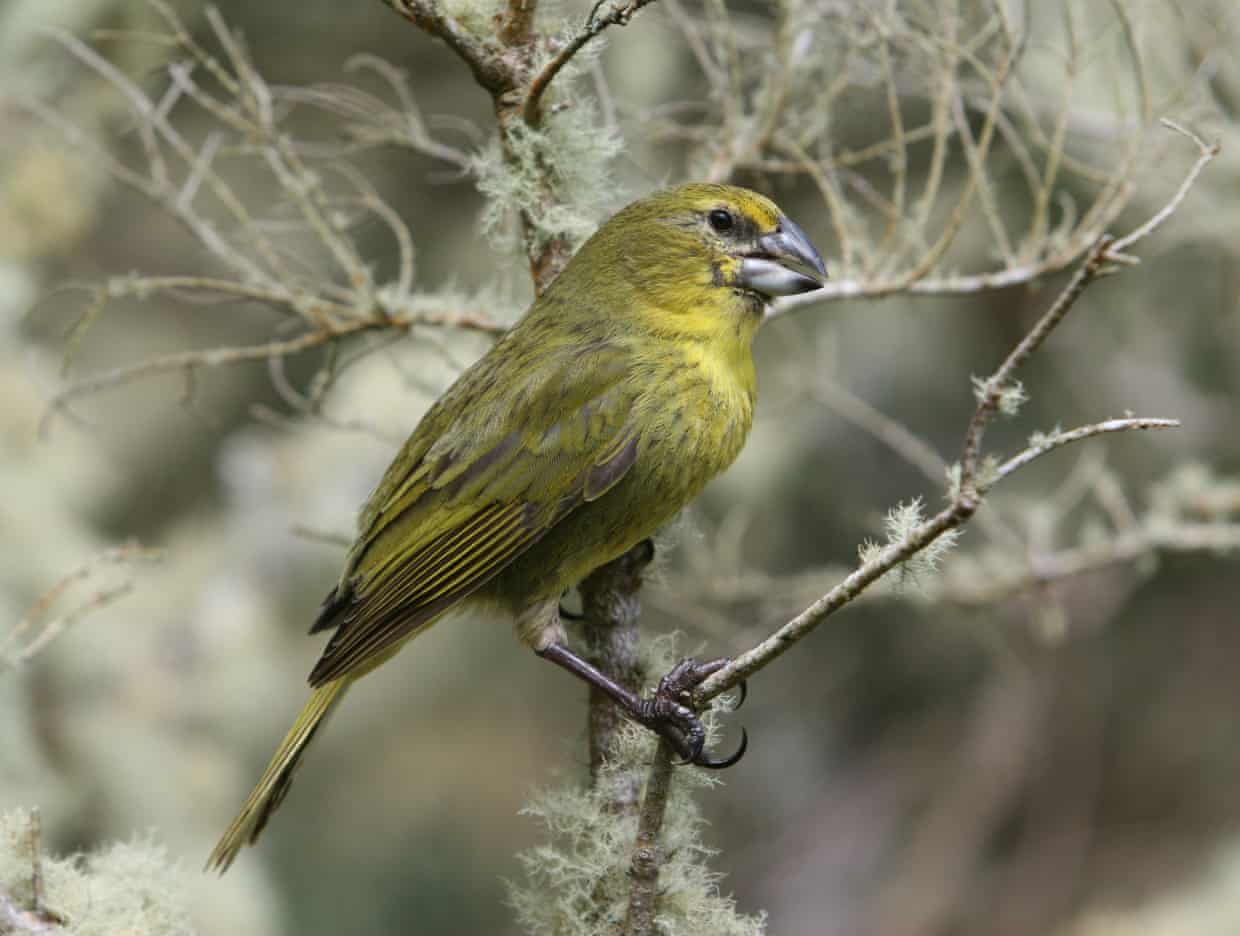
Surveys before 2019 found that the number of breeding pairs of Wilkins’ bunting was 120 and going down. Then a wasp got involved.

Before I get into today’s story about efforts to save the habitat of a rare bird, I want to explain where this is happening. Nightingale Island is in the South Atlantic, a bit closer to Cape Town, South Africa, in the east than to Buenos Aires, Argentina, in the west.

Wikipedia says, “Nightingale Island is an active volcanic island in the South Atlantic Ocean, 3 square kilometres (1.2 sq mi) in area, part of the Tristan da Cunha group of islands. They are administered by the United Kingdom as part of the overseas territory of Saint Helena, Ascension and Tristan da Cunha.

“Nightingale Island is [uninhabited but] regularly visited for scientific purposes and research. It is one of the only stops for birds in the Atlantic and sees millions of them visit it annually.” More.

I read the following report on saving the island’s threatened Wilikins’ bunting and couldn’t help wondering how we balance two goods: the need to save species and the need to prevent introduced species (in this case a wasp) from creating unanticipated future havoc.

Helena Horton wrote at the Guardian, “A tiny parasitic wasp has given a lifeline to one of the world’s rarest bird species by killing off an invasive insect that was threatening its survival.

“The Wilkins’ bunting lives on Nightingale Island, part of the Tristan da Cunha \ group; the world’s most remote inhabited archipelago. It eats the fruit of the Phylica arborea, the island’s only native tree.

“But around 2011, scientists began to notice signs of an unwelcome visitor. An invasive, sap-sucking scale insect had been, it seems, accidentally introduced on to the island by humans. These insects secrete honeydew, which encourages the growth of a sooty mould that weakens and eventually kills Phylica arborea. Their arrival threatened to destroy the forest, and the tiny bird population among with it.

“This news was devastating to the scientists who study and protect the little yellow bird, as its numbers had been suffering. Huge storms in 2019 destroyed much of the forest, and surveys before the storm found there were only about 120 breeding pairs of the bird remaining.

“The RSPB, Centre for Agriculture and Bioscience International, Food and Environment Research Agency and Tristan da Cunha Government hatched an unorthodox plan to save the buntings, releasing a small parasitoid wasp called Microterys nietneri, which prevents the scale insects from breeding. They would also set up a tree nursery to boost the number of trees and improve the biosecurity on the island to stop invasive species coming in future.

“But first, the wasps had to survive the trip from London – almost a month by land, sea and air. Dr Norbert Maczey, an entomologist at CABI, said: ‘The wasps faced an epic journey. Firstly, a flight from London to Cape Town, in a cool bag, followed by an enforced stay in a hotel room as part of a staff member’s Covid quarantine. Next came a week-long boat journey to Tristan with temperatures sometimes dropping below zero. Finally, there was a further boat trip to Nightingale Island. It seemed like luck and time was against us but some of the wasps made it.’

“Fewer than 10% of the wasps survived the trip, but in April 2021 the first release took place, and there were more over the next two years. Slowly a population of wasps has started to establish itself. …

“Surveys in February this year showed that despite losing approximately 80% of the forest, there are still an estimated 60-90 pairs of Wilkins’ bunting on Nightingale. Although the population has reduced, the forest has recovered in the short period since the wasps were released, and the scientists think numbers of buntings should stabilize and will have a chance to recover over the next few years.

“David Kinchin-Smith, the RSPB’s UK overseas territories project manager, said: … ‘Hopefully we, and the wasps, have given the buntings a much-needed lifeline.’ ” More at the Guardian, here.

Do you have an opinion on this approach?

And from Wikipedia, something curious about the remote islands: “Edgar Allan Poe‘s The Narrative of Arthur Gordon Pym of Nantucket alluded to Nightingale Island, Inaccessible Island, and Tristan da Cunha.”

Read Full Post »

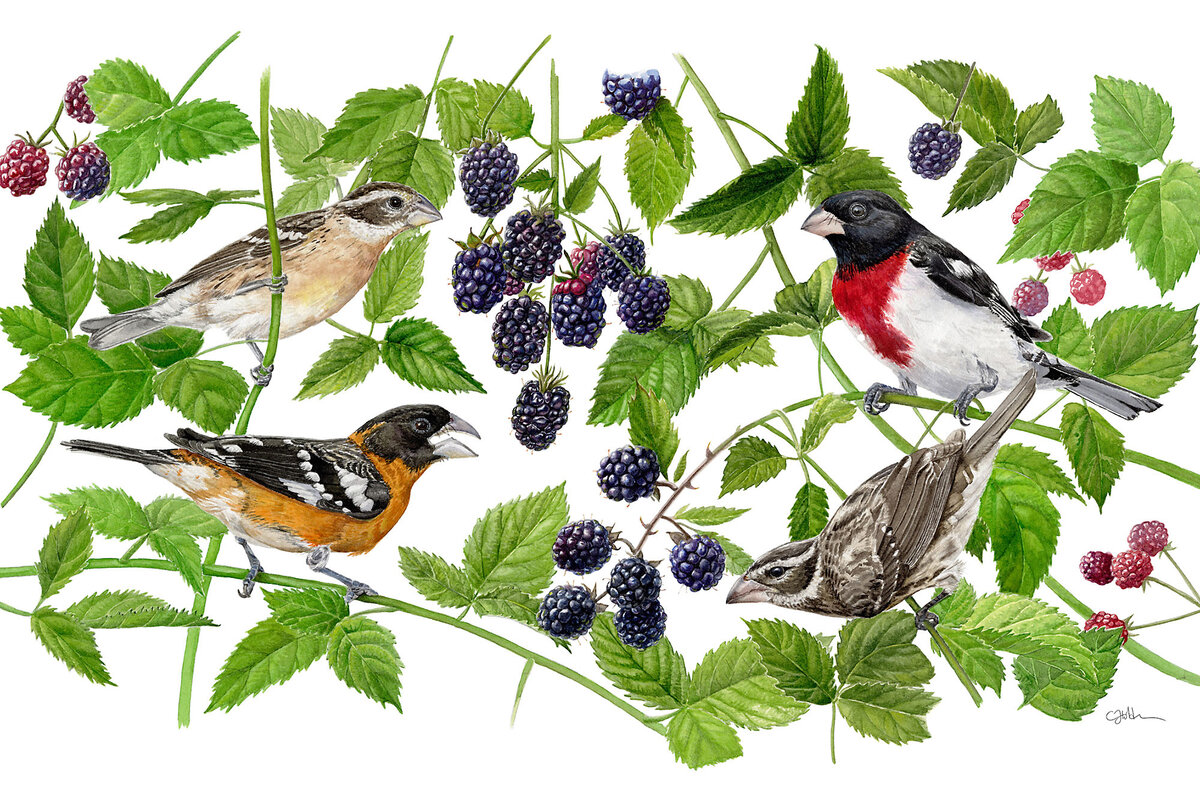
Art: Charlotte Holden.
A watercolor by Charlotte Holden, one of the artists in the Bartels Science Illustration Program at the Cornell Lab of Ornithology in Ithaca, New York, was used on the 2023 mug sent to members of the Ornithology Lab.

Our family has a lot of bird mugs. You may have some, too, especially if you have supported any environmental organization. As important as it is to protect creepy crawly insects, say, or an ugly fungus, those things don’t make great tea cups. Everyone, however, loves birds.

Today’s story is about the contemporary artists behind the bird art on your holiday cards, calendars, and coffee mugs.

Stephanie Hanes wrote at the Christian Science Monitor, “When international researchers recently discovered that a population of hummingbirds in South America was actually two distinct species – a finding made after much trekking and tracking and genome sequencing – they called on Jillian Ditner to help explain their work.

“Ms. Ditner is a bird illustrator at Cornell University’s Lab of Ornithology. And in her rendering, she could highlight the distinctions between Patagona gigas, the southern giant hummingbird, and Patagona sp. nov., the new northern giant hummingbird. …

“The birds look nearly the same. But look closely, and the plumage on the right has a bit more reddish-brown saturation. There is more distinct coloration around the northern’s neck; a beak that extends just a bit longer. 

This is one of the skills of the bird illustrator. More so than a photographer, Ms. Ditner explains, these artists can accentuate and highlight differences in species.

“They can exaggerate just a bit the ideal features that help reveal an animal’s distinct parts; play with that boundary between reality and understanding. 

“ ‘Photographs are always going to be limited,’ she says. ‘With scientific illustrations – you can take endless angles of a photograph and put them in one picture … there’s the ability to condense a lot of detail into one visual.’

“Ms. Ditner runs Cornell’s unique Bartels Science Illustration Program, a year-long fellowship for bird artists that has seen skyrocketing popularity since its founding two decades ago. (This year, Ms. Ditner received 215 applications for the solo spot; that’s up from a few dozen, she says, when she started in her position six years ago.) The Bartels program is part of Cornell’s Lab of Ornithology, which many birders in the area just call ‘the Lab.’ …

“At a time when a global library of digital images lives in one’s pocket, when attention is fought over and commoditized, there is something precious about the act of deep observation and the hand-drawn beauty that science illustration requires.  

“The bird artists at the Lab are specialists in that larger field of science illustration, a profession that includes everything from botanical sketches and renderings of the solar system to medical drawings and wildlife art. 

“Despite advances in both photography and artificial intelligence, the scientific illustration field is growing, say those who work in the field. According to The Franklin Institute, Philadelphia’s renowned natural history museum, new technology has only increased the need for science illustrators, who can help bring either nanoparticles or galaxies to a comprehensible scale; a handful of colleges have science illustration programs.

“Charlotte Holden, an artist and longtime bird lover, was one of the Bartels Illustrators in 2002. During her time in the program, Ms. Holden worked with researchers, studied bird anatomy, and honed her realism style by combining bird images with illustrations of their native flora. Like many who go through the program, her work appeared in Cornell’s Living Bird magazine, on posters, and on other materials. …

“Although Ms. Holden has been watching birds ever since she was a child outside of New York City, it was only by drawing, she says, that she began to recognize details like a bird’s different feather groups, or unique colors. 

“It’s like life, she says. It’s hard to see the details when everything is in motion. Ornithological art slows us down. It has a long history that blurs science and art and wonder; a moment to pause and appreciate the world around us. …

” ‘Art in itself is just very inspiring,’ says Maria Klos, a 2023 Bartells Illustrator who now lives in California. ‘It seems to always draw people in.’  

“One of Ms. Klos’ projects during her time in the program was to draw a pair of life-size American condor wings, which are now attached to one of the Lab’s exterior walls. Visitors can put their arms up against the image to see how their own ‘wingspans’ measure up; one more moment of art, bird, and human together.  

“Both Ms. Klos and Ms. Holden have continued their jobs as professional illustrators; both recently put on shows of their art and both say they are inspired to continue drawing nature professionally. The Bartels program has opened doors to new professional contracts, they say, but also a new way of seeing the world.

“ ‘It fosters a deeper connection to nature … when you just sit with it and observe it,’ Ms. Klos says. ‘You see things that you might have been overlooking for a long time, or might never have noticed if you didn’t sit down with it and draw it.’ ”

More at the Monitor, here. No paywall.

Read Full Post »

Photo: Chris Crowe/Smithsonian National Zoo & Conservation Biology Institute.
The endangered white-naped crane is difficult to breed in captivity. But then a zoo keeper in Virginia bonded with one.

This year marked the death of a white-naped crane called Walnut, a bird unusual not only for her rarity but for her predilections. Let’s go back a few years and learn why she was unusual.

At the Washington Post in 2018, Sadie Dingfelder wrote about the crane that fell for a human.

“Early one summer morning, as rain is misting the foothills of the Blue Ridge Mountains, a middle-aged man is courting a crane. Chris Crowe, 42, bends forward in a slight bow and then flaps his arms slowly, like wings. ‘Hey, girl, whatcha think,’ he coos.

“Walnut has heard that line before. The stately bird ignores Crowe, reshuffles her storm-cloud-gray wings, and snakes her head gracefully to the ground, looking for something tasty to eat.

“ ‘Come on, now,’ Crowe says. The zookeeper grabs a fistful of grass and tosses it into the air. This is Crowe’s sexiest move — a sly reference to building a nest together. Walnut looks up, curiosity glinting in her marigold eyes, but then she returns to probing the soft, wet ground with her bark-colored bill. She’s simply not feeling romantic. …

” ‘Try getting in the van,’ Crowe calls to me. I follow his suggestion, and, almost immediately, Walnut starts responding to Crowe’s overtures. She returns his bows and then turns away from him and holds her wings loosely away from her body. Kneeling behind the bird, Crowe rests a hand gently on her back. …

“This strange cross-species seduction has helped ensure that white-naped cranes continue to exist, at least in captivity, says Warren Lynch, a fellow zookeeper at the Smithsonian Conservation Biology Institute.

‘It’s amazing, what Chris has accomplished with Walnut,’ Lynch says. ‘This isn’t something just anyone can do.’

“When Walnut arrived at the Front Royal, Va., endangered species breeding center, back in 2004, she was the most genetically valuable white-naped crane in captivity. At 23, she had yet to produce a single chick. … Walnut hatched on July 2, 1981, in an old horse barn in Baraboo, Wis. … Volunteers named her, somewhat randomly, after their favorite dessert at a nearby diner, a walnut cream pie.

“The foundation was in full-tilt crane-making mode, trying to churn out as many of the rare animals as possible, recalls former ICF ornithologist Michael Putnam. When a pair of cranes produced eggs, staff would put the eggs in an incubator, which would prompt the pair to make more.

“Walnut’s parents [were] captured illegally in China and smuggled to Hong Kong. … They were intercepted by local authorities and eventually shipped to the [International Crane Foundation].

“Though it would have been better to return the birds to the wild, international tensions in 1978 made that impossible, Putnam recalls. Plus, no one knew exactly where in China they had been captured, or what the birds might have been exposed to during transit. ‘We didn’t want to release birds that might carry diseases and put them back into the wild flock,’ Putnam says.

“This kind of poaching is less common today, but the white-naped crane population is falling fast because of a more relentless foe: booming human populations, which are overtaking, polluting or draining the wetlands that the birds need to survive. ‘One pair of cranes, to breed, usually requires huge wetland areas,’ Archibald says. ‘It may be several acres, it may be several hundred acres.’

“In addition to demanding vast areas of untrammeled wilderness, these difficult birds seem almost drawn to marginal places. For instance, one of the white-naped cranes’ most important wintering grounds is the 2.5-mile-wide demilitarized zone that separates North and South Korea. There, in a strange, de facto nature preserve, white-naped cranes and their even-more endangered cousins, red-crowned cranes, root for tubers among the land mines they are too light to trigger. If tensions between the Koreas subside, however, the cranes will be in trouble. Farmers are already clamoring for access to the nutrient-rich land, and developers are planning for a reunification city and deepwater port.”

The long and fascinating article at the Post is here, but paywalled. So check out Walnut’s history at the Guardian obit, here.

It reads in part, “Walnut, a white-naped crane and internet celebrity, has died at the age of 42. She is survived by eight chicks, the loving staff at the Smithsonian’s National Zoo and Conservation Biology Institute, and by Chris Crowe – a human zookeeper whom Walnut regarded as her proxy mate for nearly 20 years. …

“Walnut was hand-raised by people and bonded with her human caretakers. That preference continued when she came to the institute – she showed no interest in breeding and even attacked male crane suitors. … As the offspring of two wild-caught cranes, Walnut’s genes were not represented in US zoos. So convincing Walnut to breed was regarded as a priority.

“Crowe, according to a zoo statement, won her over by ‘observing and mimicking’ the institute’s male white-naped cranes’ actions during breeding season. … Once Crowe had gained her trust, he was able to artificially inseminate her using sperm from a male crane.

“The unique arrangement was very successful and Walnut laid fertilized eggs that eventually hatched eight chicks. The fertilized eggs were given to other white-napped crane pairs who tended to them as their own. …

“Earlier this month, keepers noticed that Walnut wasn’t eating or drinking, even her favorite treats, frozen-thawed mice, peanuts and mealworms, couldn’t spark her appetite. The bird declined and, surrounded by an animal care team, died peacefully, an autopsy revealing the cause of death to be renal failure. …

“Crowe said, ‘Walnut’s extraordinary story has helped bring attention to her vulnerable species’ plight. I hope everyone who was touched by her story understands that her species’ survival depends on our ability and desire to protect wetland habitats.’ ”

Makes me think of the book Birdy — only the guy really thought he was a bird. Remember that?

Read Full Post »

Photo: Rafael Bessa
The Blue-eyed Ground-Dove was rediscovered in Brazil in 2015 after a 74-year absence from the scientific record. It was rediscovered more than 600 miles away from where it had last been seen in 1941.

Our birder friend Gene laughed at me when I told him that a woman I knew had spotted a Carolina Parakeet in New Shoreham. “Believe me,” he said. “She didn’t see a Carolina Parakeet. It’s extinct.”

Well, I suppose he was right, but I’ve always wanted to see a bird thought to be extinct — the Dodo, say, or the Ivory-billed Woodpecker.

It turns out, hope is possible.

Sarah Gilman reported the story for Cornell Lab of Ornithology’s Living Bird.

“The song was a surprise: A succession of coos like water drops, both monotonous and musical. They sounded sleepy, familiar, and yet just foreign enough to catch ornithologist Rafael Bessa’s attention.

“It was a brilliant June afternoon in 2015, and the song fluted from some rock outcroppings near the verdant palms of a vereda, or oasis, in an expanse of shrubby grasslands in southern Brazil.

“The country’s Amazon rainforest has long captured conservation headlines, but the cerrado — as this mixed savanna of grass, brush, and dry forest is called — covers 20 percent of the country’s landmass, and is more threatened.

“Bessa himself was there in the state of Minas Gerais to conduct an environmental assessment for a proposed agricultural operation. He had stumbled on the vereda while driving from his hotel to a distant survey site. There was no time to investigate the plaintive call, but the ‘woo-up … woo-up … woo-up’ sounded a bit faster and deeper than the Ruddy Ground-Doves that occur in abundance in the area. Bessa decided to return.

“The next day, he managed to record the mysterious call and summon its maker into a nearby bush with the playback. He aimed his camera and took a series of photographs, then zoomed in on the images.

“It was indeed a small dove — not necessarily the sort of quarry birders get twisted up over. Its back was an unspectacular greenish-brown, and its head, tail, and breast were a muted ruddy orange, blending to a creamy belly and a set of bony pink feet. But its eyes were arresting pools of spectacular cobalt blue, echoed by little half moons of the same dabbed across its wings.

“Bessa’s hands began to shake. ‘I had no doubt that I found something really special,’ he says.

“Seeking confirmation, he texted his friend Luciano Lima, the technical coordinator at the Observatório de Aves of the Instituto Butantan, São Paulo’s biological and health research center. Lima had done his master’s degree in a museum with an extensive specimen collection, and agreed to drive to his office to pull up the photos on his computer and see if he could identify the mystery dove.

“ ‘I was in my car,’ Lima recalls, ‘and he suddenly sent me one of the pictures, and I almost crashed!’ ”

Read more of this real-life detective story here. It contains a bonus in the form of new vocabulary words:

Just as there is a recently coined term for the last individual of a species — an endling — so too is there a much older phrase for those that reemerge — a Lazarus taxon.”

Read Full Post »

Recently, Kara Baskin wrote for the Boston Globe about a couple of young environmental philanthropists.

Arlington (Mass.) siblings Will Gladstone (age 12) and Matthew (age 9) “run the Blue Feet Foundation, which manufactures bright blue socks with bird logos to support the endangered blue-footed booby, a threatened species found in the Galapagos Islands.

“Proceeds benefit the Galapagos Conservancy, and the brothers have raised $18,000 since launching a few months ago.

“The idea began in science class at the Fessenden School in West Newton last year. …

“The brothers started a logo contest among pals. Dad Peter Gladstone helped the pair create a final design on logo site 99designs.com and located a manufacturer to to produce the cotton footwear. …

” ‘We put a thank you card in each package, write out the label, and talk about what this will go to. We ask for photos of them wearing the socks,’ Will says. …

“Will also plans to expand his business a bit, perhaps shifting to red socks for Valentine’s Day. (Yes, there is also a red-footed booby.) …

” ‘My brother says, “If we go out of business, I hope it’s because we save the birds.” ‘ ”

Read more at the Blue Feet Foundation, here. There’s a cute photo of three generations of one family wearing the blue socks in memory of their trip to the Galapagos Islands.

6/21/17. I have to add this this heavenly surreal animation I just saw, Mr Blue-Footed Booby: https://slipperyedge.com/2017/06/08/mr-blue-footed-booby/.

Photo: chutupandtakemykarma
The Galapagos bird the blue-footed booby is endangered

Read Full Post »

Here’s something fun from the bird kingdom: a mating dance that looks like Michael Jackson’s moonwalk and a researcher who posits an aesthetic sensibility in animals.

WNYC radio in New York has the story.

Richard Prum is an ornithologist at Yale University … Some of Prum’s latest work is on the philosophy of aesthetics. It stems from his earliest research, as a young scientist, studying small South American birds called manakins. Manakins are known for outlandish mating displays. The males perform an elaborate dance, including moves that look a lot like moonwalking.

“To Prum’s eye, the diversity and complexity of these dances could only be explained as an appeal to the birds’ aesthetic preferences — in other words, it’s art. ‘My hypothesis is that ornament in manakins evolves merely because it’s beautiful,’ Prum says.

“This idea clashes with the view of most evolutionary biologists, who see displays like these as signs of evolutionary fitness. They think the male manakin’s dance signals to females that he is healthy and will sire strong offspring. …

“Prum says that Charles Darwin was on his side. ‘That was Darwin’s original idea about mate choice — it’s about the aesthetic faculty’ …

“Doesn’t this idea about animals having aesthetic preferences anthropomorphize them? ‘I think that we don’t anthropomorphize birds enough!’ Prum says. ‘We’re afraid of talking about their subjective experiences, because we can’t measure it. But in fact, what they experience is desire, the subjective experience of beauty, of being attracted to something.’ ” More here.

Video: NatGeoWild

Read Full Post »

Sy Montgomery had a lovely story in the Boston Globe about studies investigating  animals’ dreams. I zeroed in on the beautiful little zebra finch.

“What do birds dream about?” Montgomery asks.

“Singing.

“University of Chicago professor Daniel Margoliash conducted experiments on zebra finches. Like all birds, zebra finches aren’t born knowing their songs; they learn them, and young birds spend much of their days learning and rehearsing the song of their species. …

“The researcher was able to determine the individual notes based on the firing pattern of the neurons. While the birds were asleep, their neurons fired in the same order — as if they were singing in their dreams.”

At American Scientist, Michael Szpir titles a related article “To Sleep, Perchance to Sing.”

“It turns out that single neurons in the forebrain song system of the sleeping birds display a pattern of activity that’s only seen in the waking bird when it sings. [Amish S.] Dave and Margoliash think that this neuronal activity is part of the learning process — the birds are rehearsing in their sleep by dreaming about singing.

“Since the awake male zebra finch will sing when a female is presented, it seems natural to ask whether the male finch has an image in mind when he sings in his sleep. Margoliash won’t speculate, but if human males are any indication we might imagine they dream of fetching female finches. It’s either that or bird seed.

“You can hear the song of the awake zebra finch at: http://www.williams.edu:803/Biology/ZFinch/zfsong.html.” More.

Read what other critters dream about at the Globe, here.

Photo: Nigel Mann

Read Full Post »

An old, falling-apart film of a heath hen has been unearthed.

Why is that thrilling? The heath hen is extinct.

Writes Carolyn Y. Johnson in the Boston Globe, “The bird stamps its feet on the ground, taking mincing dance steps through the corn stubble. Neck feathers flare like a headdress, and the male puffs out his neck, making a hollow, hooting call that has been lost to history.

“These courtship antics are captured on a silent, black-and-white film that is believed to be the only footage of something not seen for nearly a century: the extinct heath hen.

“The film, circa 1918, is the birding equivalent of an Elvis sighting, said Wayne Petersen of Mass Audubon — mind-blowing and transfixing to people who care. It will premier Saturday [March 8] at a birding conference in Waltham.

“Massachusetts officials commissioned the film nearly a century ago as part of an effort to preserve and study the game bird, once abundant from Southern New Hampshire to Northern Virginia. Then, like the heath hen, the film was largely forgotten.

“Martha’s Vineyard is where the last known heath hens lived, protected in a state preserve. But the last one vanished by 1932. …

“Jim Cardoza, a retired wildlife biologist who worked for the Division of Fisheries and Wildlife, said that for him, the film holds lessons about how conservation efforts have evolved.

“ ‘The thing that is striking to me is the habitat of the animal — it looks like they’re out in corn fields and open areas and things like that,’ Cardoza said. ‘That isn’t what the birds really inhabited — they were a scrub-land species.’ Conservationists at the time, he said, ‘didn’t know what the habitat requirements of the species even was.’  ”

Read the rest of the article and watch the film here.

I love the idea of a long-rumored, valuable film finally being found. It’s a great story. It’s also an argument for better filing systems.

State of Massachusetts woodcut, 1912. The fancier heath hens are males.

Read Full Post »

I was in a meeting on the 31st floor a month or so ago, when I saw a bird swoop past the window. That could never be a pigeon up this high, I thought. Could it be a … ?

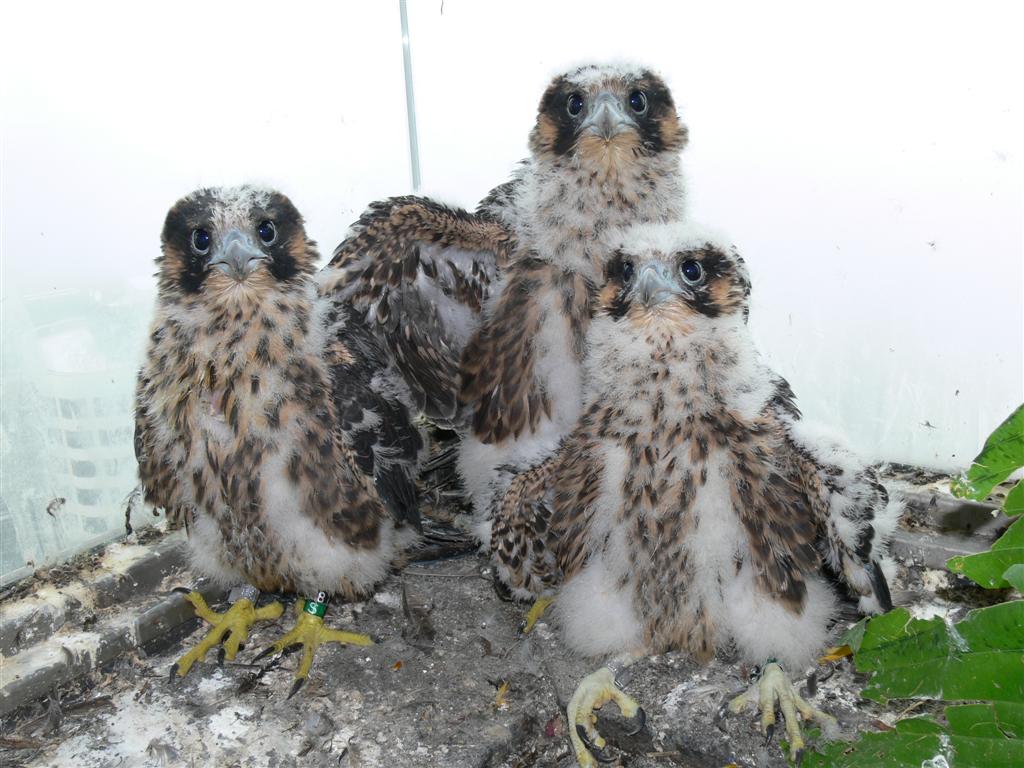
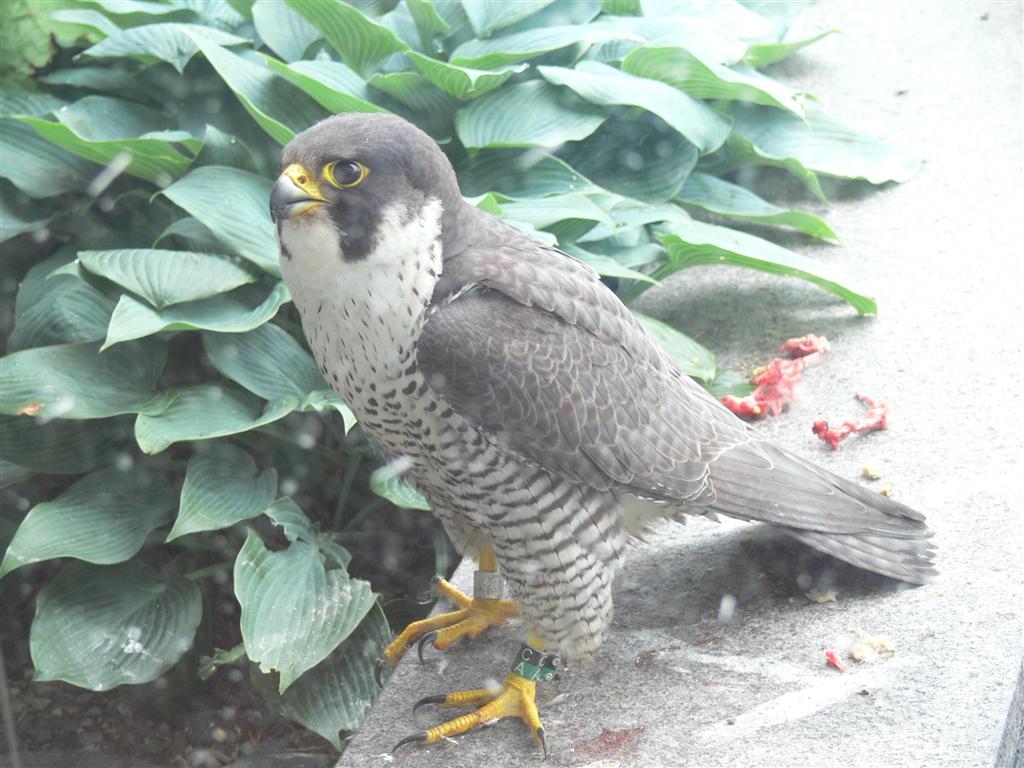
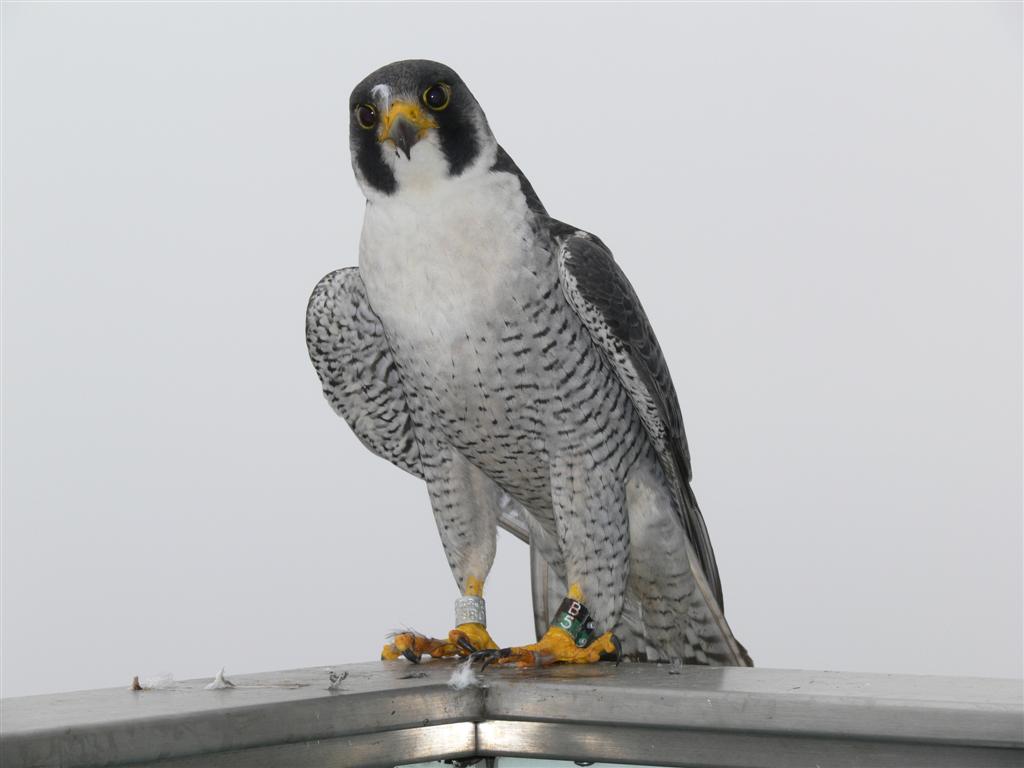
This week a colleague sent me photos. It turns out that a pair of peregrine falcons had nested several years ago on the 32nd floor outside our president’s office and, after a sojourn at the Custom House, decided to come back this year. The babies have just been tagged, and the tagger took pictures.

I have been reading a novel about Bedouins translated from Arabic. It has numerous passages on Bedouins’ fondness for falcons as hunting birds, so this feels like a coincidence. But the main thing is, they are really cool birds.


Read Full Post »

Heather Murphy reviews a cool-sounding book about birds as architects in Slate.

“Birds are exceptionally skilled architects. And, unlike humans, they do not require expensive schooling to obtain their skills. Nor do they covet their neighbors’ homes, explains Peter Goodfellow, author of Avian Architecture: How Birds Design, Engineer and Build. The innate ability to create sturdy and beautiful nests is written in their DNA. Goodfellow, a retired English teacher, has been studying birds since the 1970s. His new book documents the process of nest design and construction in extensive detail.” Read the article and check out the terrific slide show at Slate.

To see a bird building one of nature’s most complex nests, watch this BBC video of about 4 minutes, showing a weaver bird learning to master the skill.

*

*

Another new writer focuses on Feathers.

Amazon posts the book description: “Feathers are an evolutionary marvel: aerodynamic, insulating, beguiling. They date back more than 100 million years. [Biologist] Thor Hanson details a sweeping natural history, as feathers have been used to fly, protect, attract, and adorn … . Engineers call feathers the most efficient insulating material ever discovered … . They silence the flight of owls and keep penguins dry below the ice.”

John has been reading Feathers, which he interrupts occasionally to tell us some little-known evolutionary fact or to praise the author’s writing style. John and Meran are really good birders, and it’s looking like their son is a birdwatcher in the making.

Read Full Post »