Photo: Whitney Eulich.
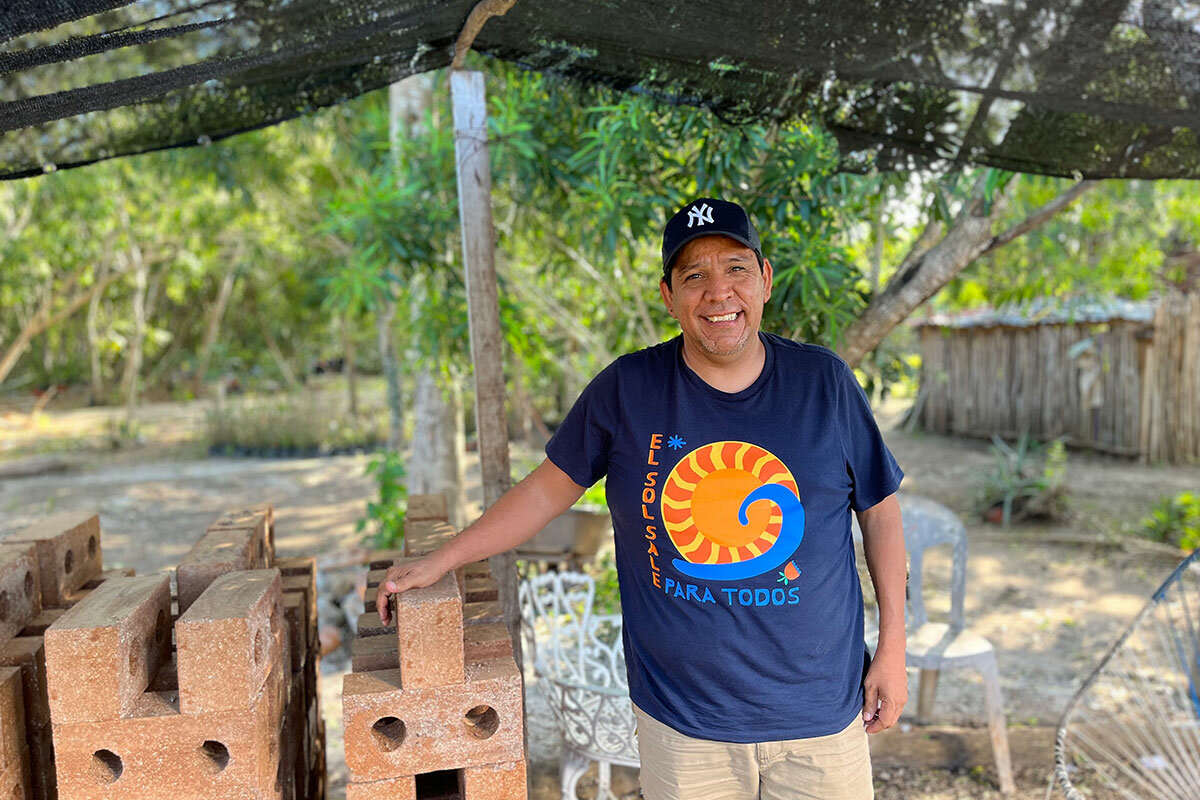
Omar de Jesús Vazquez Sánchez shows his Sargablock solution to the smelly seaweed invasion across the Caribbean shore of Mexico. He makes construction blocks out of it.
Today’s story is an example of someone with too many “lemons” who finds a way to make “lemonade.” It all started with smelly seaweed.
Christian Science Monitor writer Whitney Eulich reports from Puerto Morelos, Mexico, “Sargassum, the invasive, sewage-scented seaweed piling up on beaches across the Caribbean, isn’t something most people look upon kindly.
“But for Omar de Jesús Vazquez Sánchez, his first encounter was ‘love at first sight.’
” ‘Everyone said, “It smells horrible!” and I remember thinking, “There’s something more here,” ‘ says Mr. Vazquez, the founder of Sargablock, a small company in Mexico’s Yucatán Peninsula that transforms the algae into construction blocks.
“A record amount of sargassum is turning crystal blue Caribbean coast waters brown and smelling of rotten eggs as it decomposes in tourist spots from Mexico to Caribbean islands and now along the beaches of Florida’s east coast.
“Researchers blame pollution, overdevelopment, and global warming for the seemingly never-ending seaweed invasion that’s also present in the Atlantic.
“In 2015, as part of his gardening business, Mr. Vazquez launched a beach cleanup service to remove the leafy seaweed. But, as its arrival intensified, he started considering how to turn it into something useful, and in 2018 conceived a way to use sargassum in building blocks. Today he not only sells those blocks to construction projects, but also builds affordable housing in his community.
“ ‘When I look at Sargablock, it’s like looking in a mirror,’ he says, comparing his company to conquering his personal struggles, including addiction, and briefly, homelessness.
‘When you have problems with drugs or alcohol, you’re viewed as a problem for society. No one wants anything to do with you. They look away.’
“ ‘When sargassum started arriving, it created a similar reaction. Everyone was complaining,’ he says. … ‘I wanted to mold something good out of something everyone saw as bad.’ …
“The state government of Quintana Roo collected 19,000 tons of sargassum from beaches in 2020; 44,000 tons in 2021; and 54,000 tons last year. Researchers say the amount could nearly double this year, and it arrived months ahead of what is typically the start of sargassum ‘season’ in May. …
“Mr. Vazquez mixes 40% sargassum with other organic materials, like clay, that he then puts it into a cement-block-forming machine. The blocks bake in the sun for several days before they’re ready to use. He says he used 3,000 tons of sargassum in 2021, 2,000 tons last year. By early April 2023, he’d already used 700 tons.
“The UNDP [United Nations Development Program] selected Mr. Vazquez’s work transforming sargassum for their Accelerator Lab, which identifies and broadcasts creative solutions to environmental and sustainability challenges globally. The idea is that some of the most timely and creative responses come from locals living the repercussions of environmental dilemmas firsthand. …
“A joint study by universities in England and Ghana found that blocks made with organic material like sargassum can last for 120 years. The ecology and environment offices of Quintana Roo concluded the blocks are safe for use in construction.
“Mr. Vazquez grew up surrounded by nature – and the hardships of poverty. It shaped him into someone who takes action, he says. He remembers singing for spare change on the street as a child, before his single mother moved the family to the U.S. as unauthorized immigrants. They picked grapes in California, and Mr. Vazquez dropped out of high school to double down on what he considers his profession: gardening.
“ ‘There’s this idea of the American dream. But, for me, personally,’ he says, ‘I was always asking God to let me come back to Mexico.’
“It took almost 30 years to do so. ‘Coming back, it took a lot of time to adapt – the salaries are different. Sometimes people are skeptical’ of Mexicans returning from the U.S. he says. He worked odd jobs, like selling timeshares to tourists passing through the Cancún airport. Eventually he invested his savings – $55 at the time – in a nursery.
“As his nursery grew, he was making a name for himself creating a small but promising solution to the sargassum challenge. He gained attention through appearances on Shark Tank Mexico and a locally organized Ted Talk. Although he was living the ‘Mexican dream,’ something was missing. He reflected on when he was happiest in his life and it came down to two things: Memories of spending time in his grandparent’s simple adobe-block home in Jalisco, and being with his mother, who had sacrificed so much for him before passing away in 2004.
“ ‘We never had a house of our own, we didn’t have much food or clothes. I didn’t have a father,’ he says. When he built what he expected to be his nursery’s new office with Sargablock, he designed it as a replica of his grandparents’ home and named it after his mother, Angelita.
“ ‘The first thing that came to my mind and heart was to donate houses to women like my mother, who are doing everything in their power to make it work,’ he says.
“Enter Casas Angelitas. Using Sargablock, Mr. Vazquez has built and donated 14 homes to families in need, many single moms, but also elderly couples and parents supporting kids with disabilities.”
More at the Monitor, here. No firewall. Subscriptions for the online publication are reasonably priced.

 Suzanne's Mom's Blog