Feeds:
Posts
Comments

Posts Tagged ‘book ban’

Photo: Taylor Luck.
“The Fardous Bookstore, once under restrictions imposed by the former Assad regime,” says Taylor Luck of the Christian Science Monitor, “now sells previously banned books to eager readers.”

Books are stronger than tyrants. We hold onto that thought. We know from both history and the belief of poets that the time of tyrants has an end. I think Shelley says it best.

“My name is Ozymandias, King of Kings;
“Look on my Works, ye Mighty, and despair!
“Nothing beside remains.”

If you don’t see the downfall of the pedestal in your own country at the moment, look toward Syria. Syrians have reason to believe that new tyrants won’t be replacing the hated Assad anytime soon.

After all, books are not being banned by the revolutionary government.

“Post-revolution Syria is becoming a page-turner’s paradise,” wrote Taylor Luck at the Christian Science Monitor recently.

“After years of being banned by the former regime, dozens of long sought-after books are flooding stores across Syria, literally spilling onto the streets. An epicenter of this new literary freedom is the so-called ‘bookshop alley’ in the Halbouni neighborhood of Damascus, a leafy street lined by two dozen bookshops and printers, big and small.

“It is here that Radwan Sharqawi runs the Fardous Bookstore, a small corner shop that his family has owned since 1920. The contrast between today’s Syria and the long period of Assad family rule is like night and day, he says.

“ ‘Before, we had daily interrogations by the security services,’ Mr. Sharqawi says. ‘Now everything is permitted, nothing is banned. Now is a golden era for books!’

For decades, any book written by an intellectual or an artist who had expressed opposition to the Assad regime – or who simply did not vocally toe the official line – was banned.

“So, too, were books that touched on Syrian history from any perspective other than the ruling Baath Party’s revisionist version. Titles on the history of the Israeli-Arab conflict, or anything on the 2011 Arab Spring uprisings, were contraband.

“Islamic thinkers such as Ibn Taymiyya, the influential medieval Sunni jurist and scholar, were banned. So, too, were books by Brotherhood-aligned clerics. … Even a book as basic as a tafsīr, an annotated Quran with explanations and context, was banned, for fear it might contradict the Assad government’s tightly controlled Islamic authorities.

“ ‘These are texts about religion and God, not politics,’ says Abdulkader al-Sarooji, owner of the Ibn Al Qayem bookshop, as a customer browses shelves of leather-bound Islamic books, their titles engraved in decorative golden calligraphy. …

“As soon as the regime fell, Mr. Sarooji began importing books from Turkey and northern Syria to Damascus. Syrians are rushing to snatch up banned titles. …

“ ‘There is demand for banned books because people feel there is a gap in their knowledge, even in their religious knowledge,’ says Mr. Sarooji.

“The most dangerous texts during the Assad era – and the books in highest demand now – are works of literary fiction, titles that draw on the real experiences of Syrians who spent time in jail and suffered abuse at the hands of the regime. The most fiercely banned book was Bayt Khalti, by Ahmed al-Amri, which details the horrors faced by women in the notorious Sednaya prison.

“Now Bayt Khalti is prominently displayed on bookshelves and vendors’ roadside stands across Damascus – in both legitimate editions and blurry knockoffs that feed the high demand.

“ ‘This book was the most dangerous one,’ street-side book vendor Hussein Mohammed says as he waves a copy of Bayt Khalti. ‘If they caught you with this, you were a goner.’

“Another popular banned text, Al Qoqaa, or The Cochlea, details a Christian Syrian’s time in Mr. Assad’s prisons.

“Eyad, a young Damascene, purchased a book of fiction from Mr. Mohammed after spending an hour browsing in the bookshop alley. ‘There are a lot of books that I have wanted to read for years,’ he says.”

More at the Monitor, here.
Read Full Post »

Photo: JRE.
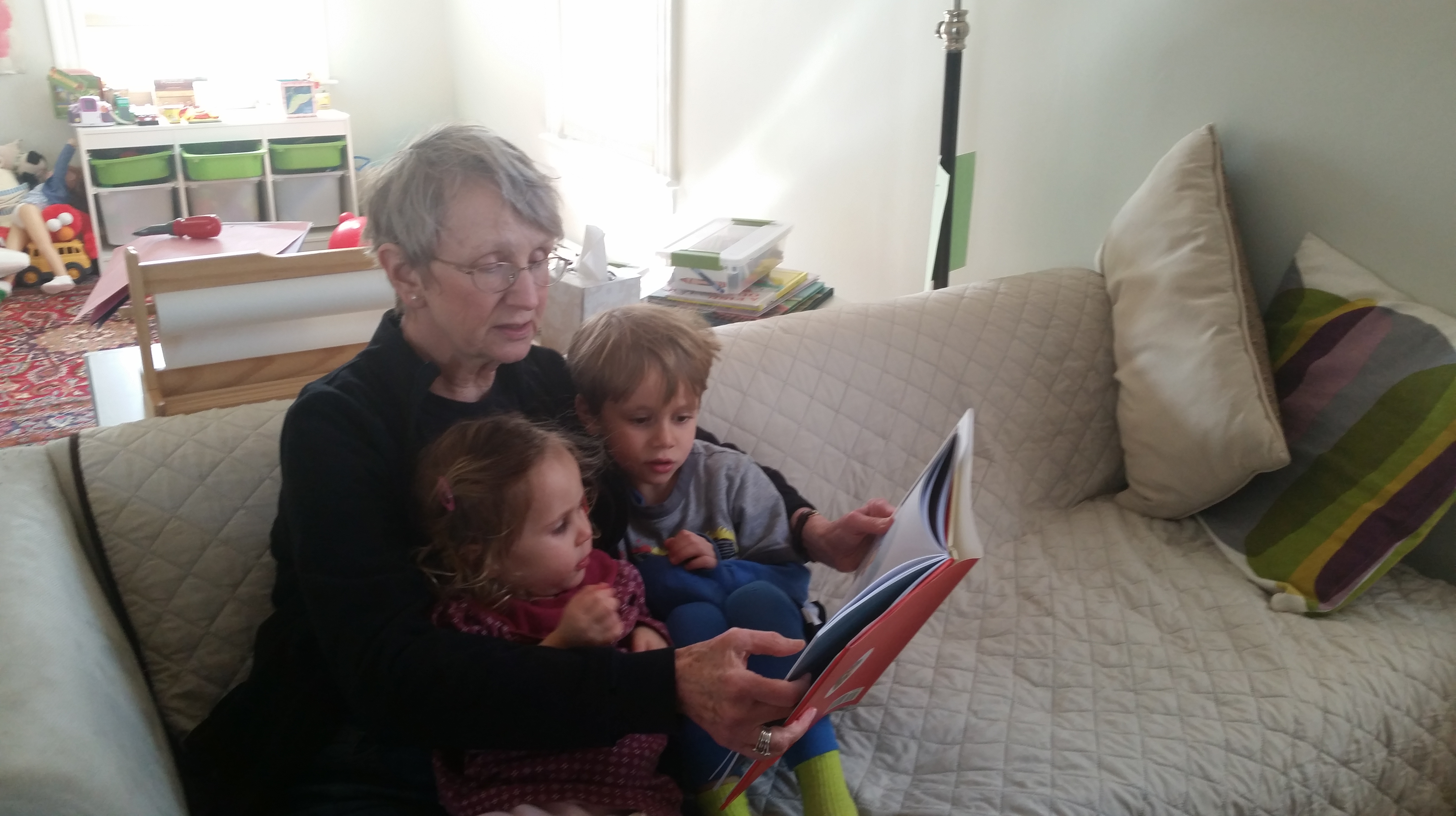
Now almost 12 and 15, these two are good readers.

I recently learned about a group called Grandparents for Truth, organized in reaction to other groups pushing book bans in schools and threatening librarians.

I am not a member, but I think reading is important and I understand enough history to know what happens to countries that start with book bans, so I thought I would share the information.

Huda Hassan wrote at MSN.com in late 2024, “Last August, a retired special-education teacher named Holly Hall joined a rally of grandparents warring against book censorship in Temecula, a small Southern California town. Locals had gathered to oppose a school-board decision to ban a social-studies reader, Social Studies Alive!, for citing Harvey Milk — the first openly gay politician elected in the state. ‘The Harvey Milk reference was in the supplemental materials,’ 72-year-old Hall says, ‘which meant that it wouldn’t have even been mentioned in some classes.’

“The world of literature is currently ablaze with rapidly escalating book bans targeting narratives and histories about gender and sexual identity, race, class, and just about anyone deemed ‘other.’

“[In 2024] alone, 1,128 books have been challenged, according to the American Library Association, which documents ongoing censorship attempts across the nation. Florida is the state with the most banned books (3,135 bans, according to PEN America), and in the 2022–23 school year, there were book bans in 153 districts across 33 states, including Texas, Missouri, Utah, and Pennsylvania.

“Earlier this year, schools in Escambia County, Florida, removed 1,600 books on gender and race from school libraries and, through this process, even banned multiple dictionaries. In August, New College of Florida, a public liberal-arts college, disposed of hundreds of library books, emptying the school’s Gender and Diversity Center. Then, this fall, major publishers — including Simon & Schuster, Penguin Random House, and HarperCollins Publishers — filed a lawsuit against book-removal provisions in Florida (through HB 1069, a law introduced in 2023).

“When Hall, who taught in California for 40 years, spoke out at that rally in Temecula, she gave an impassioned speech about censorship in her state. ‘I addressed the dangers of banning books,’ she says. ‘It’s not 1933 Germany.’ Opponents attended the Temecula rally too, such as Moms for Liberty, a Florida-based parenting group formed in 2021 that’s pushing for banning books on race and what it calls ‘gender ideology.’ A few months prior, the same three school-board trustees Hall spoke against had voted to ban the school’s study of critical race theory the day they were sworn into office. This preemptive act confused many, as no courses on critical race theory had been offered at the school. …

“As parents across the country and groups like Moms for Liberty have joined the attacks on literature, grandparents like Hall are mobilizing in response, and they are afraid. ‘I am so concerned about my country, our freedom, and the world,’ Hall says.

“But she felt encouraged to speak in front of her peers and opponents last year because she knew she was not alone. She was invited to the rally by Grandparents for Truth, a national organization formed in the summer of 2023 to fight for the right to read. ‘A neighbor walked by and told me about the group. He had a sign in his yard,’ says Hall. …

“In Philadelphia, Ruth Littner, one of the earliest members to join Grandparents for Truth last summer, discovered the collective through her daughter, Alana Byrd, the national field director of People for the American Way. Like Hall, the pair are committed to countering book banning despite heckling or pushback from the police. ‘I am the daughter of two Holocaust survivors,’ Littner says on the phone from her home. ‘When Alana told me she had an initiative to fight this kind of authoritarianism, I jumped right on that. I was the first one to get the Grandparents for Truth T-shirt.’

More at MSN, here. No paywall.

Read Full Post »

Photo: Brooklyn Public Library.
Teens in towns where some books are banned were given access to a card from the Brooklyn Public Library, just like one the New Yorker above enjoys.

It’s hard to imagine, but this is where we are. We don’t ban websites that tell you how to make a lethal weapon, but there are apparently ideas in books young people shouldn’t think about.

In one small step for humankind, the Brooklyn Public Library decided not to be passive about the situation.

I’m sorry to be late with this story, but I only just learned about the initiative and believe you might be interested. On April 13 last year, the library posted the following release on its website.

“Brooklyn Public Library (BPL) is launching a new campaign today, titled Books Unbanned, to help teens combat the negative impact of increased censorship and book bans in libraries across the country. For a limited time, young adults ages 13 to 21 nationwide, will be able to apply for a free eCard from BPL, unlocking access to the library’s extensive collection of eBooks.

“ ‘Access to information is the great promise upon which public libraries were founded,’ said Linda E. Johnson, President and CEO, Brooklyn Public Library. ‘We cannot sit idly by while books rejected by a few are removed from the library shelves for all.’ …

“The card will be good for one year and is designed to complement access to resources for teens in their local communities. The Brooklyn Public Library eCard provides access to 350,00 eBooks; 200,000 audiobooks and over 100 databases. Teens will also be connected to their peers in Brooklyn, including members of BPL’s Intellectual Freedom Teen Council, to help one another with information and resources to fight censorship. …

“To apply for the card, teens can send a note to BooksUnbanned@bklynlibrary.org, or via the Library’s s teen-run Instagram account, @bklynfuture. The $50 fee normally associated with out-of-state cards will be waived. Teens are encouraged to share videos, essays, and stories on the importance of intellectual freedom and the impact that book challenges and bans have had on their lives. 

“The Library will also make a selection of frequently challenged books available with no holds or wait times for all BPL cardholders, available through the library’s online catalog or Libby app. The titles include: The Black Flamingo by Dean Atta, Tomboy by Liz Prince, The Bluest Eye by Toni Morrison, The 1619 Project by Nikole Hannah-Jones, Juliet Takes a Breath by Gabby Rivera, On Earth We’re Briefly Gorgeous by Ocean Vuong, and Lawn Boy by Jonathan Evison.

“While challenges to books and ideas are nothing new, the initiative was conceived in response to an increasingly coordinated and effective effort to remove books tackling a wide range of topics from library shelves. The American Library Association’s Office of Intellectual Freedom counted more than 700 complaints last year, the most since it began keeping records more than 20 years ago.  

“In Texas, Matt Krause, chairman of the Texas House of Representatives General Investigating Committee, has called for public school libraries to ‘account’ for 850 sexually explicit or racially preferential books. The list includes a wide range of titles from National Book Award winner How to be an Antiracist by Ibram Kendi to John Irving’s bestselling Cider House Rules. Books which feature LBGQT characters; advice for dealing with bullies; and tips for teens on relationships are all included on the list, along with titles on historical events including the rise of the KKK, the Indian Removal Act and the election of Harvey Milk. …

“Locally, the New York State Education Department (NYSED) removed a tweet by the New York State Librarian after she recommended the book Gender Queer: A Memoir. NYSED said it was not aware of the graphic contents in the book. …

“Said Nick Higgins, Chief Librarian, ‘Limiting access or providing one-sided information is a threat to democracy itself.’ ”

The only one of the books mentioned that I have read is The Bluest Eye, by Toni Morrison, a Nobel winner. There is no doubt it is heavy-duty stuff, but that doesn’t mean people should be bliocked from reading it. The ideas are serious, and, I think, important, and even if they weren’t, I don’t see that any group of people should make decisions about what to read for any other group.

More at the Brooklyn Public Library, here.

Read Full Post »