Feeds:
Posts
Comments

Posts Tagged ‘book club’

Photo: Peter Quadrino.
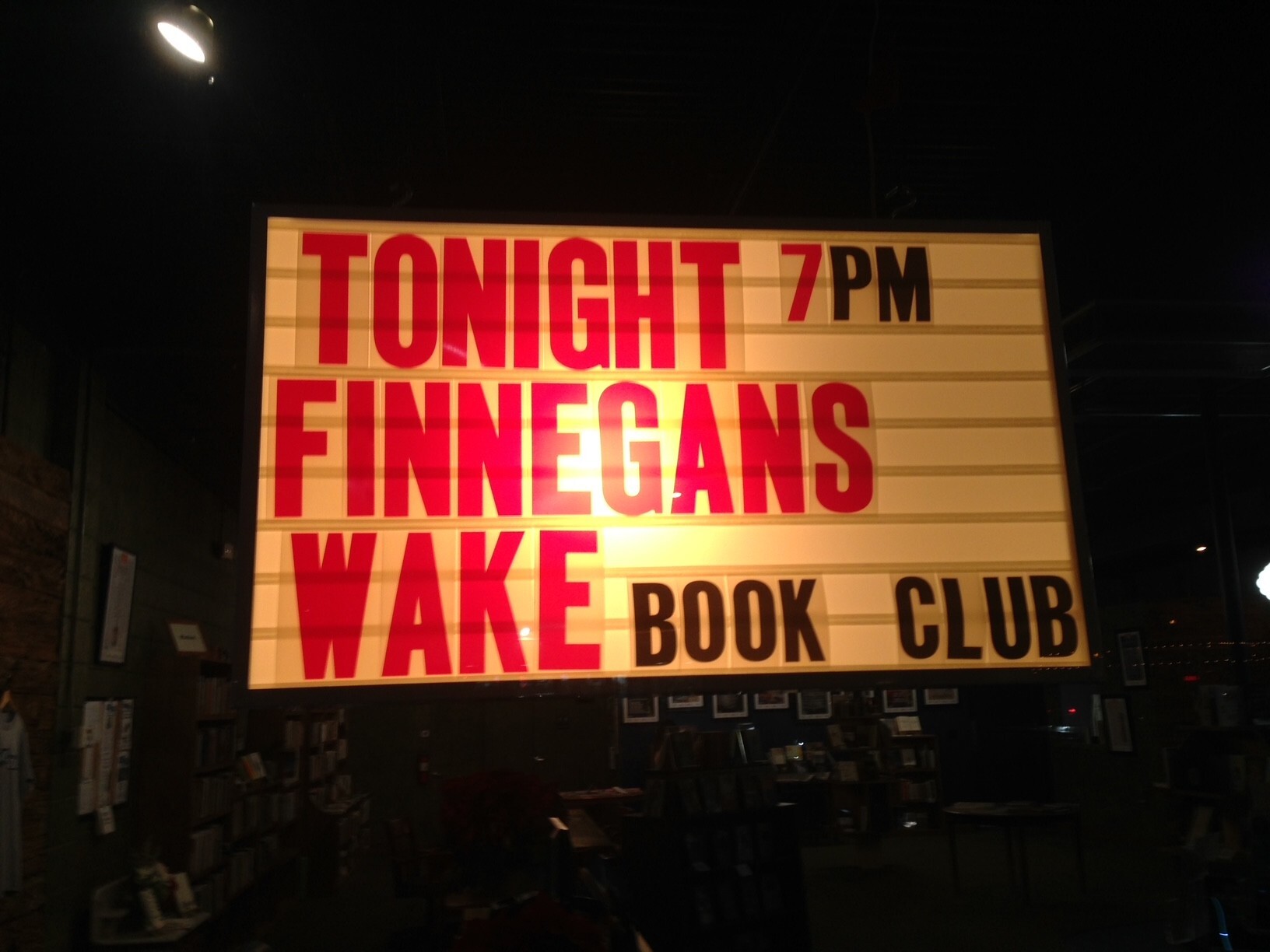
A Texas club has been reading
Finnegans Wake for 12 years. And making progress.

I have a bunch of reactions to today’s story about a book group reading the same James Joyce novel for 12 years and still going. One is that I would have benefited from reading Finnegans Wake with others because there was so much I didn’t understand. Another is that my stereotype about Texans needs constant correction: of course, there are people in Texas who tackle literature!

Sean Saldana wrote about this book club at Texas Standard, which I follow on Mastodon.

“In 1939, Irish author James Joyce published Finnegans Wake, a piece of literature that defies comprehension. 

“ ‘riverrun, past Eve and Adam’s,’ it begins, ‘from swerve of shore to bend of bay, brings us by a commodius vicus of recirculation back to Howth Castle and Environs.’ 

“The book starts and ends with a sentence fragment, combines multiple languages and has no clear or linear plot. It’s a work that’s so dense, one group that started in Austin has been working on it for more than a decade.

“ ‘We’re only reading one page at a time,’ said Peter Quadrino, founder and organizer of the Finnegans Wake Reading Group of Austin, TX.

“Every other week, Quadrino hosts a Zoom call where people from around the world gather and attempt to understand one of the most infamous books in English literature.

“The group spends the first 15 minutes of each meeting socializing. Then they all go around in a circle and each person reads two lines until they’re done with that week’s page.

“After that, they spend about an hour and a half researching, annotating and trying to make sense of Joyce’s experimental prose.

“ ‘We used to read two pages per meeting,’ said Quadrino. ‘Then at a certain point there was just so much going on in the pages and so much in the discussion that we had to lower it to one page per meeting.’ …

“The book’s complexity has made it a point of fascination for literary enthusiasts in the eight decades since it was first published. Houston, New York, Boston, Seattle, Dublin, Kyiv and many other cities around the world host groups dedicated to reading and analyzing Finnegans Wake. …

“ ‘I never really consider what it’s going to be like when we finish because I don’t want it to end,’ explained Quadrino, ‘and if we do finish we’ll just circle right back to the beginning and keep reading.’ ” More at Texas Standard, here.

Would you want to join a book group like that? I have heard of similar ones. Humans just don’t want to be defeated by complexity. The Athenaeum in Boston reads Proust’s Remembrance of Things Past over and over, too.

Read Full Post »

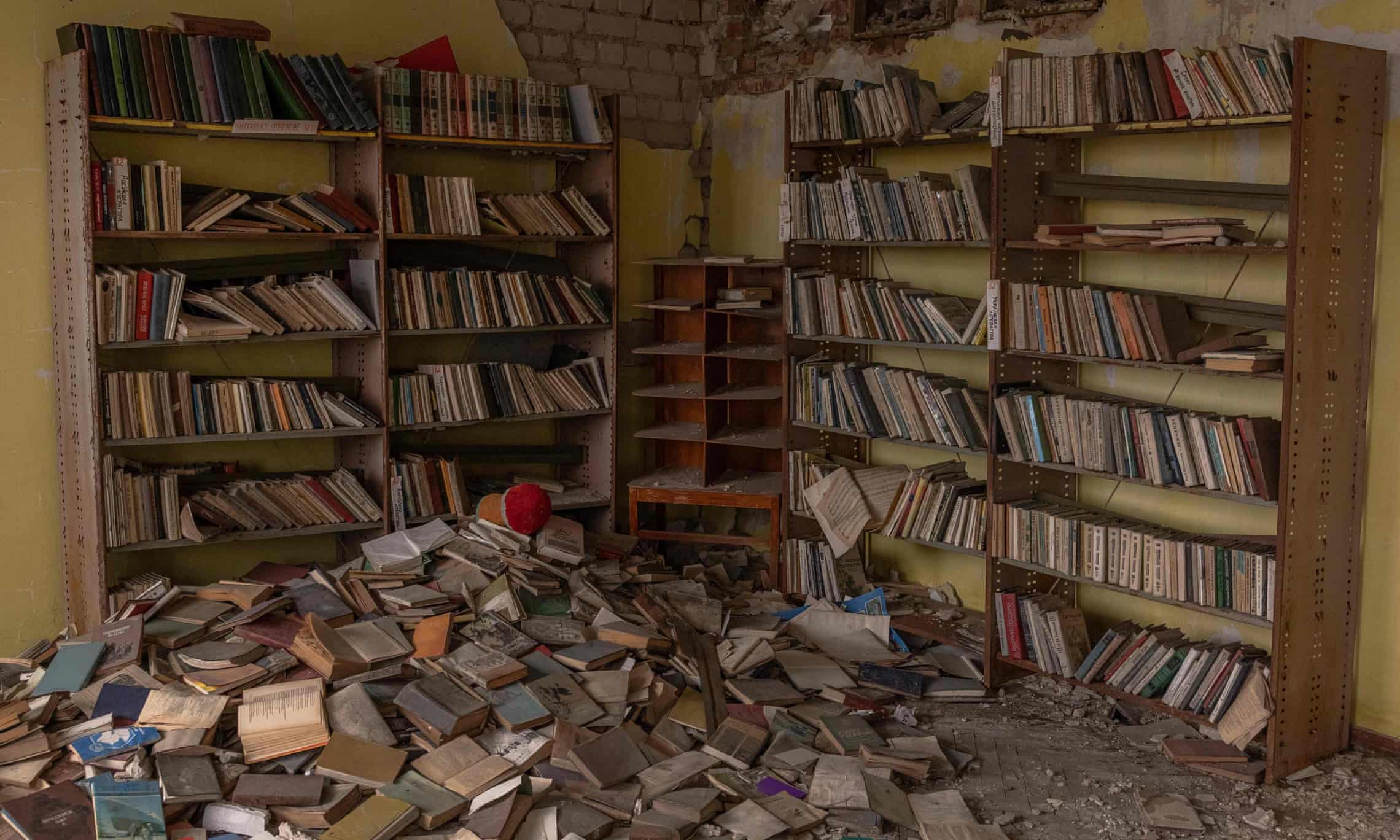
Photo: Roman Pilipey/AFP/Getty Images.
The house of culture in the village of Posad-Pokrovske in southern Ukraine was badly damaged in attacks by Russian forces in 2022. 

There’s a secret teen book club in occupied Ukraine, where the “official” schools teach Russian propaganda. Confided one student, “They don’t teach us knowledge at school, but to hate other Ukrainians.” 

Peter Pomerantsev and Alina Dykhman report at the Guardian, “It must be one of the most dangerous book clubs in the world. Before they can feel safe enough to talk about poetry and prose, 17-year-old Mariika (not her real name) and her friends have to first ensure all the windows are shut and check there is no one lurking by the flat’s doors.

“Informants frequently report anyone studying Ukrainian in the occupied territories to the Russian secret police. Ukrainian textbooks have been deemed ‘extremist’ – possession can carry a sentence of five years. Parents who allow their children to follow the Ukrainian curriculum online can lose parental rights. Teens who speak Ukrainian at school have been known to be taken by thugs to the woods for questioning.’

“That is why the book club never meets with more than three people – any extra members would pose further risk of being discovered.

“Apart from the danger, there is another challenge: finding the books themselves. In the town where Mariika lives, the occupiers have removed and destroyed the Ukrainian books from several libraries – nearly 200,000 works of politics, history and literature lost in one town alone.

“So Mariika and her friends have to use online versions – careful to scrub their search history afterwards. The authorities like to seize phones and computers to check for ‘extremist’ content.

“Among the poems and plays Mariika’s book club likes to read are those of Lesya Ukrainka, the 19th-century Ukrainian feminist and advocate of the country’s independence under the Russian empire.

“In 1888 Ukrainka also formed a book club, in tsarist-era Kyiv, at a time when publishing, performing and teaching in Ukrainian was banned. Ukrainka’s works, in turn, explore the 17th-century struggle of Ukraine for independence from Moscow.

“In the dramatic poem ‘The Boyar Woman,’ the heroine chides a Ukrainian nobleman who has come under the cultural influence of Muscovy and praises a humiliating peace with the tsar that has ‘calmed’ Ukraine: ‘Is this peace,’ she asks, ‘or a ruin?’ …

“Over the centuries, Russia’s tactics have adapted. During the Russian empire, Ukraine was conquered, and its language and literature were suppressed. At other times, the Kremlin used mass starvation and the mass murder of intellectuals, as in the Holodomor, the Ukrainian famine of the 1930s, when about 4 million people were killed by Stalin’s policies.

“During the later years of the Soviet Union, the approach was subtler: some Ukrainian schools and a small amount of publishing were allowed but if you wanted to prosper, you had to speak Russian. Ukrainian poets and activists who asked for more national rights were sent to the last labour camps as late as the mid-1980s. …

“As it has done for centuries among its colonies, the Kremlin is changing the population on the ground by deporting local people and importing new ones with no connection to Ukraine. Since 2014, more than 50,000 Ukrainians have been forced to leave Crimea and about 700,000 Russian citizens brought in, many of them with military and security service backgrounds. …

“More than 19,000 children have been forcibly removed to Russia to indoctrinate them and break their connection to Ukraine. … There are the 1.5 million children who are still inside the occupied territories, but who are being forced to abandon their Ukrainian heritage, attend military youth groups and ultimately be conscripted into the Russian army. …

” ‘They don’t teach us knowledge at school,’ said Mariika, ‘but to hate other Ukrainians. They’ve taken down all Ukrainian symbols and have hung portraits of Putin everywhere. History is all about “great Russia” and how it’s always been under attack by others.’ …

“Part of what keeps Mariika’s book club going is the desire for people outside the occupied territories to realize that there are people fighting for their right to exist as Ukrainians. Not all the books the club has been reading are overtly political. Sometimes they enjoy reading books that are just about normal life of young women in Ukraine – about dating and shopping.

“These tales take on a greater meaning in the occupied territories – a way to stay in touch with everyday life in the rest of the country. Novels have always helped to make you feel part of the community, of a nation.

“But still there is no getting away from the all-too-relevant ideas of Ukrainka’s writing. One of her main themes was to meditate on the relationship between personal freedom – the freedom of the imagination and to define your life – and the political freedom of the nation. ‘Whoever liberates themselves, shall be free,’ she wrote.

“Mariika’s book club makes those words real every day.”

More at the Guardian, here.

Read Full Post »

Just to remind you on the day after the Capitol invasion* that good people are still in the majority around these parts, I offer a recent story from California. It’s about prison inmates who received kindness from a local school and found an impressive way to give back. And since the story is about people in prison for serious crimes, it’s also about redemption.

As Lauren Kent at CNN reported in November, “It’s hard to imagine two more different places than an elite private school and California’s Soledad State Prison, which houses the state’s largest concentration of men sentenced to life behind bars.

“But for the past seven years, the two worlds have collided in an unusual way: through a book club. Palma School, a prep school for boys in Salinas, California, created a partnership with the Correctional Training Facility (CTF) at Soledad State Prison to form a reading group for inmates and high school students — bringing the two groups together to learn and develop greater understanding of one another.

“But the reading group has developed into much more than an exchange of knowledge and empathy. When one Palma student was struggling to pay the $1,200 monthly tuition after both his parents suffered medical emergencies, the inmates already had a plan to help.

‘I didn’t believe it at first,’ said English and Theology teacher Jim Michelleti, who created the reading program. ‘They said, “We value you guys coming in. We’d like to do something for your school … can you find us a student on campus who needs some money to attend Palma?” ‘

“The inmates, who the program calls ‘brothers in blue,’ raised more than $30,000 from inside the prison to create a scholarship for student Sy Green — helping him graduate this year and attend college at the Academy of Art University in San Francisco.’Regardless of the poor choices that people make, most people want to take part in something good,’ said Jason Bryant, a former inmate who was instrumental in launching the scholarship. ‘Guys were eager to do it.’

“Bryant served 20 years for armed robberies in which one victim was fatally shot by an accomplice. But while inside Soledad State Prison, he made a daily effort to turn his life around, earning his bachelor’s degree and two masters and running leadership training programs for inmates. ‘I’m never far from the reality that I committed a crime in 1999 that devastated a family — several families — and irreparably harmed my community,’ Bryant said. ‘I keep that close to my heart, and I would hope that people can identify the power of forgiveness and the probability of restoration when people put belief in each other.’

“Bryant’s sentence was commuted in March due to his contributions in restorative work while he was in prison. He now works as the Director for Restorative Work at an organization called Creating Restorative Opportunities and Programs (CROP), which helps equip formerly incarcerated people with tools like skills training and stable housing in order to succeed in their communities. …

“Hundreds of incarcerated men jumped at the opportunity to make a heavy, meaningful investment in someone else’s life. Considering that minimum wage in prison can be as low as 8 cents an hour, raising $30,000 is an astonishing feat. It can take a full day of hard labor to make a dollar inside prison. … Some brothers in blue who had no money to donate even hustled to sell possessions or food so they could be a part of the campaign. …

“Sy and his family started making visits to the prison in addition to taking part in the Palma reading group. He and his family have embraced building relationships with many of the bothers in blue, and four former inmates even attended his high school graduation. …

“The inmates also plan to continue the scholarship program for another student in need. With the help of inmate leadership groups and the CROP organization, they want to keep paying it forward. … Said Bryant. ‘If more people just decided to do good things, this world would be a better palace.’ “

More at CNN, here.

* In the first version of this post, I said the Capitol invasion Wednesday was a first in American history. I stand corrected.

Read Full Post »

Photo: Steven Senne/AP
New England Patriots 23-year-old rookie wide receiver Malcolm Mitchell joined a suburban women’s book club when he was at the University of Georgia.

Here’s great story that John sent me. He had been to an event at Life is good and heard a young football player talk about the sequence of events that followed his joining a women’s book club.

Emmett Knowlton wrote about the football player at Business Insider.

“New England Patriots 23-year-old rookie wide receiver Malcolm Mitchell is perhaps the biggest book lover in the NFL and, now, a published children’s-book author — all thanks to a chance encounter in a bookstore.

“In a fun story in The Boston Globe back in May, Mitchell said that when he was a junior at the University of Georgia, he decided to join a suburban, all-women’s book club after a serendipitous meeting with one of the members in the stacks of a Barnes & Noble.

” ‘I was there picking up “Me Before You,” the next book for the club,’ Silverleaf Book Club member Kathy Rackley told The Globe. ‘Malcolm walked up to me and said: “Can I ask you something? Can you recommend a book?” ‘

“Rackley had no idea that Mitchell was a star receiver on the Georgia Bulldogs, but the two got to chatting. When Rackley revealed that she was in a book club, Mitchell asked if he could join, and the two exchanged contact information. …

“Two days later, Mitchell showed up to the meeting. From The Globe

‘ “I didn’t mind [inviting him] at all,” [the hostess] recalled. “Because I didn’t think there was any way he’d show up!” But he did and [impressed] the group with his thoughts and opinions — and his own life experiences. …

“Mitchell continued to participate in the club, and he became a real book lover. According to The Globe, he was often found reading at his football locker, and when it was his turn to recommend a book he made his new friends read Marcus Luttrell’s ‘Lone Survivor.’

” ‘The book club helped me grow into a better individual, a person who learns and grows throughout life in general,’ Mitchell said.

“Mitchell’s current lifestyle has made it difficult for him to regularly attend the club. But he remains an avid reader, and he recently published a children’s book, ‘The Magician’s Hat,’ about the magical powers of reading. He started a foundation, too, called Read With Malcolm, that encourages childhood literacy.” More here.

I love the openness and enthusiasm of a guy who would ask a stranger for a book recommendation and then ask to attend the book club!

Read Full Post »