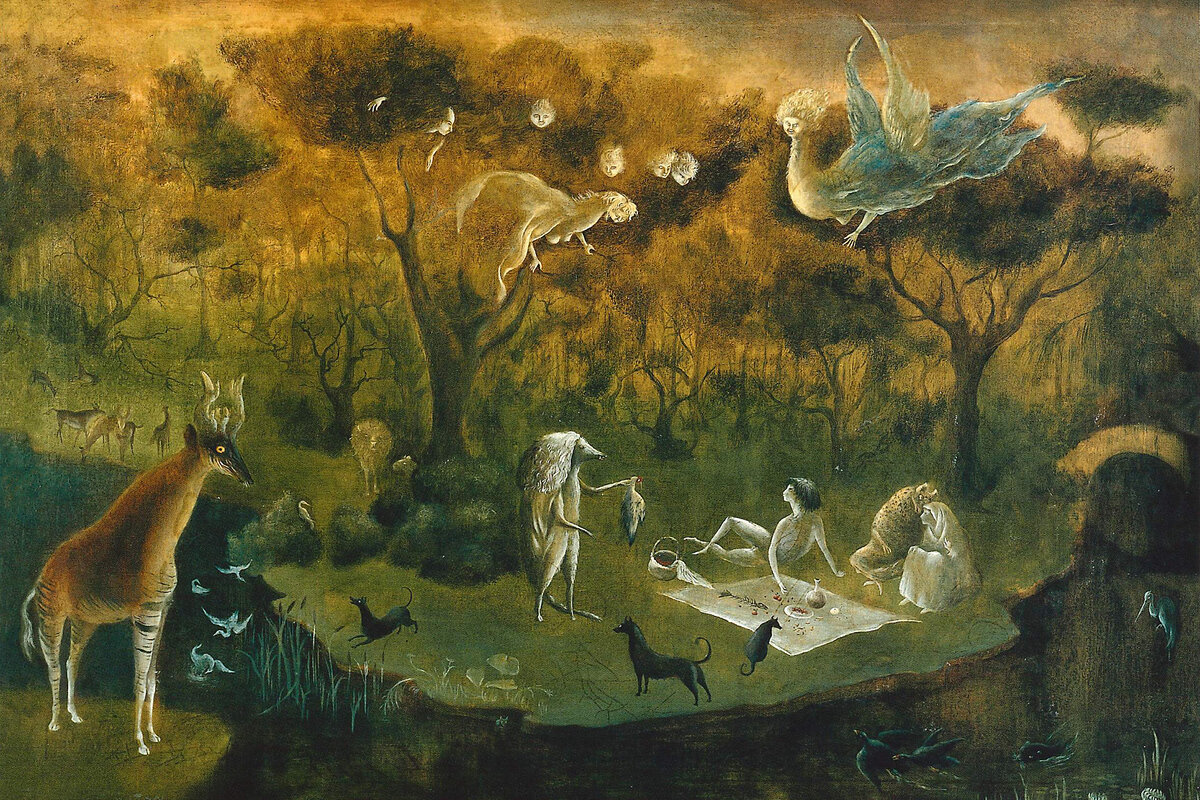
Art: Leonora Carrington/Arts Rights Society, New York.
“Pastoral” (1950) is among the works included in “Leonora Carrington: Dream Weaver” at Brandeis University’s Rose Art Museum in Waltham, Massachusetts.
All praise to the Rose Art Museum at Brandeis University for thinking differently. Compared with other museums in New England, it has always been a little bit “out there.” In today’s story that involves taking a new look at the surrealists, especially a previously underappreciated one.
Mackenzie Farkus writes at the Christian Science Monitor, “Shape-shifting creatures. Dreamscapes of greenery. Prancing hyenas and noble white horses. These are just a few of the hallmarks of surrealist Leonora Carrington.
“The artist – who was born in 1917 in England and died in 2011 – was once on the periphery of the surrealist movement. But in the decade following her death, Ms. Carrington’s work has experienced a revival.
“While her adopted homeland of Mexico has long embraced her art, the celebration of Ms. Carrington’s legacy has reached a crescendo in other parts of the world in recent years. Her reemergence follows a trend of increased attention to fellow women creators. …
“In the case of Ms. Carrington, her ‘Les Distractions de Dagobert’ (1945) sold for $28.5 million at Sotheby’s in 2024, cementing her status as the highest-selling female artist in British history. … Her first solo exhibition in New England – at Brandeis University’s Rose Art Museum – is on display until June 1, and then moves to the Katonah Museum of Art in New York. …
” ‘What Leonora offers – and what surrealism offers – are alternative ways of understanding the world: not through the capitalist economic system of transactional politics, but tapping into empowerment through the imagination, invisible truths, things that have to do with our subconscious,’ says Gannit Ankori, director and chief curator of the Rose Art Museum in Waltham, Massachusetts.
“Dr. Ankori curated the museum’s exhibit ‘Leonora Carrington: Dream Weaver.’ A number of the pieces on display – including works in tempera, gouache, acrylic, oil, pencil, pen, and fiber – have rarely been seen outside private collections. …
“In the 1950 painting ‘Pastoral,’ water fowl, a hyena, and other animals congregate around an androgynous couple as ethereal animal-human hybrids float above. Ms. Carrington often emphasized the coexistence of humans and animals in her work.
“Of particular resonance to Dr. Ankori was Ms. Carrington’s love for Mexico … ‘a welcoming country that embraced and offered safe haven to refugees from war-torn Europe in the 1940s,’ says Dr. Ankori. … ‘And these immigrants, many of them intellectuals and artists, resettled in this new, embracing homeland and felt welcome. They built community and developed cultural excellence in the arts and philosophy and literature and more.’
“Alongside her many paintings, textile works, and sculptures, Ms. Carrington was also a prolific writer. Her 1944 memoir, Down Below, details her experiences of institutionalization in Spain. Her fictional work includes a wide range of surrealist short stories, plays, and novels. …
“Born into an upper-class Catholic family in England, Ms. Carrington often rebelled against the societal restrictions imposed on her. She was twice expelled from convent schools, and favored reading Irish fairy tales, Lewis Carroll, and Beatrix Potter over learning how to become the perfect debutante.
“A viewing of Max Ernst’s 1924 painting ‘Two Children Are Threatened by a Nightingale’ and a copy of Herbert Read’s 1936 book Surrealism influenced her artistic development, as did her tutelage under the French modernist Amédée Ozenfant.
“Women in the surrealist movement were often relegated to the role of the femme enfant – often young, beautiful women who were expected to be subservient to male artists.
“Ms. Carrington, however, had other plans. ‘I didn’t have time to be anyone’s muse,’ she once said. ‘I was too busy rebelling against my family and learning to be an artist.’ …
“Ms. Carrington eventually found her way to Mexico and married Hungarian photographer Emérico ‘Chiki’ Weisz.
“There, she encountered a community of European artists who had fled the horrors of World War II, often exhibiting her art in local galleries. She became close friends with fellow émigré and artist Ms. Varo. Together, they studied kabbalah, alchemy, Tibetan Buddhism, and Mayan mystical writings – the ideas of which feature prominently in Ms. Carrington’s art. She went on to become one of the founding members of Mexico’s 1970s feminist movement. …
“Ms. Carrington’s first solo museum show in Italy will open at Milan’s Palazzo Reale in September, on view until January 2026. An exhibition at the Musée du Luxembourg in Paris will be on view from Feb. 18 to July 19, 2026.”
More at the Monitor, here. No paywall.

 Suzanne's Mom's Blog