Feeds:
Posts
Comments

Posts Tagged ‘breakdancing’

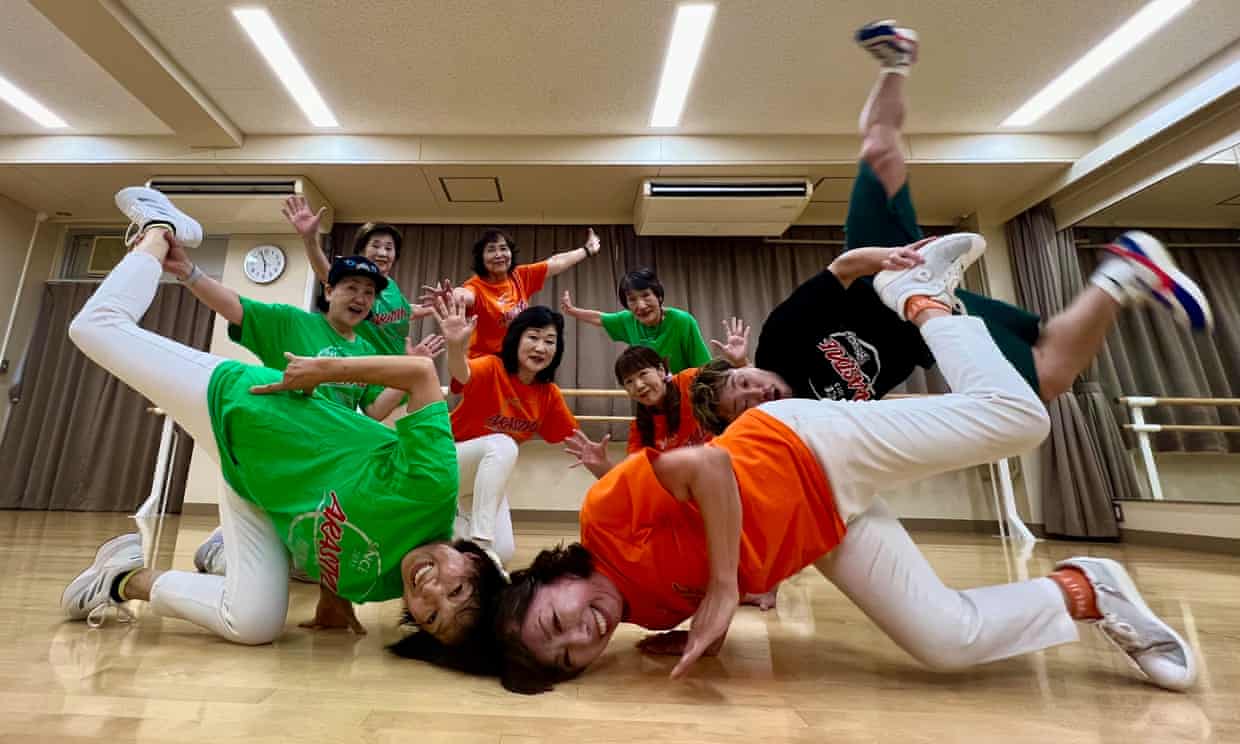
Photo: Justin McCurry/The Guardian.
Members of Ara Style Senior breakdancing club at a recent class in Tokyo, Japan. 

When John was in middle school, he got into breakdancing for a while, an activity that seems manageable for young people. But what about for the elderly? For them, the more recent nomenclature, “breaking,” seems more appropriate.

But not in Japan. Justin McCurry filed another story at the Guardian about that endlessly fascinating country.

“Ten people – wearing bright orange and green T-shirts that mark them out as members of Ara Style Senior – do not belong to the demographic you would normally associate with breakdancing. Their average age hovers just below 70, and the oldest is 74.

“But on a hot afternoon in an eastern Tokyo suburb, amid nervous smiles and initial timing issues, the group ends with a perfectly executed pose the dance’s originators in 1970s New York neighborhoods would probably agree is not too shabby at all.

“Senior breaking is one of a growing category of sports tailored to Japan’s large population of older people who, thanks to the country’s extraordinary longevity statistics, are determined to keep popping and locking for as long as their bodies will allow.

“ ‘At first I thought, there was no way I could breakdance at my age,’ says 69-year-old Hitomi Oda. ‘And of course, we can’t do anything extreme, but it’s fun just to do the easy moves and get your body working.’

“These superannuated b-girls and b-boys, who meet twice a month at a community center in the capital’s Edogawa ward, have the organizers of this summer’s Paris Olympics, and former breaking national champion Yusuke Arai to thank for this novel approach to fitness in their later years.

“ ‘Some of my mother’s friends told her they were interested in learning how to breakdance, and when it was chosen as an Olympic sport, I thought, “Why not give it a go?” ‘ Arai tells the Guardian. …

“The 39-year-old tailors his class to bodies that may not be as supple as the children he has been teaching for almost a decade. ‘You have to lower the hurdles to make it possible for older people to do the moves, so I begin with a focus on easy moves using the top half of the body,’ says Arai. …

“The class is just a few minutes old when the dancers, faces flushed from stretches and warm-up exercises, take the first of several breathers. The genteel approach works: since the classes started last year, not a single dancer has so much as sprained an ankle.

“A few have backgrounds in other forms of dance, but most had never tried breaking until a combination of Olympic excitement and gentle peer pressure brought them through Arai’s door. Now they are converts, practicing together between sessions with the help of YouTube tutorials.

“The class ends with a meticulously rehearsed routine that combines toprocks and floor moves and, as its sign-off, a baby freeze the dancers are asked to re-create multiple times by a visiting Japanese TV crew.

“ ‘The rhythm and the perseverance mean it stimulates your brain as well as your body,’ says Kazuharu Sakuma, the only male dancer, who is here taking a trial class.

“The 71-year-old says he will be back. ‘It’s not like you have to memorize the moves … you just do them two or three times and you realize, “yes, I can actually do this.” That’s when it becomes really enjoyable. It’s also great for general fitness … I’m hoping it will make it easier to walk up stairs.’

“Class regular Takako Mizutani removes her trucker cap and pronounces herself ‘not in the least bit tired. … It doesn’t matter if you’re not very good at it, it’s a lot of fun and a proper workout,’ adds Mizutani, who has a background in jazz dance. ‘I plan to keep breaking for as long as I can.’ ”

More at the Guardian, here. No paywall.
Read Full Post »

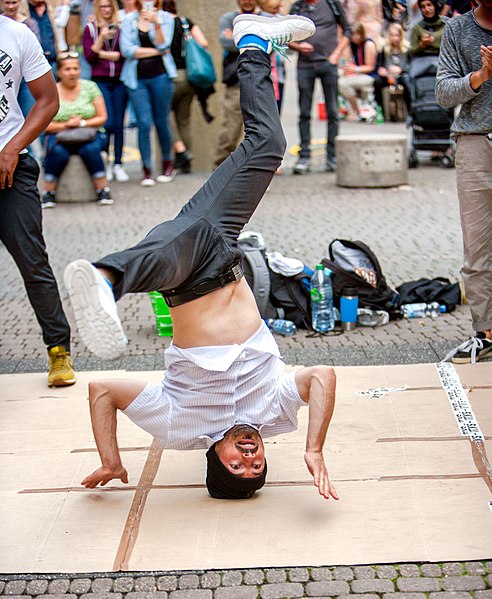
Photo: Wahrmund/ Wikimedia.
Break dancing in Cologne, Germany, 2017.

Back in the 1980s, John was really into break dancing. I think he mainly replicated what he saw other people doing, although he might have taken a class.

Today break dancing is considered athletic enough to be included as a competitive sport in the Olympics. Wow.

Rick Maese has the story at the Washington Post. “When her son had his fill of piano lessons, Ellen Zavian began looking for some other activity to keep him busy. She paid a visit to a dance studio in Washington that specialized in breaking — better known as break dancing to anyone who remembers the 1980s or simply breakin’ to many participants — and it didn’t take long before mother and son were hooked.

“Zavian is a sports law professor at George Washington University. … It didn’t take long before she started brainstorming about what was possible with breaking, an acrobatic urban dance style long associated with oversized boomboxes, hip-hop music, athletic spinning, whirling and ‘freezing.’

“ ‘I just thought: “My kid loves it. I work in sports. I’ve created associations. Why not? This is what I do,” ‘ Zavian said

“That was a full decade ago. The result was the United Breakin’ Association (UBA), an early step in organizing a sprawling, disorganized collection of young dancers, known as b-boys and b-girls, many of whom had no interest in formalizing and codifying their preferred form of self-expression. They were part of an anti-establishment counterculture that feared being co-opted by people who didn’t understand the dance or its dizzying band of denizens.

“The story of breaking’s meteoric rise to the Olympic stage — it’s set to make its debut at the Paris Summer Games in 2024 — involved an unlikely and reluctant partnership between street-savvy breakers and traditional ballroom dancers. …

“’Most of us knew that this could be big one day. We just didn’t really know how it would happen,’ said veteran b-boy Moises Rivas, who dances under the name ‘Moy.’ …. ‘We just had to deal with the misconceptions, negative connotations and people who didn’t always want to give it the credibility it deserves.’

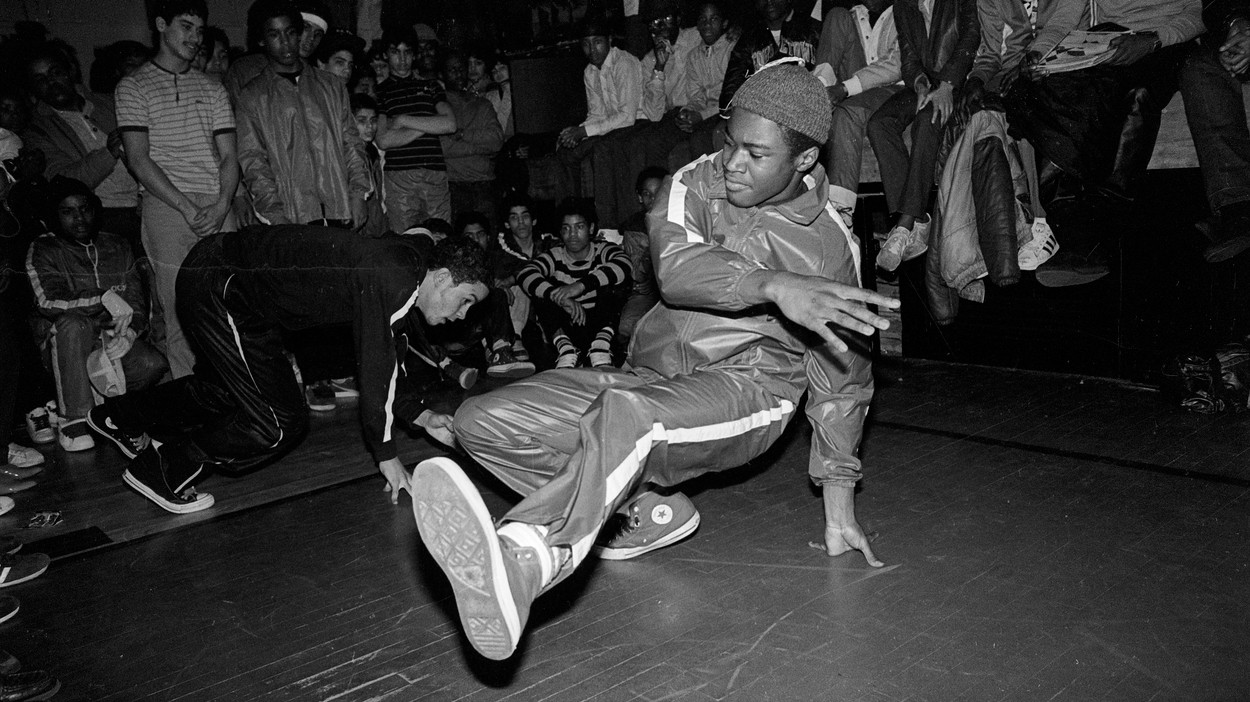
Photo: Ricky Flores.

“Born in the South Bronx nearly 50 years ago, breaking long ago had spread across the world. … From Los Angeles to Miami, there were parallel efforts to grow the sport but little coordination. Steve Graham had dabbled in breaking in college in the early 1980s. He worked on Wall Street and then established a successful private equity firm in Philadelphia. He gravitated back to breaking in his 50s, dancing alongside his children. He saw the potential for growth. The dance wasn’t just a form of expression; competition was baked into it with fierce dance battles between b-boys and b-girls.

“He ran a popular competition in Philadelphia and established a Pro Breaking Tour and a nonprofit membership organization called Urban Dance & Educational Foundation with a vision of drawing together the fragmented breaking world. Many of the competitions were spectacles, drawing large crowds with elaborate lights and window-rattling beats, but the sport was driven by independent event promoters without any movement trained on the Olympics.

“Far removed from booming bass notes and twirling young b-boys, however, serious efforts were afoot to get other forms of dancing on sport’s biggest stage. The global governing body was called International DanceSport, an umbrella organization for all dance disciplines, from Boogie Woogie to salsa. It was formally recognized by the International Olympic Committee in 1997, but officials there failed in their efforts to get ballroom dancing accepted into a Summer Games. Rather than pack up their tap shoes, they rebranded as the World DanceSport Federation (WDSF) and decided to double-down. …

“Breaking was far from the organization’s core when WDSF enlisted the help of Jean-Laurent Bourquin, an IOC veteran, in 2015, asking him for his help in wooing Olympic officials. The WDSF leaders were hopeful they could push specific styles of dance — either Latin or rock-and-roll — but after consulting with his colleagues in the Olympic world, Bourquin surprised them. …

“Dancing would be a viable candidate for the Olympics, he told them, but not the style they were used to.

“The WDSF’s top governing board included no breakers, so the proposition was something of a quandary: The organization could realize its Olympic dream, but only with a rogue, largely unfamiliar discipline.

“ ‘It was a bitter pill that was hard for everyone to swallow,’ recalled Ken Richards, who was on the board at the time and is now president of USA Dance. … ‘We had to come to this understanding and agreement that if dance can get a foot in the door with a style the IOC wants, then maybe the other dances aren’t as far behind as we feared.’

“Bourquin planted a seed with the IOC in 2016 and traveled to the Rio Olympics to chat up IOC members. [He] wanted to see breaking at the 2018 Summer Youth Olympics in Buenos Aires, a more apt platform and a friendly way to introduce the sport to Olympic officials, who skew older. For many in the Olympic world, it was the first time they considered dancing a true sport. And for many in the breaking world, it was the first time they considered the Olympics a realistic goal. …

“ ‘They didn’t view their talent as a sport,’ Zavian recalled, ‘so I had one of the skateboarders come to our meeting and talk about the difference between a sport and art. It was a very heated topic: “You’re going to take our culture away. You’re going to take our art away.” ‘ …

“But the ball was moving. While Graham provided much of the funding, the critical push for the Summer Youth Olympics was spearheaded by the larger dancing community, not the breakers.”

At the Washington Post, here, you can read what happened next.

Read Full Post »