Feeds:
Posts
Comments

Posts Tagged ‘british columbia’

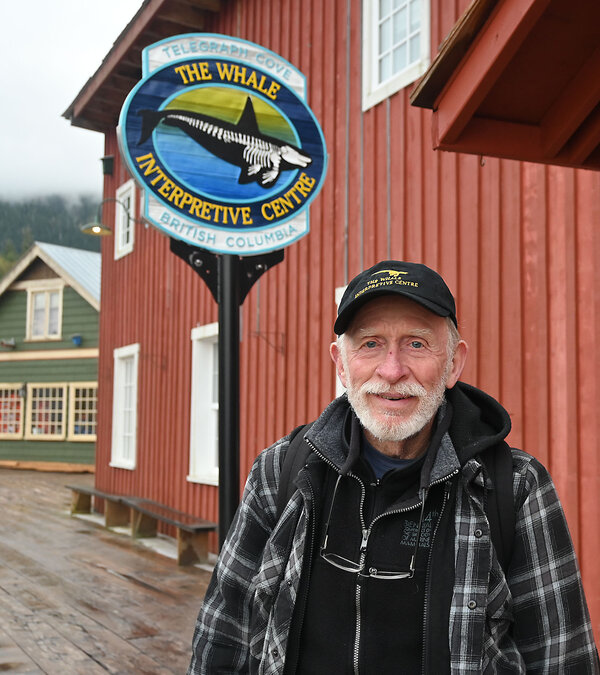
Photo: Jules Struck.
Jim Borrowman was part of a successful lobby to create an ecological reserve in western Canada’s Johnstone Strait in the 1980s.

Today’s story is about a few people whose determination helped to reverse the decline of a group of Orca whales — people who just don’t give up.

At the Christian Science Monitor, Jules Struck wrote recently about their work.

“Jim Borrowman cut the engine of the Nisku in the gray water of the Johnstone Strait, relinquishing his boat to an eastbound tide. He unraveled the line of a hydrophone – a cylindrical, underwater microphone – and dropped it portside.

“On the other end of the cord a pint-size Honeytone speaker in the cabin broadcast a conversation from the deep: the ethereal, two-toned call of an orca whale to her clan.

“ ‘I think they’re what we call “A1s,” ‘ said Mr. Borrowman, browsing a database of local orcas on his phone.

“Mr. Borrowman has been watching, and watching over, these whales for decades. He was one in a band of Vancouver Islanders who successfully lobbied in the early 1980s to set aside a protected area for Northern resident orcas, which lost a third of their population to hunting and capture in the 1950s and ’60s.

“This early act of ocean preservation laid a foundation from which decades of important research – and a deep local allegiance to the whales – have flourished. Galvanized by this data, environmentalists and First Nations just won a battle to evict commercial open-net fish farms from the area, which compete with the orcas’ food supply.

“With early signs of abundant salmon, and a small but decades-long uptick in Northern resident population numbers, it feels to some like nature rallying.

“ ‘You can see the whales coming back,’ says Alexandra Morton, an author and marine biologist who has studied salmon in the Johnstone Strait since the 1980s. She was part of a group that occupied a Vancouver Island fish farm in 2017 in protest of the industry.

“The A1s spotted by Mr. Borrowman from the bow of the Nisku are one pod of one type of orca, called Northern resident killer whales, which number some 400 and live along the coast of British Columbia.

“They’re doing particularly well, and have been growing by a handful of members each year since the ’70s. Northern residents are the most reliable visitors to the Robson Bight (Michael Bigg) Ecological Reserve, where Mr. Borrowman has served as a warden and run a whale-watching tour business with his wife, Mary, for decades until recently retiring.

“ ‘This is a beautiful, sensitive estuary at the terminus of a 100,000-acre watershed, the last untouched one on the east coast of Vancouver Island at the time,’ he says.

“It’s unique for another reason. At two known beaches at the mouth of the Tsitika River, Northern resident orcas rub gracefully along the seafloor pebbles in what scientists have dubbed a unique ‘cultural behavior.’

“It was this behavior, first captured in underwater footage by Robin Morton, Alexandra Morton’s late husband, that convinced the public, the press, and finally the federal government to set aside about 3,000 acres of water plus shore buffer as a protected area closed to boat traffic.

“Today, volunteer wardens with the Cetus Research & Conservation Society Straitwatch program monitor the reserve and gather population data on the whales and their pods. …

“Today, the whales’ major issues are food scarcity, noise, and chemicals in the water. But if the threats to orcas have become more complex, the responses have grown increasingly well-informed by a bedrock of research, much of which has come out of the ecological reserve and its orbit. …

“Decades of research have since shown that major pathogens and lice leak from [salmon] farms’ huge, suspended net pens straight into the paths of migrating salmon, ravaging their thin-skinned young and immobilizing the adults.

“Pacific salmon are also an important food source and cultural pillar for First Nations. They are intricately linked to the ecosystem, and scientists have even tracked nutrients from decomposed salmon high into the mountains.

“Ms. Morton campaigned for decades to close the fish farms. Nothing changed until she and Hereditary Chief Ernest Alexander Alfred, with a group of other First Nations people, peacefully occupied a Vancouver Island salmon farm owned by Marine Harvest.

“That protest led to a 2018 agreement with the British Columbia government requiring the consent of three First Nations – ‘Namgis, Kwikwasut’inuxw Haxwa’mis, and Mamalilikulla – for fish farms to operate around Vancouver Island.

“First Nations closed more than a dozen salmon farms in and near the strait. Then, the federal government announced it would ban all open-net farms in British Columbia by 2029.

“The decision is not universally supported by First Nations along the coast: 17 have agreements with salmon farming companies, which collectively employ around 270 Indigenous people, according to the Coalition of First Nations for Finfish Stewardship. Overall, open-net salmon farming accounts for 4,690 jobs and $447 million in gross domestic product across Canada, according to the BC Salmon Farmers Association.

“But for many, it was a turning point. Coho and especially Chinook salmon stocks spiked this year in Vancouver Island and its inlets, according to the Pacific Salmon Foundation, after years of downturn.”

Read more at the Monitor, here.

Read Full Post »

There are many stories about how people in poor or immigrant communities pull together to help one another when the government doesn’t. Today’s article is about the mutual aid systems of black communities in Canada, the US, and other countries.

Vicky Mochama writes at the Walrus, “There aren’t, compared to Ontario and Quebec, that many Black people in British Columbia: less than one-tenth of the overall Black Canadian population. But, when troubles [strike], official numbers don’t matter. …

“As covid-19 began to take hold, a group of activists and organizers did something that, for Black folks, is as old as time: they started a mutual-aid group.

“ ‘Our community members are likely to be found in the blind spots of the [federal] agencies that are giving out the money,’ says Kevonnie Whyte, one of the group’s organizers. The money the group has collected has gone to Black migrants without permanent residency, Black students stuck in Canada on visas that limit their ability to work, and Black people trapped in the rinse cycle of the gig economy — taxi drivers, delivery couriers, cleaners, and dog walkers.

“The premise of the fund is simple: for the duration of the pandemic, any Black person in BC can apply to get $150 to use for whatever they need. The fund prioritizes Black people who, for whatever reason, don’t get access to government supports like the Canada Emergency Response Benefit. …

“A group of young women in Boston started a mutual-aid drive to get help — cash, food, assistance — to the vulnerable in their community. Students at Pittsburgh’s Carnegie Mellon University started spreadsheets to help people cover basic expenses. … By late May, Whyte says, the Black in BC Mutual Aid collective had raised nearly $20,000 and had disbursed three-quarters of that to over 100 people. …

“Then, in June, everything changed. In the aftermath of the killing of George Floyd, the group received an astounding influx of donations, quintupling their fund in ten days to over $100,000; by early July, they had topped $170,000. …

“Over decades and centuries, mutual aid has helped people pay rent, buy groceries, and acquire medicine; it has given workers something where there is so much nothing to be had, and it has given luckier people a way to help out in desperate times.

“So why weren’t we doing mutual aid before — everybody, all the time? Well, Black people were.

” ‘Mutual aid is not new. It’s a long-standing practice of Black communities. ‘Mutual aid is just something that we’ve always done,’ says Caroline Shenaz Hossein, a professor in York University’s social science department. …

“In the late aughts, Hossein’s research took her to the Caribbean, where she met the ‘banker ladies’: women who ran and participated in money pools. Money pools are deeply familiar to many people from Black diasporas. …

“There’s a magical quality, money appearing as if from nowhere. Depending on where you’re from and who invited you in, the pools have different names: sol (Haiti), susu (Ghana), box hand (Guyana), jama (Kenya), hagbad (Somalia). There are cultural nuances in how you get into one, and the amounts may range, but the principle is almost universally the same — you get out what you put in.

“A typical arrangement might look like this: ten women decide to each contribute $30 a month to a pool, and they each get their turn receiving money from the pool — a $300 cash injection when they do. …

“1932, at the height of the Great Depression, Black people in Gary, Indiana, developed a local economy though mutual aid. ‘The last bank had just pulled out of their neighbourhood. Everybody was unemployed,’ says political economist Jessica Gordon-Nembhard.

“The way she tells it, they didn’t know exactly what to do. Maybe, they thought, we could start a co-op for groceries or just to share what little we do have. Twenty African American families joined a study group; for a year and a half, they met monthly to talk and plan, chaired by a local high school teacher, Jacob L. Reddix, with a passion for cooperative economics. (A cooperative economy is one in which ‘most of the economic activity is organized around cooperative ownership … in a democratic way so that they all participate in decision making about the economic activity,’ Gordon-Nembhard explains.)

“Eventually, they pooled enough money ($24 at first) to buy their groceries in bulk. Next came a credit union. Within five years, the area added a gas station and two branches of a co-op grocery store, and at the school, they began to teach a curriculum on cooperative enterprises.

“In the middle of a depression and despite the continued closure of the steel mills, the Consumer’s Cooperative Trading Company was bringing in $160,000 (US) in sales and had a membership in the hundreds. The title of their agenda — ‘A Five Year Plan of Cooperative Action for Lifting the Economic Status of the Negro in Gary’ — was precise: in good times and bad, the people must prosper with the economy.”

It’s a pretty interesting article. Read more here.

Read Full Post »

The radio show Living on Earth recently reported how negotiations among environmental activists, the timber industry, indigenous people, and the British Columbia government protected 85 percent of a huge Canadian forest.

“Eighty-five percent of the Great Bear Rainforest in British Columbia is now protected … Steve Curwood discusses [the compromise] with reporter Andrew MacLeod of the magazine The Tyee, who explains what’s been protected and what’s open for logging.

MACLEOD: “It’s an area of 6.5 million hectares between the top end of Vancouver Island and the Alaska Panhandle. So it’s an area, about the size of Ireland, and it’s quite remote. There are only about 1,400 people who live there. So much of it has never been logged. This is usually described as the largest intact temperate rainforest in the world, a very lush, mossy, moist year-round ecosystem. … We’re talking trees that five or six people put their arms around. Some of these cedars can be in 20 feet in diameter …

CURWOOD: “Tell me what is the [forest’s] Spirit bear?

MCLEOD: “They are a subspecies of black bear. They are a genetic variant that comes out white, so it’s a white black bear. There are also Grizzly bears there, there are whales, wolves, and just a relatively pristine ecosystem up there.

CURWOOD: “And who calls them Spirit bears? …

MACLEOD: “My understanding is that it goes back through the First Nations, there have always been these genetic variant bears there and they’re seen as special.”

When Curwood asks why the timber industry agreed to the negotiation, MacLeod explains that the campaign to protect the forest helped to avoid extended confrontation.

“Lots of First Nations people will tell you they’ve been on the land for thousands and thousands and thousands of years and it’s been sustainable, it’s been healthy, that it’s really only last 150 years of colonialism where you’ve seen clear-cuts and destruction and species driven to extinction. On the other hand, there are lots of people from First Nations who are working in the logging industry today as well. Over time, First Nations have sort of reestablished their rights. There have been some precedent-setting cases just in the last few years that have recognized aboriginal title does exist.” More here.

Of possible interest: Read how Wabanaki diplomacy smoothed a similar negotiation process in Maine, here.

Photo:  Elsen Poulsen/Animals Asia, Flickr CC BY-NC 2.0
A white Spirit bear fishing

Read Full Post »