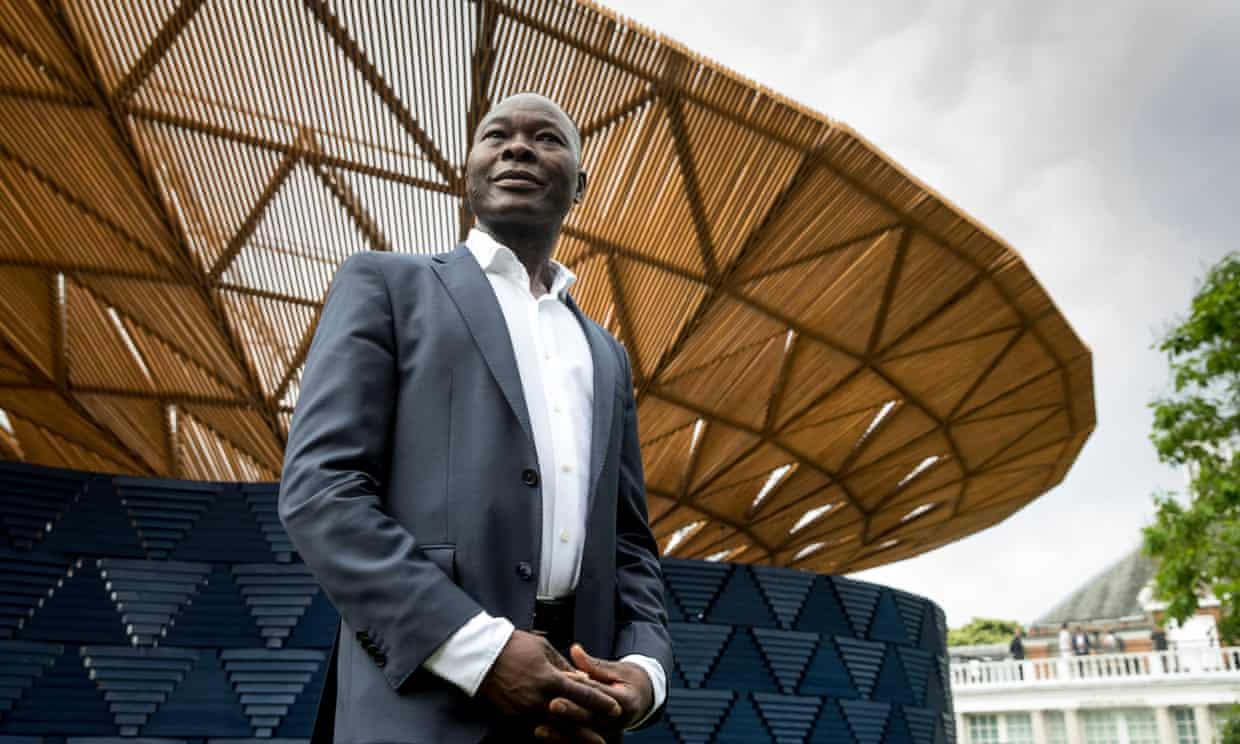
Francis Kéré, outside his Serpentine pavilion in London, is the most recent recipient of the prestigious Pritzker Prize for architecture.
There’s a 7-year-old girl in my family who has been designing buildings this week, complete with elevators, staircases, rooftop playgrounds, and two kinds of dining rooms. With flowers. I can’t help wondering if this is the kind of childhood interest that leads to a career like the one in today’s story.
Oliver Wainwright reports at the Guardian, “Few architects have experienced such a meteoric rise, against such odds, as Francis Kéré. Born in a remote village in Burkina Faso without running water or electricity, he began his career by building a mud-brick school for his community, before being selected to design the country’s national parliament less than 15 years later. Now he continues his unparalleled trajectory, named as the winner of the 2022 Pritzker prize, architecture’s highest international accolade.
“ ‘It is unbelievable,” said Kéré, speaking from his office in Berlin. “I don’t know how this all happened. First of all I am happy and overwhelmed, but the prize also brings a great sense of responsibility. My life is not going to be easier.’
“He is the first black architect to be recognized in the [award’s] 43-year history, reflecting the profession’s overwhelmingly white, male, middle-class bias. …
“ ‘I don’t want to talk about racism directly,’ he said, ‘but this is a field where you need a lot of resources. You really need to be strong and be lucky, as competitions are not always so open. I hope that young people in Africa will see me and know that this is a possible path for them too.’
“Kéré has made a name for himself with a series of schools and medical facilities in Africa that appear grown out of their context, built by local communities with the bare minimum of resources. Often featuring walls of clay-earth bricks, shaded by large, overhanging corrugated metal roofs, his buildings are elegantly tuned to their arid climate – whether in Mali, Togo, Kenya, Mozambique or Sudan – using natural cooling to avoid the need for air conditioning.
” ‘Francis Kéré’s entire body of work shows us the power of materiality rooted in place,’ said the Pritzker jury, chaired this year by Chilean activist-architect Alejandro Aravena. ‘His buildings, for and with communities, are directly of those communities – in their making, their materials, their programmes and their unique characters. They have presence without pretence and an impact shaped by grace.’
“Born in Gando in 1965, Kéré was … the first in his community to attend school, sent away at the age of seven, after which he won a scholarship to study woodwork in Germany. He saw slim prospects for a career in carpentry in a country that had little wood, so he switched to study architecture at the Technical University of Berlin. For his final project he designed a primary school for his home village – and set about fundraising and mobilising friends and family to see it built. It was realized in 2001, for about [$26,000]. …
“Kéré’s Gando primary school set out the basic principles that would go on to define his work, using earth bricks made on site, topped with a perforated ceiling crowned by a thin ‘flying roof.’ …
“Kéré suspended his metal canopy above the classrooms to encourage stack ventilation, drawing cool air in through the building’s side windows and releasing hot air through the holes in the ceiling. The whole village was involved in construction: children gathered stones for the foundations while women brought water for the brick production, beginning a collaborative model of practice that he has continued ever since. The school won an Aga Khan award in 2004, catapulting Kéré to international fame and prompting him to found his practice in Berlin the following year. …
“International commissions including the Serpentine pavilion in 2017, and an installation for the Coachella music festival in 2019, have continued to help him raise funds and awareness of his work in Africa. …
“His biggest project so far, for the national assembly of Benin, is currently under construction, rising out of the ground in the capital, Porto-Novo, in the form of a majestic palaver tree. ‘The site is next to a botanic garden,’ he said, ‘so we proposed to extend the garden and place the biggest tree in the centre, with a debate hall beneath the figurative tree canopy – reflecting how democracy has always been conducted in west Africa.’
“His equivalent project back home, for the national assembly of Burkina Faso in Ouagadougou, is now hanging in the balance, after the president was removed by a military coup in January. Kéré was commissioned in 2015, following a national uprising when the parliament was torched and the then-president hounded out of the country. …
“ ‘I want the people to take ownership over the parliament building,’ he said, ‘so that, one day, when the next revolution comes, they will protect it as their own.’ ”
More at the Guardian, here.


 Suzanne's Mom's Blog