Feeds:
Posts
Comments

Posts Tagged ‘butterfly’

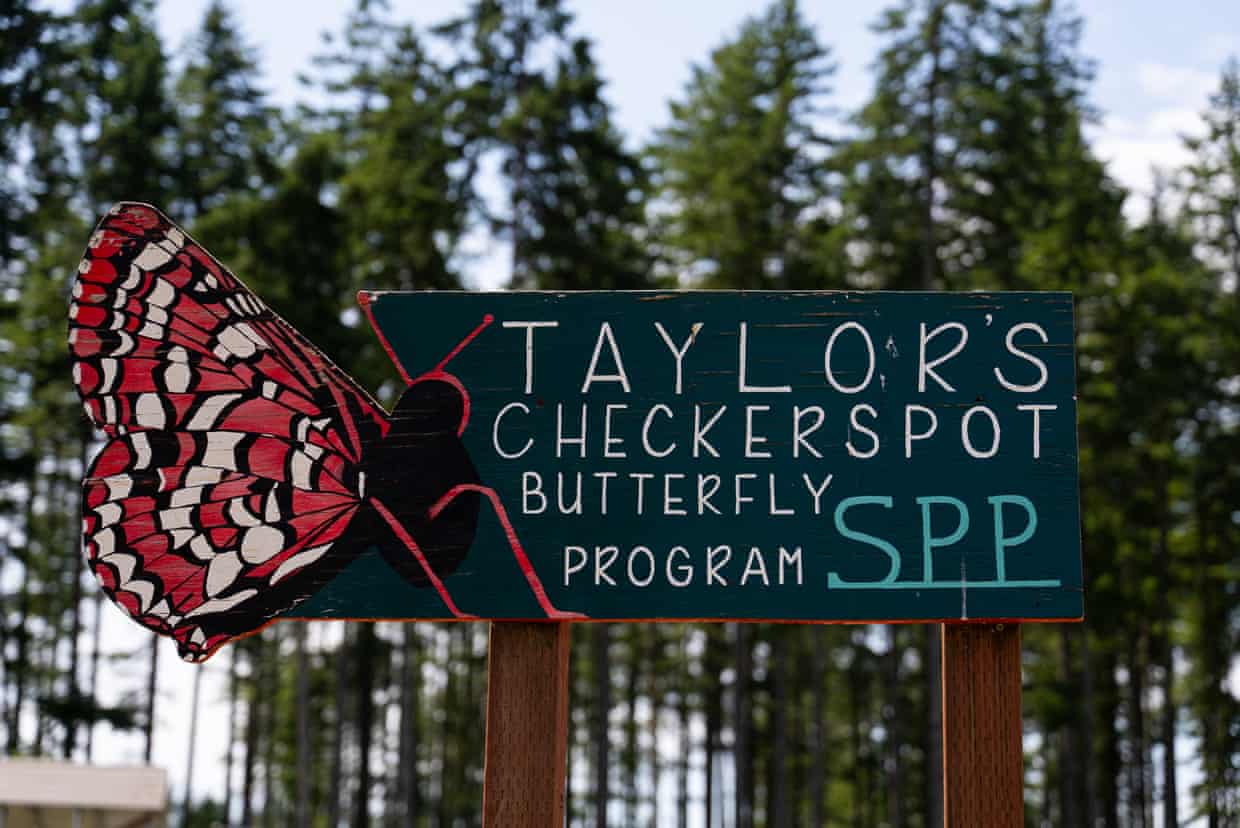
Photo: Washington State Department of Corrections.
Last year, scientists working with a team of incarcerated women released more than 67,000 larvae of a beautiful, endangered butterfly.

Today’s story about incarcerated women helping scientists reminds me that you don’t have to be in prison to get satisfaction from working for a cause. These women are gaining confidence, self-esteem, and hope for a better future.

Andrew Buncombe reports at the Guardian, “Trista Egli was standing in a greenhouse, tearing up strips of plantain and preparing to feed them to butterfly larvae.

“Of the many things the team here has tried to tempt larvae of the Taylor’s checkerspot [with], it is the invasive English plantain they seem to love the most.

‘The big thing for me is being part of an effort to save an endangered species,’ says Egli, 36. ‘It is a big thrill.’

“Egli is one of seven women incarcerated at the Mission Creek correctional facility, located a two-hour drive from Seattle, who are part of a year-long program that takes captured butterflies, harvests their eggs, and oversees the growth of the larvae before they are released into the wild where they will turn into adults.

“Last year, scientists working with the team released more than 10,000 larvae. The adult butterflies live for just a handful of fabulous, wing-fluttering days. …

“Many of the women speak of their pride working on a project that feels like it is making a positive contribution to the world.

“Lynn Cheroff, 42, said she had been thrilled to talk about it with her two young children when they come to visit. When she telephones her mother about the work, her mother tells her she is proud. Another woman, Jennifer Teitzel, appreciates the sense of order and discipline the program demands and instills.

“Every detail about the eggs and larvae has to be collated and recorded. It is the women’s responsibility, and nobody else’s, seven days a week.

“[While] the program run by Washington state department of corrections (DOC) is part of an effort to prepare the women for life once their sentences are over and to smooth the path to work or college, there is no sugar-coating their predicament.

“Egli, who has three young children, is serving a nine-year sentence for a 2020 drunken hit and run that left a woman with permanent brain damage.

“ ‘I am paying the price for that every day. I can never go back and undo what happened,’ she says. ‘But I can try to make sure the rest of my life is about making the world a better place.’

“The program at Mission Creek has been operating for 10 years. Kelli Bush, the co-director of Sustainability in Prisons Project, a partnership between the DOC and the Evergreen State College in Olympia, says a crucial component are graduate students who visit to offer educational support.

“Bush says in addition to providing the women something to feel proud about as many deal with shame and guilt, the program also gives them confidence about their own capabilities. …

“She says, ‘It’s routine to hear people say “I didn’t think I was smart and I’m realizing I’m doing science.” … Pretty soon people find themselves reading peer-reviewed scientific journals and saying, “I can do this too.” ‘

“The Taylor’s butterfly’s preferred habitat is open grasslands and prairie. For thousands of years, such landscapes were created and maintained by active burning by Indigenous communities. Without such native stewardship, and with ever-increasing threats from developers and town planners, the amount of grassland has drastically diminished. …

“A favored place is Joint Base Lewis-McChord (JBLM), operated by the US army and situated 10 miles from Tacoma. Training with heavy artillery has long kept the prairie free of unwanted vegetation. Yet when the Taylor’s was added to the US Endangered Species Act list in 2013, it presented military officials with a challenge; how could they continue to make use of the base without harming a species now protected by federal law?

“Dan Calvert, of the Sentinel Landscape Partnership, a coalition of federal and state groups that works with landowners to promote sustainable land use around military installations, says JBLM contains ‘90% of the prairie habitat in western Washington.’ …

“One of the efforts to boost the numbers of Taylor’s checkerspot in locations off-base – and thereby allow the military to work unimpeded at the base – led to funding for the Mission Creek project by the Department of Defense (DoD). …

“The collaboration has helped boost the Taylor’s checkerspot. This year could be a record year for releases of adults. In 2024, the program released about 10,900 larvae.

“However, there’s a dark cloud looming over the program. Mission Creek is set to close in October because of budget cuts. There is a plan to transfer the women and the program to a prison at Gig Harbor, located 25 miles away, but there is some concern among current participants it could simply be cut entirely.

“Egli, who is set to become eligible for a work-release program under which she would serve the last 18 months of her sentence working outside the jail and returning to do what’s known as a DOC re-entry facility every night, says the program changed the person she was.”

More at the Guardian, here. No firewall. Donations support his valued news outlet.

Read Full Post »

Photo: Top Africa News.
One of the benefits of having Kenyan farmers raise butterflies for a living is that they are protecting East Africa’s largest coastal forest.

I’m reading a strange British novel called Ash Before Oak in which the protagonist is keeping a diary about the natural world he encounters on leaving London for England’s West Country. As a kind of self-therapy for the impending breakdown he senses, he makes lists of — and tries to focus on — all the flora and fauna he sees. Starting with butterflies.

Who knew there were so many butterflies in the world? Who knew there were so many in southwest England? They do have a mesmerizing quality. Today’s article is about how unsuspecting butterflies are mesmerizing people in Africa while doing good work for the planet.

Evelyn Makena wrote at Top Africa News, “Before becoming a butterfly farmer, Dickson Mbogo made a living by selling charcoal from trees he cut in the forest.

“ ‘In my search for food and an income, I was destroying the forest,’ he said.

“Now, after getting involved in butterfly farming, Mbogo’s weekly routine involves visiting sections of Kenya’s eastern Arabuko-Sokoke Forest to capture butterflies using trapping nets.

“Home to some of the world’s endangered animals and plants, the Arabuko-Sokoke Forest Reserve is the most extensive indigenous forest on the east African coast. Once part of an extensive coastal forest that ran from southern Somalia to northern Mozambique, the forest is visible for miles along Kenya’s north coast highway.

“It is home to several threatened bird species, including Clarke’s weaver bird and the Sokoke scops owl, as well as endemic animals like the Aders’s duiker, the golden-rumped elephant shrew and the bushy-tailed mongoose. It is also home to elephants and other members of the ‘big five.’

“The forest also hosts almost 300 butterfly species. For local communities living adjacent to the forest, these butterflies are now the source of a sustainable livelihood, enhancing the conservation of a forest previously threatened by illegal logging.

“At home, Mbogo places the butterflies in a netted cage that houses different varieties of trees for the butterflies to feed on and lay eggs.

“ ‘Butterflies can lay up to 300 eggs. After a few days, eggs hatch to caterpillars and feed on specific food plants until they develop into pupae,’ explained Mbogo.

“After the pupae stage, farmers take the insects to Kipepeo Center in Gede town, a few kilometers from their homes.

“ ‘Here, the insects are sorted according to species, graded, carefully wrapped in cotton for protection and packaged in boxes. They are then exported to markets in the United Kingdom,’ said Hussein Abdulahi Aden, Project Manager of the Kipepeo Butterfly Project.

“From an initial 141 members when the project started, [in 2022, there were] 872. … Farmers are paid for every pupa delivered, depending on the species type. Pupae can attract between Ksh. 90 – 225, (US$0.75 – 1.8) with farmers making collective earnings of up to Ksh.15 – 20 million (US$124,000 – 166,000) per year.

“According to Aden, the Kipepeo project was started in 1993 by the National Museums of Kenya and other stakeholders to reduce pressure on the forest while offering an alternative source of income to locals. Initially, the project was met with resistance from the community.

“ ‘For a community used to subsistence farming of maize, cashew nuts and coconuts, the idea of butterfly farming was strange and perceived as mystical. There was also fear that this was a government project aimed at evicting them from their farms,’ Aden explained. But other community members followed suit as the pioneer farmers began reaping the project’s benefits. …

“Among the butterfly species reared are the colourful African Swallowtail, Silver Stripped Charaxes and Taita Blue-banded Swallowtail. There are also other less colorful species, like the African Migrant.

“The project buys all the pupae brought by the farmers. When supply is higher than the demand, the surplus is released to the Kipepeo Butterfly Exhibition House at Gede to educate the public on the insects. Some are released back into the forest for the continuity of species – ensuring that the forest is not only protected from the charcoal burners but is also well pollinated. …

“In many ways, Kipepeo project members have become champions of conservation within the community. Sofia Saidi, a member of the Mkongani group, said that members report any suspicious activities they may come across in the forest to the relevant authorities, including Kenya Forest Service and Kenya Wildlife Service. The project has also trained volunteer community scouts who patrol the forest and deter illegal activities.

“The Kipepeo project has also been crucial in improving food security in the community. Specific butterfly species play a vital role in pollination. According to Aden, a survey conducted within a five-kilometre radius of the forest boundary found that farms closer to the forest had better yields, indicating the impact of the butterflies on plant reproduction.”

More at Top Africa News, here. For an audio story about Kenyan butterfly growers, check out The World, here.

Read Full Post »

34224912476_b47a3dd0d1_k-1200x600

Credit: Tjflex2/Flickr
Inside the pupa (or chrysalis), the caterpillar actually turns to liquid during metamorphosis. Despite such an extreme transformation, the butterfly or moth can retain learning from its caterpillar days.

Do you remember being a newborn? I don’t think our species is capable of that kind of remembering. What about other species? Recent research suggests that butterflies have a kind of muscle memory from the good old days of their caterpillar-hood.

An article from Curious Kids — a series that gets experts to answer questions that kids send in — has the scoop. Evan, age 5, asked the question.

“We have caterpillars at home. I would like to know whether they will remember being caterpillars when they are butterflies.”

“Dear Evan,

“I think it is highly unlikely that a butterfly or moth remembers being a caterpillar. However, it may well remember some experiences it learned as a caterpillar.

“That fact in itself is especially amazing because inside the pupa (or chrysalis), the caterpillar actually turns to liquid as it transforms into a butterfly or moth (the adult stage).

“The transformation from the pupa to the adult is the most dramatic change in the life cycle of a butterfly, and scientists refer to this change as metamorphosis. During metamorphosis, the body tissues of the caterpillar are completely reorganised to produce the beautiful adult butterfly that emerges from the pupa.

“Scientists have known for a long time that caterpillars can learn and remember things when they are caterpillars, and adult butterflies can do the same when they are butterflies. However, because of metamorphosis, we were not sure if an adult butterfly could remember things it learned as a caterpillar.

“This ability to remember caterpillar experiences as an adult was tested in a study by a team of scientists at Georgetown University in the US.

“The researchers trained the caterpillars to dislike the smell of ethyl acetate, a chemical often found in nail polish remover. They did this by giving the caterpillars little electric shocks every time they smelled the chemical. Soon, these caterpillars were trained to avoid that smell because it reminded them of the electric shock.

“They let the caterpillars transform into adult moths, and then tested the moths again to see if they still remembered to stay away from the ethyl acetate smell.

“And guess what? Most of them did! The scientists had shown that the memories of avoiding the bad smell experienced as a caterpillar had been carried over into the moth stage. …

“Thank you for sending in this very interesting question.

“Yours sincerely,

“A/Prof Michael F. Braby”

More at the Conversation, here.

Read Full Post »

Here’s a guy who didn’t just ring his hands when he learned that a magnificent butterfly species was endangered in his part of California; he decided to do something about it.

Zachary Crockett reports at Vox, “It begins its life as a tiny red egg, hatches into an enormous orange-speckled caterpillar, and then — after a gestation period of up to two years — emerges as an iridescent blue beauty. Brimming with oceanic tones, the creature’s wings are considered by collectors to be some of the most magnificent in North America.

“For centuries, the California pipevine swallowtail — or, Battus philenor hirsuta — called San Francisco home. As development increased in the early 20th century, the butterfly slowly began to disappear. Today it is a rare sight.

“But one man’s DIY efforts are starting to bring the butterfly back.”

Tim Wong, a 28-year-old aquatic biologist at the California Academy of Sciences, tells Crockett, ” ‘I first was inspired to raise butterflies when I was in elementary school … We raised painted lady butterflies in the classroom, and I was amazed at the complete metamorphosis from caterpillar to adult.’ …

“Years later, he learned about the pipevine swallowtail — which had become increasingly rare in San Francisco — and he made it his personal mission to bring the butterfly back.

“He researched the butterfly and learned that when in caterpillar form, it only feeds on one plant: the California pipevine (Aristolochia californica), an equivalently rare flora in the city.

” ‘Finally, I was able to find this plant in the San Francisco Botanical Garden [in Golden Gate Park],’ Wong says. ‘And they allowed me to take a few clippings of the plant.’

“Then in his own backyard, using self-taught techniques, he created a butterfly paradise.”

Read more here. It sure takes persistence.

Here’s hoping an elementary school project in 2016 will lead to the rescue of another endangered species down the road.

Photo: Tim Wong (@timtast1c)

Read Full Post »