Photo: Etsy.
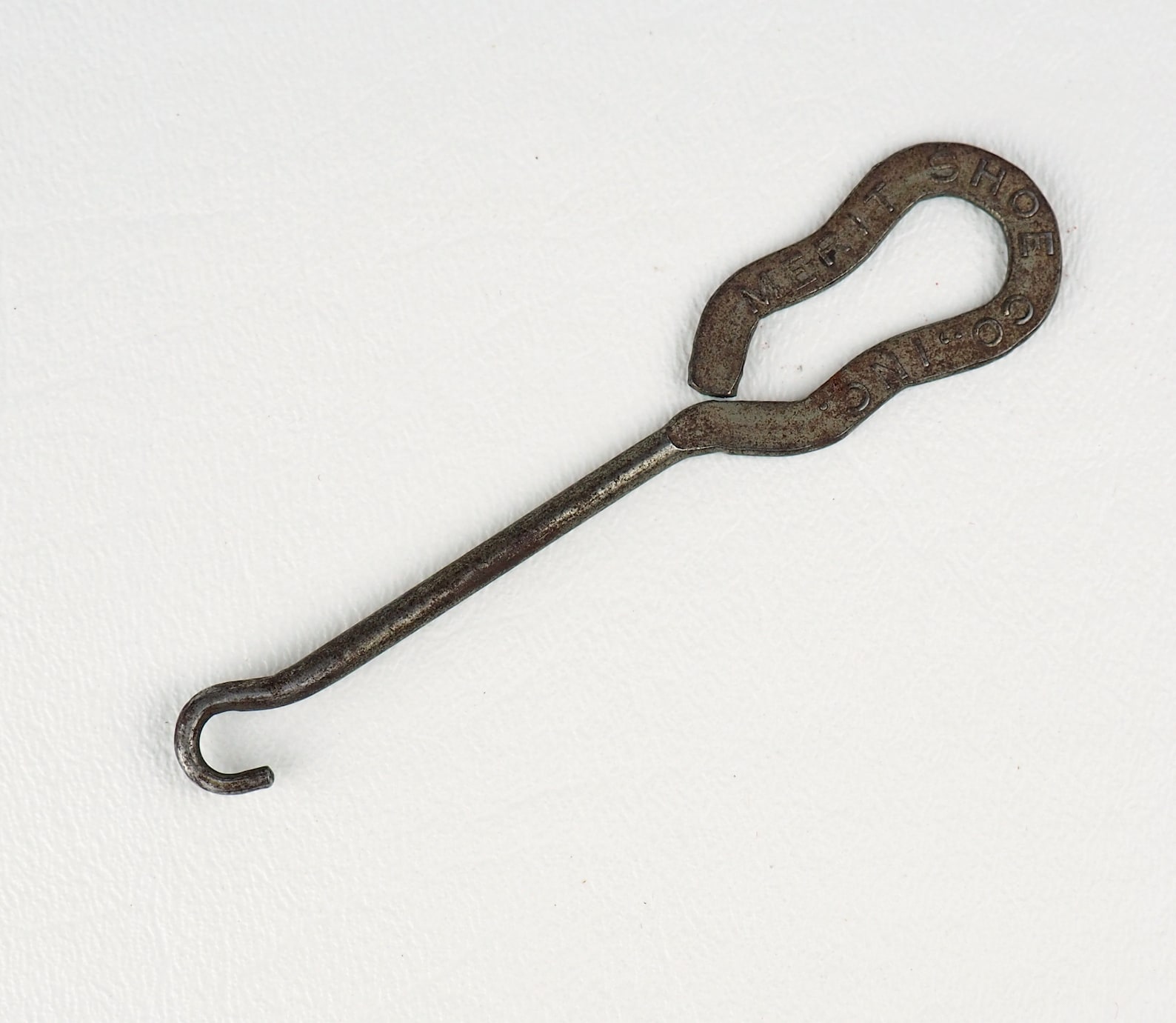
Antique button hook for shoes.
Recently, Suzanne’s friend Jackie Delamatre has been researching and writing about unfamiliar utensils like grapefruit spoons. There sure are an array of antique gizmos for her to choose from, and lots of new ones.
Don’t you love the word “gizmo”? It was so handy when Suzanne was a toddler and was asking too many times in 10 minutes “what’s this called, what’s that called?”
Today’s story explains why and how we use words like gizmo, whatchamacallit, thingamajig …
Ursula Kania, a senior lecturer in English Language and Linguistics, at the UK’s University of Liverpool, writes at the Conversation.
“Years ago, humans started speaking and we’ve not shut up since. Sometimes, though, we struggle to remember the name of an object, a place, or a person we want to talk about. The technical term for this phenomenon is ‘lethologica.’ … Drawing the occasional, temporary blank is very common. Unsurprisingly, stress doesn’t help, and it gets worse as we age.
“But what can we do if we’re coming up empty yet still want to keep the conversation going? …
“We can hesitate, using so-called fillers like ‘ehm’ and ‘uh’ to buy us some time, in the hope that the right word will make a delayed but triumphant appearance. We can describe what we mean, hoping to still get the message across. … We may even be able to recall certain formal characteristics of the word, like the first letter or sound, or how many syllables it has and generously offer these clues to the puzzled listener: ‘You know – this guy we met last week, I think his name starts with a G.’
“This is why we also call this the tip-of-the-tongue phenomenon. We’ve almost got it, and our brain is doing its best to use all stored bits of information (for example, on the word’s pronunciation and meaning) to come up with something useful to say, even if it isn’t the correct word itself.
“Sometimes, this results in us making up words on the spot (referred to within linguistics as ‘spontaneous’ or ‘ad-hoc coinages’). You may not find them in the dictionary, but they usually still make sense in context.
“Even young children already come up with them in an attempt to put into useful practice what they’ve already learned about language. …
“My favorite example in this category, though, is a Tweet about a German customer in a Welsh pub who couldn’t recall the word ‘cutlery’ and politely asked for ‘food weapons.’
“Last but certainly not least, we may use ready-made placeholders like ‘thingamajig,’ ‘whatchamacallit’ (for an object) or ‘what’s-his-name’ (for a person).
“Apparently, the struggle to find the right word is real and has been for some time, because the Oxford English Dictionary has its own category for these terms, labelled ‘thing or person whose name is forgotten or unknown.’ It includes 64 entries and some records go back as far as the early middle English period (1100–1300).
“Not all of them are still used today. The last attested use for the strangely evocative whiblin’ was in 1652, for example, and ‘jiggumbob’ is marked as obsolete.
Others, like ‘gizmo’ or ‘doodah’ are still going strong, though, and you can even buy ‘Whatchamacallits’ and ‘Whozeewhatzits’ – they are chocolate bars made by Hershey’s.
“There are threads on Reddit dedicated to collecting placeholder words in English and from around the world. They are worth exploring, with gems like ‘doomaflitchie,’ the Dutch ‘huppeldepup’ and the German ‘dingsdabumsda.’ “
If you know any others, especially whatchamallits in non-English languages, do let us know. We old folks need lots of these substitutes. More at the Conversation, here. No paywall.

 Suzanne's Mom's Blog