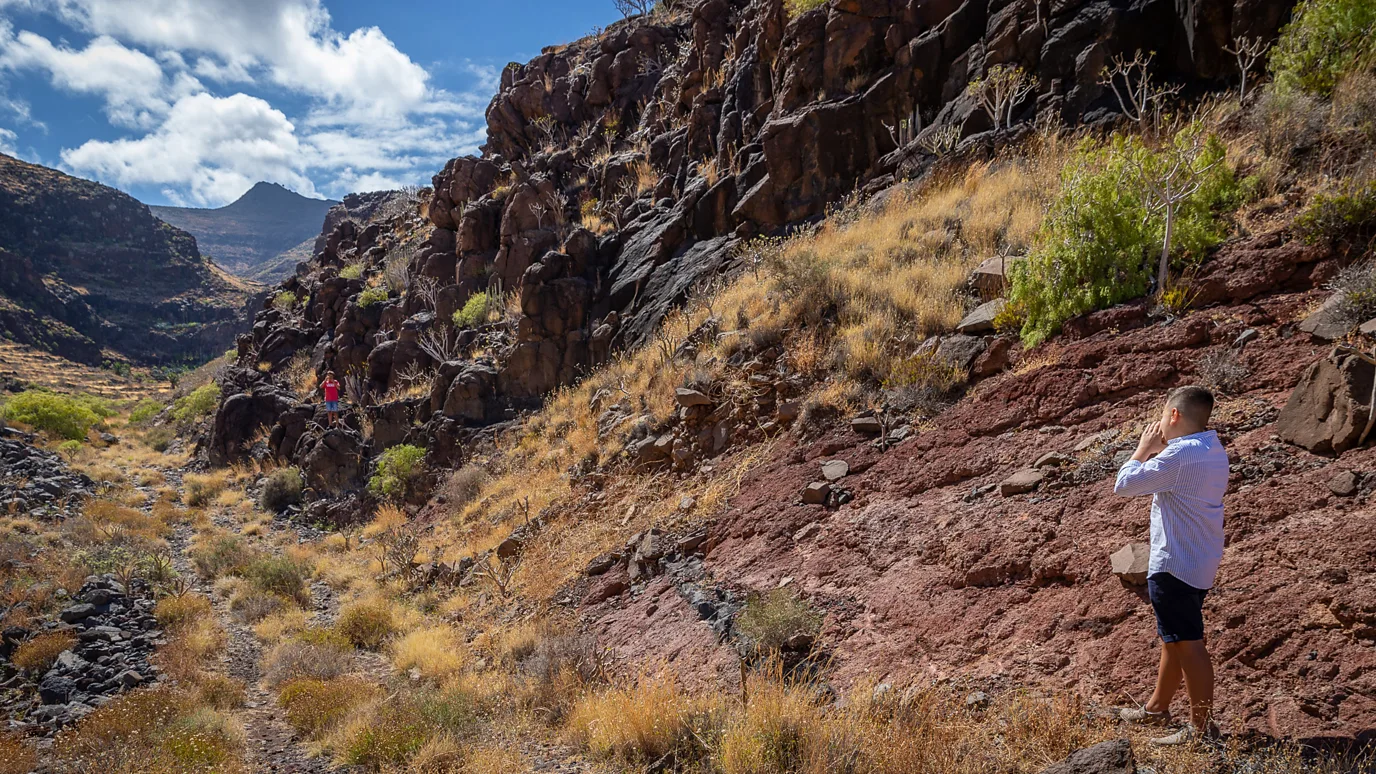
Photo: Richard Franks.
On the island of La Gomera, expert whistlers communicate across long distances.
How do you get your news? News models are emerging all the time. I get local updates from a nonprofit that has been expanding ever since its launch a couple years ago. (To read about the nonprofit wave, search on “nonprofit news” at this blog.) I also listen to the radio and use social media that provides links to mainstream media.
But what if you got news from a whistler? What would that be like?
Richard Franks writes at the BBC, “In the rugged crags of Barranco de Ávalo, a ravine on the small Canary Island of La Gomera, two local 12-year-olds were practicing their Silbo Gomero, the local whistling language. For an entrancing few minutes, Irún Castillo Perdomo and Angel Manuel Garcia Herrera’s lilting warbles reverberated around the barren gorge and soared proudly into the air like eagles in flight.
“They were accompanied by 70-year-old retired Silbo Gomero teacher Eugenio Darias, whose grandfather used to own and work on this very same land. He told me that the boys’ whistled conversation was similar to any they would have over text message or in the playground, but the focus was instead on the six differentiating sounds that make up La Gomera’s protected whistle language.
“While it’s true that most children their age would sooner pick up their phone and tap away, this small Canary Island invites them to think differently. Thanks to Darias, their threatened tongue has been a compulsory school subject since 1999 – and almost all 22,000 residents can understand it alongside their mother tongue of Canarian Spanish.
” ‘It’s important to give students the idea that they can really use it if they need to, like other languages, but also that it’s not necessary for everyday use,’ said Darias, who pioneered the Silbo Gomero learning program. … ‘Having the whistle protected within our compulsory curriculum prevents extinction altogether.’ …
“Silbo Gomero, which is one of the most studied whistling languages and was officially declared an Intangible Cultural Heritage by Unesco in 2009, uses six condensed sounds to communicate. Two differentiating whistles replace the five spoken vowels in Spanish, while just four replace the 22 consonants. Whistlers elongate or shorten the sounds to mimic the words.
“Several whistling methods exist on the island, though perhaps the most traditional is demonstrated by local sculptor José Darías. His Whistling Tree sculpture at Mirador de Igualero, a viewpoint in Vallehermoso overlooking a ravine where Silbo Gomero was most active, shows how the index finger should be bent and placed inside the mouth while whistling with an open palm beside it to amplify the sound.
“Experienced whistlers use different finger methods and can often tell who is calling by the whistle’s ‘accent’ alone – but most whistlers will introduce themselves and call the recipient’s name. When the message is understood, they whistle back ‘bueno bueno.’ …
“DNA-based research published in 2019 by Tenerife’s La Laguna University has matched La Gomera’s early inhabitants, the Guanches, with Berbers (now known locally as Amazigh). These indigenous people roamed North African regions more than 3,000 years ago and communicated by whistle; it’s therefore widely believed that the Spanish settlers on the island adapted the whistling language of La Gomera’s early inhabitants to suit their native tongue. …
“Silbo Gomero lent itself to La Gomera’s demanding terrain – namely its deep ravines – allowing the locals to communicate with a drifting, piercing sound that could travel for several kilometres. From atop the ravines, the locals would announce events, request livestock be brought over, warn of impending danger, or even announce the death of a family member. ‘It saved a lot of climbing,’ said Darias.
“In the 1950s, Silbo Gomero was used so frequently that there was often a scattered queue of farmers waiting to send instructions across the valleys. … ‘Nobody wanted to climb up and down the ravines to pass on a message. Because of this, so many whistling conversations were happening at the same time, and we would have to wait our turn,’ Darias said. …
“Silbo Gomero was first in decline by the 1960s, when growing economic conditions forced many of the island’s workers to emigrate to more prosperous countries like Cuba and Venezuela, as well as the neighboring Canary Island of Tenerife. Soon after, phones became commonplace and threatened the language altogether.
“By the 1990s, modern technology ascendancy and the introduction of new roads and paths on La Gomera removed the necessity and practicality of Silbo Gomero, dangling it near extinction. …
“ ‘The whistle has been defended with greater care in the Canary Islands, [local broadcast journalist Francisca Gonzalez Santana] noted, ‘because it is an essential part of our culture: the orography of the islands, with mountain areas and canyons, and our economy that has been linked to agriculture and livestock.’
“While the whistle is now rarely heard outside of school or other official programs, however, it is occasionally used in the few parts of the island with no telephone connection. ‘I know of two goat herders who still whistle to each other,’ Darias said. … ‘Their livestock moves around in an area with no mobile network, and that’s why it’s necessary.’ “
More at the BBC, here. No firewall. You can listen to whistlers sending messages here, at the radio show called The World. And be sure to read my 2015 post, here, on a Turkish whistling language.
The world is full of amazing things.

 Suzanne's Mom's Blog