Feeds:
Posts
Comments

Posts Tagged ‘carbon capture’

Photo: Seabound.
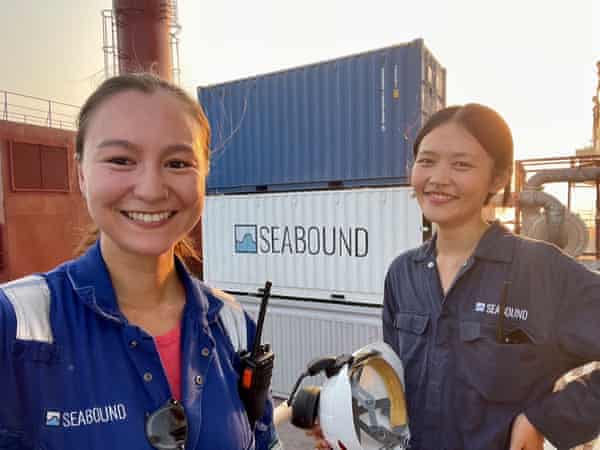
Seabound co-founders are chief executive Alisha Fredriksson (left) and chief technology officer Rojia Wen. Seabound’s carbon-capture prototype sailed for two months on a midsize container ship. 

Today’s story is about two women in the male-dominated shipping industry and their work on what might be a stepping stone to sustainability. The challenge is that the process to create their carbon-absorbing pellets also involves carbon release.

Emma Bryce writes at the Guardian, “An industrial park alongside the River Lea in the London suburb of Chingford might not be the most obvious place for a quiet revolution to be taking place. But there, a team of entrepreneurs is tinkering with a modest looking steel container that could hold a solution to one of the world’s dirtiest industries.

“Inside it are thousands of cherry-sized pellets made from quicklime. At one end, a diesel generator pipes fumes through the lime, which soaks up the carbon, triggering a chemical reaction that transforms it into limestone.

“With this invention, Seabound, the company behind it, hopes to capture large amounts of carbon directly from the decks of cargo ships, and help clean up this strikingly polluting industry. …

“Behind all this is Alisha Fredriksson, a young entrepreneur who once dreamed of being a doctor but reached a turning point in her career after reading a report from the Intergovernmental Panel on Climate Change that detailed the global implications of 2.7 F degrees versus 3.6 F degrees of warming.

“ ‘That’s when I realized that everyone around the world will be affected by the climate crisis, and so if I cared about large-scale social impact, the best thing I could do would be to help tackle it,’ says 30-year-old Fredriksson, chief executive of Seabound. …

“Trials have shown that her invention can scrub most of the carbon from the ship exhaust, filtered through its lime-pebbled interior. Ultimately, the goal is to have this device strapped to ships across the world’s oceans, she says. …

“She and her co-founder, Roujia Wen, hit on the idea of scaling down the existing quicklime-based carbon-capture technology typically employed at industrial plants. They then made a prototype, and attracted about $4m in funding from investors. Some of this came from shipping companies. ‘It all happened really quickly. Suddenly we had money, and we had to go build it,’ says Fredriksson. …

“Since then, successive prototypes of the Seabound container have taken her from the company’s test-bed in east London, to … a three-week voyage to test its efficiency. This showed that a Seabound unit can capture 78% of all the carbon from the exhaust that is pumped through it, and 90% of the sulphur, a toxic air pollutant.

“The latest prototype is being built to the dimensions of a standard 20ft shipping container, so that it can seamlessly slot in with cargoes on deck, Fredriksson says. … Once in port, the limestone-filled units can be substituted for containers of fresh quicklime. This product is made by heating limestone to high temperatures in kilns, an energy-intensive process that also releases CO2 from the limestone, making production extremely carbon-intensive.

“Companies are trying to make quicklime using kilns heated with renewable energy, or developing methods to capture the released CO2 so that it doesn’t enter the atmosphere. Seabound is working to source this ‘green’ quicklime, Fredriksson says. …

“Some critics are concerned that decarbonizing technologies could distract from solutions, such as zero-emission ammonia fuel or wind-powered innovations, that are essential to push the shipping industry to net zero.

“ ‘The potential for short-term use of carbon-capture retrofits on existing vessels should not become a justification to extend the lifespan of fossil fuels or delay the shift to truly sustainable alternatives,’ says Blánaid Sheeran, climate diplomacy policy officer at Opportunity Green, a nonprofit organization focused on gaps in global climate policy.

“But Fredriksson believes Seabound’s technology could support this transition. In April, at a meeting of the International Maritime Organization, UN member states agreed to a landmark deal that will start charging ships for every ton of emissions above a threshold. That threshold will gradually decrease to push the industry towards green fuels.

“Seabound slots into this new regulatory landscape, according to Fredriksson, by enabling ships to decarbonize their fuels, thereby lowering their emissions, and gradually adjust to the rules by adding more containers over time. …

“Fredriksson says [Seabound’s] offering is cost-effective and she has already had a commitment from one company to fit the first full-scale containers on to its ships this year.”

More at the Guardian, here. No firewall. Donations sought.

Read Full Post »

Photo: United Airlines via Flight Global.
United Airlines will invest in carbon capture to try to limit the bad effects of its fuel on the climate.

It would be better for the planet if we all took fewer airplane trips, but consumer demand just keeps increasing. Especially after the pandemic, everyone wants to get away by plane. So here is an alternative way to deal with aviation pollution. Would love to know if you regard this as a good solution.

Steven Mufson reported for the Washington Post in January, “United Airlines is … backing carbon capture — the nascent technology designed to suck carbon dioxide from the atmosphere.

“United Airlines is the first major U.S. air carrier to take a step toward trying to remove some of the greenhouse gases spewed by it and every other airline, pollution that is driving up global temperatures.

“For United, it’s an alluring project. Governments, particularly in Europe, are beginning to crack down on emissions from airlines. Last month, the U.S. Environmental Protection Agency for the first time regulated greenhouse gas emissions from commercial aircraft. … United is increasingly focused on its voluntary goal of net-zero emissions by 2050 — good publicity at a time of growing alarm about climate change.

“But it may also be placing an early bet that carbon-capture technology could — with the help of federal tax credits — prove profitable. …

“Steve Oldham, chief executive of Carbon Engineering, which has developed carbon-capture technology, said United is taking an unusual approach to decarbonization. ‘When most are thinking they have to stop emissions, here you have a very credible company with a real need saying that the best way of dealing with emissions is removing them,’ he said.

“A lot is at stake. If global airlines were lumped together as one country, they would rank among the world’s top five or six emitters of carbon dioxide, according to the International Energy Agency. Aviation accounts for 3.5 percent of the planet’s man-made greenhouse gas emissions, a recent Manchester Metropolitan University study says. At high altitudes, the planes leave behind contrails of carbon dioxide, nitrogen oxide, water vapor and soot.

“When it comes to commercial aviation, there are no low-carbon alternatives. In the summer, a small white-and-red all-electric-powered Cessna e-Caravan flew safely over Washington state — for only 28 minutes. The plane had room for nine, but only the pilot was on board.

“Solar-powered flights are even less practical. A plane called Solar Impulse 2 went around the world over 14 months, but it could only hold the pilot in an unheated, unpressurized phone-booth-size cockpit whose single seat doubled as a toilet. The plane flew at an average of 30 miles per hour to maximize energy savings, and, despite an enormous wingspan, it was only able to carry the equivalent weight of one automobile.

” ‘The aviation sector is one of the hardest to decarbonize,’ Oldham said. ‘Planes require fuel and burn a lot of fuel. At high altitude, the impact of those carbon emissions is greater than if they were released on the surface.’

“So United says it will become a partner in 1PointFive, a joint venture designed to finance and deploy a large-scale direct-air-capture plant. The firm, formed in August by a subsidiary of Occidental Petroleum and Rusheen Capital Management, will use technology created by Carbon Engineering.

“The name 1PointFive refers to the U.N. goal of limiting the average increase in global temperature to 1.5 degrees Celsius compared with preindustrial times. Constraining global warming to that level could avert the most catastrophic fallout from climate change, scientists say. The company will build its first plant somewhere in the Texas Permian Basin, an area rich in shale crude oil and natural gas.

“Occidental, the biggest oil and gas operator in the Permian, will take the carbon dioxide from the air and pump it into old wells to extract more oil. Legislation gives firms a $35-a-barrel tax credit for this capture and use. Occidental will leave the carbon dioxide underground; it has said it has enough geologic storage capacity to bury 28 years worth of U.S. emissions. …

“Scale remains a problem. United has improved its fuel efficiency by more than 45 percent since 1990, the year often used as a benchmark for climate-oriented energy savings. It has added aerodynamic fins on wingtips, used only one engine when taxiing on runways and bought planes that weigh less. But the number of travelers has soared, and airline fuel consumption has gone up. The federal Energy Information Administration estimates that jet fuel demand will more than double by 2050.

“Each carbon-capture plant will take up about 100 acres and capture 1 million tons, equivalent to the work of more than 40 million trees. To put that into perspective, worldwide emissions are 40 gigatons. Offsetting that would require 40,000 carbon capture plants. …

“David Victor, a professor and climate expert at the University of California at San Diego, said, ‘The airlines are an example of a sector where firms are starting to see the writing on the wall … and a lot of them don’t know what to do.’ “

More at the Washington Post, here.

Read Full Post »