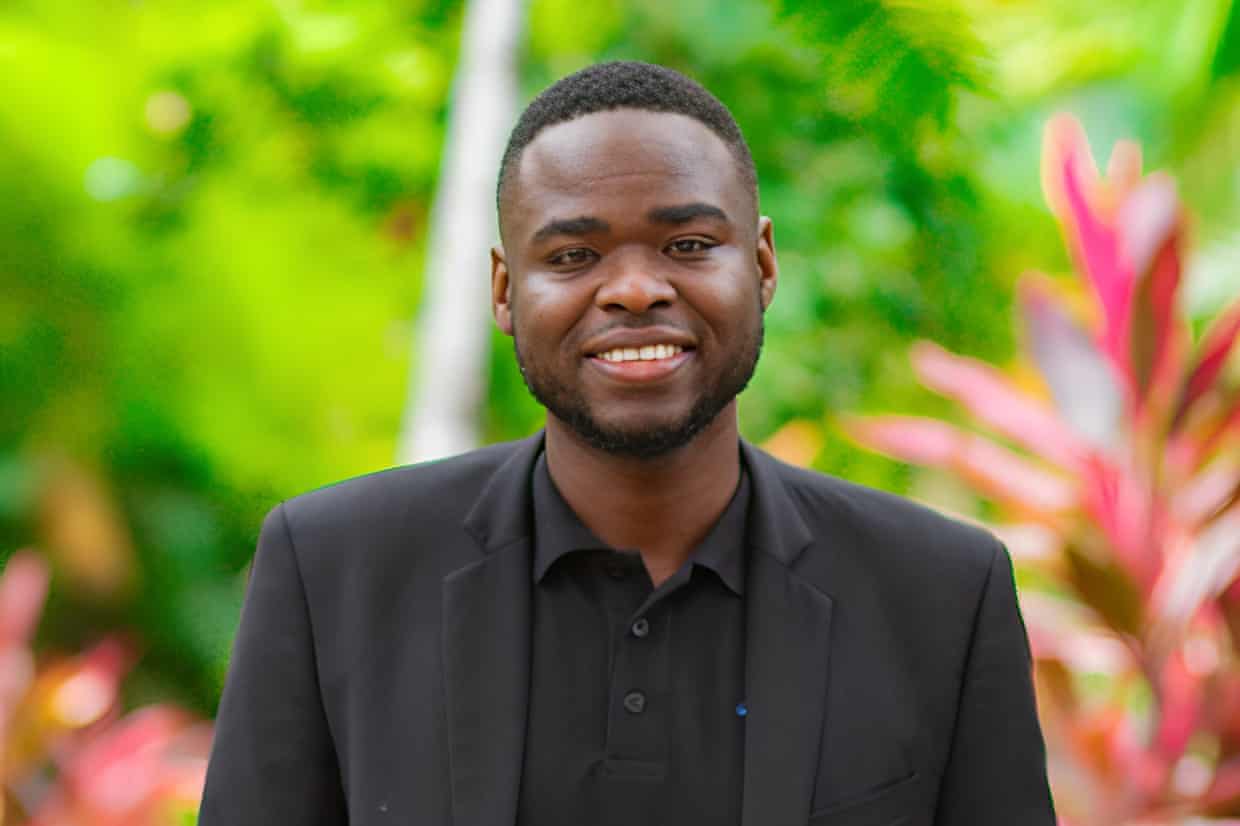
Photo: Rayvon Stewart.
Rayvon Stewart invented a workable model for a door handle that could disinfect itself after every touch.
Ever since seventh grade, when my health teacher showed an educational animation about how disease could spread by touching things with germs on them, I’ve been wary of doorknobs. I even answered the question on an intelligence or psychological assessment truthfully, knowing it would trigger alarm bells. Test: “Are you afraid of doorknobs?” My brain: “Well, yes. Everyone should be afraid of doorknobs!”
Natricia Duncan writes at the Guardian about someone else who thought doorknobs were a problem.
“When the Jamaican university student Rayvon Stewart invented a workable model for a door handle that could disinfect itself after every touch, it was hailed as a potential gamechanger for hospitals, hotels and other businesses, with promising implications for controlling the spread of disease, particularly during pandemics like Covid-19.
“Speaking at a recent product launch, Alison Drayton, assistant secretary-general of the Caribbean Community (Caricom), a 15-member bloc of Caribbean countries, described the invention as a ‘meaningful solution’ for the region and a ‘life-saving design that fits our reality.’
“Stewart, now 30, was just 23 and a student at Jamaica’s University of Technology when he conceptualized the pioneering ultraviolet self-sanitizing door-handle model he calls Xermosol, which he says can kill 99.9% of pathogens but is safe for people and animals. Since then he has been working to bring the product, which benefits from a provisional patent protection under the patent cooperation treaty, to market, winning Jamaica’s Prime Minister’s National Youth Award and the Commonwealth Health Innovations Awards in the process. …
“Stewart grew up in a poor household with his grandmother, in the rural farming community of Mount Prospect. ‘Even though times were tough, we never really thought about that. We knew that we had something to do as a family,’ he said. The software engineer and his cousin were the first in their family to go to university.
“There, he discovered his love of inventing and entered a competition with his first idea: 3D modeling software that would allow people to virtually fit clothes before purchasing online. When he started volunteering in a hospital, his passion for innovation became about solving a problem.
” ‘I saw how patients were suffering, the assistance that they needed, and how difficult it was for the nurses,’ he said. This, he added was the inspiration for Xermosol.
“Dr Camille-Ann Thoms-Rodriguez, a University of the West Indies consultant microbiologist, said that, while the invention did not replace the need for World Health Organisation cleaning guidelines in hospitals, Stewart’s smart self-sanitizing door handle was an innovative tool that can be used alongside others, for infection control. …
“She said, ‘A lot of the innovation that we see in healthcare is often from a first-world country where there are more resources … but it doesn’t mean that we don’t have good ideas here.’ …
“Kirk-Anthony Hamilton, co-founder of Tech-Beach Retreat, a Caribbean-based tech platform that connects innovators, entrepreneurs and investors through summits, programs and investment, said there was a growing desire in the region to tackle ambitious tech projects.
“ ‘Young people in the Caribbean are seeing what opportunities they’re missing out on, and they want to be a part of it. They’re reading stories about a guy in a garage coming up with a concept, and two years in, the company is making $50m a year,’ he said. …
“In the broader field of digital technology, businesses such as the software development company BairesDev, which has a global workforce of more than 4,000, said it saw a 400% increase in applications from developers in the Caribbean between 2020 and 2024.
“One possible explanation for this, the company’s director of talent acquisition, Felipe Turra, said, was the increased demand for software engineers during the Covid pandemic as lockdowns drove innovation. ‘Companies started saying, hey … I need to develop new applications, because people can’t leave home,’ he said, adding that the Caribbean being largely aligned to the US, both in terms of language and culture, made it a good fit for its US-based clients.
“For Stewart, the shift in innovations and increasing digital talent is ‘challenging the myth that there isn’t awesome, life-changing technology in the Caribbean.’ “
More at the Guardian, here. (The Guardian relies on donations to continue delivering factual news.)

 Suzanne's Mom's Blog