Feeds:
Posts
Comments

Posts Tagged ‘cement’

Photo: Evan Qu/Unsplash.
Self-healing concrete at the Pantheon in Rome.

I grew up in a family that placed high value on the humanities — the arts, literature — and the people who practiced them. With the exception of our beloved Uncle Jim, who was a chemist, and Margaret Lawrence, who was a physician, we didn’t know how to admire people who didn’t fit our limited definition of “creative.”

But today, I’m bowled over by the imaginative pragmatism of people who invent solutions to real-world problems like those who reengineer gasoline engines to use electricity, for example, or who invent building materials that reduce the dangerous carbon dioxide we pump into the atmosphere.

I think even my parents would have loved that today’s scientists are finding inspiration in the ancients. After all, it was fine to admire archaeologists.

Adele Peters reports at Fast Company on research that suggests new possibilities for ancient wisdom.

“A road or bridge made from modern concrete might only last 50 years. But the massive Pantheon building in Rome, made from unreinforced concrete, has been standing for nearly two millennia. And nearby, some ancient concrete aqueducts still deliver water to the city. What made ancient Roman concrete so much more durable?

“A new study from researchers at MIT and Harvard University, along with labs in Italy and Switzerland, suggests that an ancient manufacturing technique can create self-healing concrete that naturally fills in cracks. Using a similar process now could help shrink concrete’s massive carbon footprint. ‘We’re looking to the ancient world as a source of inspiration,’ says chemist Admir Masic, an engineering professor at MIT who focuses on sustainable construction materials.

“Cement, the glue that binds concrete together, is responsible for up to 8% of global emissions when it’s made, both because of the energy it uses and the process of heating up limestone, a key ingredient in the material, which releases CO2 directly. Multiple startups are now working on alternatives: including companies that replace limestone with different rocks or add captured CO2 to the final product.

“The Roman-inspired approach is different. By making concrete last much longer, far less of it would need to be made in the first place. … The older production method also happens at a lower temperature, so it uses less energy.

“The researchers studied samples from a 2,000-year-old city wall in an Italian city. They focused on tiny white fragments of lime that aren’t found in modern concrete, but are ubiquitous in old ruins throughout the former Roman Empire. …

“In the past, some researchers thought that the fragments, called lime clasts, were the result of sloppy mixing. But it’s more likely that they were formed deliberately, and the study suggests that they are the reason the concrete lasts so long.

When tiny cracks form in the concrete, water travels to the lime clasts, which dissolve and then fill the cracks with calcium carbonate.

“The researchers attempted to duplicate the manufacturing process that created the lime clasts, and then tested the material against samples made with modern techniques. After cracking the samples and adding rainwater, they watched what happened: The old-school concrete healed itself within two weeks, while in the modern version, the cracks remained.

“Other approaches to ‘self-healing’ concrete also exist now. For example, it’s possible to embed bacteria in concrete that can fill cracks; but it’s costly to make. ‘Current self-healing concretes are very expensive because they are based on very complex chemistry, while our material is super cheap,’ Masic says. … The ancient process involves adding quicklime, a calcium oxide-based material (also known as lime), directly to other ingredients before adding water.

“A new startup is now spinning out from the research to bring the concrete to market. It may later add other features that the lab is studying, including making concrete that can absorb CO2 as it sits outside.” That would be amazing!

More at Fast Company, here.

Speaking of “creative,” check out the varied interests of that MIT chemistry professor: “Professor Masic’s research focuses on the science-enabled engineering of sustainable construction materials for large-scale infrastructure innovation. A chemist by training, with expertise in biomineralization, he specializes in the development of multifunctional cement-based materials, ranging from self-healing concrete materials to carbon absorbing concretes and electron conducting cement-based materials.

“He is a principal investigator in the Concrete Sustainability Hub at MIT, a faculty fellow in Archaeological Materials at MIT’s Center for Materials Research in Archaeology and Ethnology (CMRAE), and the faculty director of the Refugee ACTion Hub (ReACT) at MIT. MIT ReACT aims at providing new professional content development for displaced learners around the world.”

Read Full Post »

47538971_303

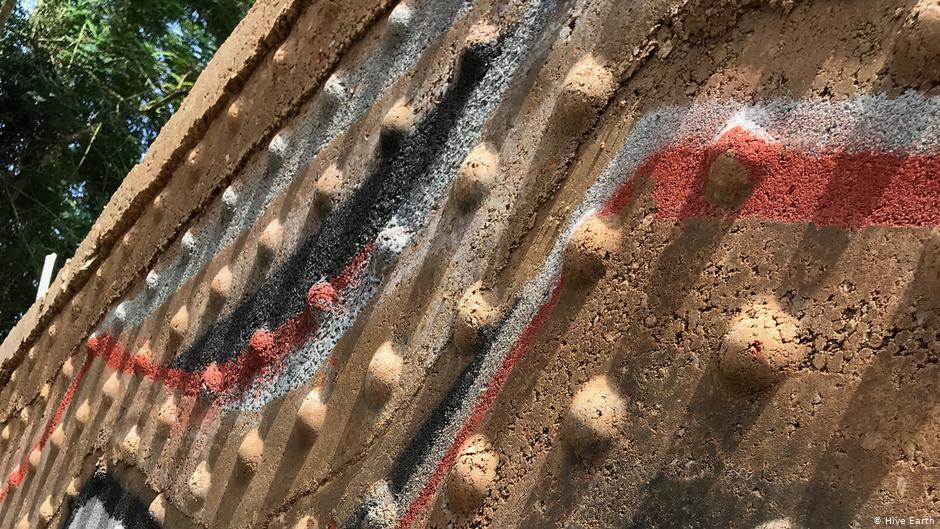
Photos: Hive Earth
Joelle Eyeson is a co-founder of Hive Earth, which is working to address the housing challenges in Ghana. The company supports using the traditional ‘rammed earth’ technique as much more eco-friendly than cement.

Lately, I’ve seen a number of articles about how cement is bad for the planet. (For example, this story on the mining of sand used in cement.) But what else can we use? We can’t cut down all our remaining trees.

In Ghana, a company interested in sustainable home-building practices is experimenting with modernizing some traditional materials. DW interviewed Joelle Eyeson, co-founder of Hive Earth. Here is the DW interview.

“What are the housing challenges in Ghana right now?
“Joelle Eyeson: There is need for around 2 million new houses in Ghana per year, but most of the building is concentrated in the capital Accra, where land is very expensive. The other issue is that when you build in more rural areas it then becomes expensive to travel to the cities for work. We knew that the majority of people in Ghana have a relatively low wage. We thought it is strange you have workers building these big houses that cost hundreds of thousands of dollars and they could never afford them.

“So our aim is to build houses that our workers and the majority of Ghanaians and West Africans can afford. The prototype that should be ready by the end of the year will cost roughly $5,000 for a one-room house.

“What exactly is the ‘rammed earth’ technique that you use?
The rammed earth technique is just a mixture of laterite, clay and then granite chippings. We use 5 percent cement to bind it but also do it using lime.

We wanted a way of building without using cement, because it is very toxic; especially in our climate it combines with the heat and humidity and creates a really bad indoor air quality.

“When we discovered the rammed earth technique, we thought it was great because it is basically like the traditional mud house, but updated. It’s a tried and tested technique that’s been around for centuries. Parts of the Great Wall of China were even built with rammed earth.

“In what other ways are the buildings eco-friendly?
“In Ghana it is so hot you usually need air conditioning systems in your home, but these are not always affordable, eco-friendly, or good for your health. We teamed up with some German engineers who gave us the idea of underground cooling systems. We dig around 8 feet or more until we get to the cool air underground. Then we use a solar pump which is constantly bringing the cool air into the home. Then it is only the cost of the solar pump (around $300) which people need to pay and there are no bills. …

“With our foundation we are also planning on doing more workshops with local communities, helping to teach them the skills of building with rammed earth. We are also planning on building eco toilets. … We want to enable people to come and learn about rammed earth, build something that is beautiful, eco-friendly and useful for their own communities.”

More at DW, here.

The rammed-earth building technique uses local materials in Ghana and almost no cement.

47539467_403

Read Full Post »

When homes are destroyed in disaster zones, the Mobile Factory can turn the rubble into Lego-like building blocks to create new housing. They snap together without mortar.

Stella Dawson of the Thomson Reuters Foundation writes, “In Amsterdam a mobile factory, the size of two shipping containers, ingests rubble at one end, liquifies it into cement, and spurts out Lego-shaped building blocks.

“Call it rubble for the people, converting the deadly debris from disasters into homes and hospitals, cheaply and quickly.

“It’s the brainchild of Gerard Steijn, a 71-year-old sustainable development consultant turned social entrepreneur, who leads the Netherlands-based project to recycle the rubble from natural disasters and wars.

“He plans to create ecologically sound and safe housing by producing 750 building blocks a day from the debris, enough for one home at a cost of less than $20,000 each.

” ‘In disasters, you have piles and piles of rubble, and the rubble is waste. If you are rich, you buy more bricks and rebuild your home,’ Steijn said in a telephone interview.

‘But what happens if you are poor? In disasters it is the poorest people who live in the weakest houses and they loose their homes first. I thought, what if you recycled the rubble to build back better homes for poor people?’

“His rubble-busting Mobile Factory has fired the imagination of a landowner in Haiti and a civil engineer at the University of Delft. They have joined forces to test Steijn’s idea and build the first rubble community in Port au Prince next year. …

“Unskilled people can build the homes with the blocks, which meet demanding Dutch construction standards to ensure they will last for many years. [Hennes de Ridder, an engineering professor at the University of Delft,] expects further stress tests he planned for Peru in a few months will show the homes can withstand temblors of at least 6 on the Richter scale.” Read more here.

Photo: The Mobile Factory
Model homes built from cement rubble are on display at an industrial park in Amsterdam. The brightly painted homes are designed for disaster zones, using technology that creates Lego-style building blocks from cement rubble.

Read Full Post »