Feeds:
Posts
Comments

Posts Tagged ‘choreograph’

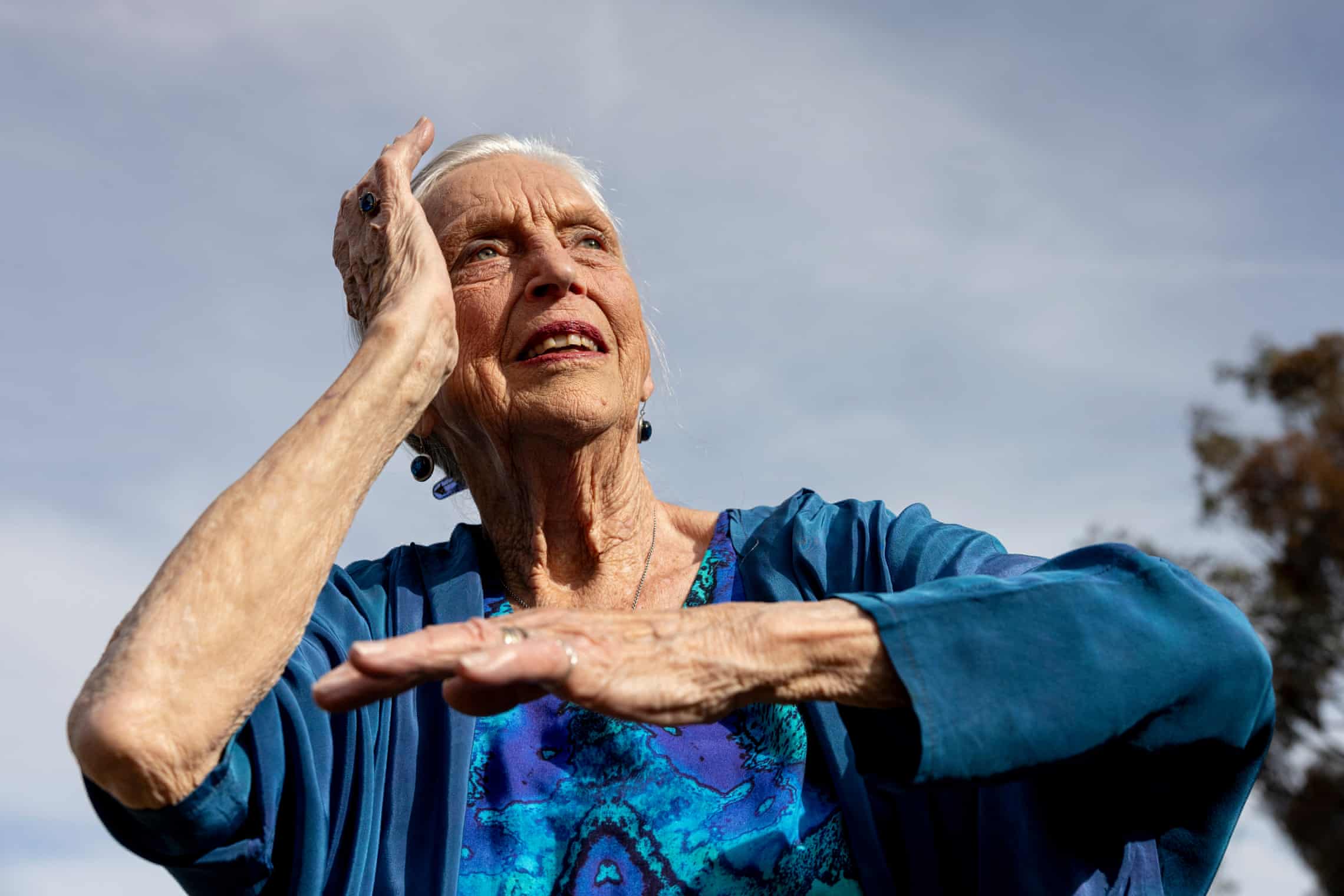
Photo: Teagan Glenane/The Guardian.
Australian choreographer Elizabeth Cameron Dalman at her property in Bungendore, just outside Canberra. “I’d always been inspired by nature, which I imagined as I was performing.”

As an older citizen who thinks backing up in a parking lot is living life on the edge, I can never resist a story about elderly people who ignore aging.

Steve Dow at the Guardian wrote recently about a dancer in Australia.

“At 91, Elizabeth Cameron Dalman dances in nature at her bushland retreat outside Canberra, Mirramu Creative Arts Centre, surrounded by writers, singers and visual artists. … ‘So many people bring up this age thing,’ she says, ‘and my reply is that in dance we are ageless.’

“A contemporary dance pioneer in Australia, Dalman has just seen the final performance of one of her ‘great inspirations’ and occasional collaborators, dancer Eileen Kramer, in a filmed component of the dance work ‘Afterworld,’ part of Sydney festival. Kramer died in November at 110. ‘I’m going to live to that age,’ Dalman chuckles.

“In Adelaide in 1965, Dalman co-created Australian Dance Theatre, running the company for a decade, confounding the era’s prejudice against modern dance and women artistic directors. …

“She [likes to] talk about what feeds longevity, pointing to medical research showing the health and mobility benefits of dancing for Alzheimer’s and Parkinson’s patients. ‘It’s not just pure exercise, you are adding creative activity,’ she says. ‘You’re engaging the left and right side of the brain.’ …

“Dalman has been consulting with ADT’s current artistic director, Daniel Riley, on the company’s 60th anniversary production ‘A Quiet Language.’ … The show, created by Riley, is billed as an examination of legacy, ‘transmuting the rebellious energy of the company’s early days into an electric new era.’

“Over the past decade, Dalman herself has graced international stages, notably touring for four years as part of the Irish choreographer Michael Keegan-Dolan’s critically acclaimed ‘Swan Lake/Loch na hEala,’ which transposed the classical ballet to the Irish midlands. When Keegan-Dolan posted an international callout for a woman aged 60 with long white hair to play the story’s cranky, arthritic matriarch, Dalman – 82 at the time – emailed saying she had the requisite long white hair. …

“Dalman has always been determined to dance. … She enrolled in dance class at three, learning both classical ballet and modern. Later, she began an arts degree at the University of Adelaide. …

“In 1957, aged 23, Dalman paid her way to London with the hope of launching a dance career. There, she saw a life-changing performance by the Mexican choreographer José Limón. ‘He touched my soul. I thought, “Oh wow, that’s how I want to dance,” ‘ she recalls. In 1960-61 she studied at the Folkwang school in Essen, Germany, where her classmates included Pina Bausch: ‘She was amazing, a technical whiz.’

“In Germany, Dalman met the Colombian American choreographer Eleo Pomare, who rose to prominence in the civil rights era. She created works with Pomare’s company from 1961 to 1963, living in Amsterdam with him and four other dancers. Pomare later remarked that Dalman danced ‘as if she swallows the heat and you feel that the heat is burning from the inside out.’ …

“Dalman returned to Australia in late 1963, and performed in the artist Stan Ostoja-Kotkowski’s experimental theatre show ‘Sound and Image’ at the 1964 Adelaide festival. It inspired her to open a dance school, and in 1965 she took her students on a regional tour, alongside dancers from Royal Ballet alumnus Leslie White’s Adelaide academy.

“Buoyed up by the tour’s success, Dalman and White set up Australian Dance Theatre, but the going was financially tough, and White left in 1967. Dalman put Australian Dance Theatre forward to perform in the 1968 Adelaide festival, but when it turned down her request for financial support she instead bought some half-price cruise ship tickets and took the troupe on its first international tour, sailing to the Netherlands, Switzerland and Italy.

“Back home, Dalman faced discrimination because of her gender: ‘I felt the battle, I had to keep proving myself. Even once we got a little bit of funding later, in 1973, and I’d been running the company since 1965, never in the red, this board member, a man, said, “Oh we have to do something about the finances, they haven’t been run correctly.” Then he took us into the red the next year.’

“Dalman remained artistic director until 1975. Then, having split with her husband, she and [their son] Andreas moved to Ventimiglia, a seaside town in northern Italy. … She founded a dance school and a youth dance theatre there in 1976, and it became ‘a place of healing.’

“In 1986, on a visit home to Australia, Dalman met another mature artist, who became an inspiration: the Japanese butoh dancer Kazuo Ohno, then almost 80. … A decade later, Dalman and Andreas visited Ohno – who was still dancing, and preparing to tour the US – at his Yokohama home. ‘He said, “Oh Elizabeth, it’s so good to talk to a senior, mature artist.” ‘ Dalman, then 60, had been contemplating ending her career. ‘When I met him, I realized I had to keep going.’

“In 1989, Dalman bought a 40-hectare property at Bungendore, near Weereewa/Lake George, outside Canberra. The bush reminded her of Italy, dancing among the olive groves or by the river. She established Mirramu Creative Arts Centre there the same year, followed by Mirramu Dance Company in 2002. …

“ ‘It was hard leaving Adelaide because that was my home, but the pull of this place, the land and the lake, is very powerful.’ “

More at the Guardian, here.

Read Full Post »

Photo: Ilan Godfrey.
Vusi Mdoyi, center, rehearsing this month with the Step Afrika! dance group at the Soweto Theater in Soweto Township in Johannesburg.

And speaking of other cultures, today’s story is from South Africa. It reminds me of how much I loved Miriam Makeba albums in the ’60s. And in the ’80s, a Xhosa-Zulu couple we knew (the husband was attending grad school at Harvard). I also remember young John (age 12 or so) auditioning for a kid show on Boston television with his pitch about ending apartheid. The American Black host doubted kids would be interested. Then there was the tour-de-force play Syringa Tree, Pamela Gien’s heartbreaking one-woman show about South Africa. It’s all coming back to me.

Now John Eligon reports at the New York Times on an intriguing dance story from South Africa.

He begins, “The young boy couldn’t resist the dance moves he saw being performed around him: the rapid foot taps, the ligament-spraining knee twists, the torso shimmies, all coming together in what some might describe as a sort of urban tap dance.

“Growing up in an impoverished Black township near Johannesburg in the 1980s, the boy, Vusi Mdoyi, loved watching his father dance with friends, in a style known as pantsula, in the dirt yards of their staid four-room bungalows. It was a sprinkle of joy in the dark days of apartheid.

“At about 7 years old, Mr. Mdoyi began mimicking the dance form. By 10, he was dancing in school festivals. By 14, he had created his own dance crew with neighborhood friends.

“Now 44, Mr. Mdoyi is a celebrated dancer and choreographer who has helped to achieve what felt unimaginable during apartheid: turning the street art of pantsula into a high art that attracts global praise, and audiences. …

“In 1998, while still a teenager, Mr. Mdoyi took part in workshops and shows put on by a dance company, Step Afrika!, which was co-founded in South Africa by C. Brian Williams, a Howard University graduate who had worked in the region. The company fused African American step dancing with traditional African dance.

“The interest that the American dancers showed in pantsula and other African dances helped to inject a sense of pride that their dances were meaningful, Mr. Mdoyi said. Under the white-led apartheid government, which had lost power only four years earlier, Africans were often made to feel ashamed of their own culture, he said. …

“In part with connections made through Step Afrika!, Mr. Mdoyi made his first overseas trip, to teach a pantsula workshop in Britain in 2001. The next year, he toured internationally with Via Katlehong, a pantsula dance company named after his native township. …

“Mr. Mdoyi’s latest work is in some ways a full circle moment to what originally vaulted his career from South African festivals to stages across the world: He choreographed and danced in a piece performed in Soweto this month, during the 30th anniversary celebration of Step Afrika!

“His new piece, titled, ‘The Tattered Soul of a Worker,’ tells the story of South African migrant workers who were forced to travel from their homes to find jobs, and it offers a critique of a capitalist system that has left the working class struggling.

“The dancers, clad in midcentury formal suits, dance at times with beer crates — it’s common in South Africa to see young people dancing pantsula with beer crates at traffic lights, seeking tips. …

“Black South Africans began to take up tap dancing in the 1960s after seeing it in American films, [Gregory Maqoma, an acclaimed South African dancer and choreographer who has mentored Mr. Mdoyi] said. That eventually evolved into pantsula, which started in townships where Black South Africans were forced to live.

“The apartheid regime largely restricted Black South Africans from freely traveling into cities. That left them with virtually no access to the theaters and studios where dance thrived as an art form. So for many Black South Africans, there was little expectation that dance could be anything more than a social activity. …

“As apartheid restrictions began to loosen in the late 1980s and early 1990s, opportunities increased for Black South Africans to access formal dance training and turn their talents into art.

“For Mr. Mdoyi, his focus on dancing as he grew up kept him away from the violence that consumed many Black communities while the government tried to maintain its fragile grip on power in the dying days of apartheid. Mr. Mdoyi said he connected with a popular street entertainer who danced pantsula and introduced him to the dance scene in nightclubs around Johannesburg. …

“The nightclubs were something of a dance academy for Mr. Mdoyi. He met street dancers from many different neighborhoods, each bringing their own styles, techniques and approaches. …

“Mr. Mdoyi’s dance productions can come across as stage plays, with elaborate costuming, soundtracks and even dialogues that tell a story beyond the dance moves themselves. He plays with genres and moods.

“In a performance called ‘Footnotes,’ Mr. Mdoyi and other dancers lay a soundtrack with typewriters, typing eviction notices. The piece grows angry and frantic as disgusted shouts from tenants boom over loudspeakers. …

“In 1998, Mr. Mdoyi won an award at a national dance festival for the first time, and the festival director connected him with Jackie Semela, who had established the Soweto Dance Theater, a company based in the nation’s largest township. Mr. Semela helped to start Step Afrika!, which in 1994 held its first festival, in Soweto, only months after South Africans elected Nelson Mandela president in the country’s first democratic election.

“Under Mr. Semela’s tutelage, Mr. Mdoyi not only honed his craft as a dancer and found a springboard to perform and choreograph pieces internationally, but he also learned the business side of the profession. He now has two companies dedicated to creating pantsula shows and teaching the dance.”

Read more and see cool videos of the dances at the Times, here.

Read Full Post »