Feeds:
Posts
Comments

Posts Tagged ‘choreographer’

Photo: John Lindquist/Harvard Theatre Collection.
Dancer and choreographer Alvin Ailey.

I have a special memory of dance icon Alvin Ailey, who early in his career came to Spring Valley (NY) High School to perform and offer a class. I jumped at the chance. I remember he gave me a moment of personal attention when I was trying to learn a step.

New York City’s Whitney Museum of American Art also has memories. 

Rebecca Schiffman writes at Hyperallergic, “Alvin Ailey’s performing arts transcend the traditional boundaries of dance. The seminal dancer and choreographer created a living history of movement imbued with cultural memory and personal expression. Through his choreography and his company’s performances, he seamlessly interwove narratives of Black, American, and queer identity, exploring themes of struggle and liberation in performances that were both physically dynamic and deeply rooted in the human condition. His expansive vision of what modern dance could be — flexible, inclusive, and multidisciplinary — makes his work an ideal centerpiece for the Whitney’s first-ever exhibition dedicated to a performing artist.

Edges of Ailey at the Whitney Museum of American Art blends performance footage, recorded interviews, and notes from the late choreographer’s personal archive with paintings, sculptures, music, and installations by more than 80 artists. As Ailey himself reflected in a 1984 interview, ‘There was movement, there was color, there was painting, there was sculpture, and there was the putting it all together.’ This holistic approach allows the two sides of the exhibition — Ailey’s life and work alongside art that relates to or is inspired by him — to coexist harmoniously, each enriching the other to compose a more complete story of American culture.

“Among the exhibition’s direct references to dance are Barkley Hendricks’s painting ‘Dancer’ (1977), depicting a Black woman in a white leotard set against a white ground; Senga Nengudi’s sculpture ‘R.S.V.P.’ (1975), evoking a body or body parts through stretched nylon pantyhose and sand; and two paintings of dancers in rehearsal by Lynette Yiadom-Boakye, one of which was created specifically for this exhibition.

“These works are complemented by an 18-screen video projection of various Ailey performances, played on a loop throughout the space and accompanied by scores from Josh Begley and Kya Lou. Another section hosts videos of musicians, dancers, and choreographers who influenced Ailey, including Katherine Dunham, Maya Deren, Carmen de Lavallade, and Duke Ellington. 

“But the real lure of the exhibition lies in the opportunity to connect with the storied Alvin Ailey on a personal level through his notebooks, journal entries, letters, and other ephemera meticulously organized alongside corresponding artworks. Ailey was a scrupulous note taker, chronicling his life in painstaking detail. On Monday, September 20, 1982, he works through his daily minutiae: ‘Woke up at 10:30, call from Atlanta, watched soaps and drank tea, called Ernie at 12:13, Sylvia called at 2:00 to talk about …’ But in other entries, such as one from 1980 that states ‘nervous breakdown, 7 wks in hosp,’ Ailey’s brevity highlights the overwhelming weight of the experience of a mental breakdown, a reality that might be too heavy or painful to unpack in words. Aptly placed next to this entry is Rashid Johnson’s ‘Anxious Men’ (2016), a drawn alter-ego of the artist’s own anxieties.

“Born in 1931 into a lineage of sharecroppers in rural Texas at the height of the Great Depression, Ailey was raised by his mother after his father abandoned them. Constantly searching for work, she moved them from town to town; at one point, when Ailey was just five, he helped her pick cotton. This upbringing, steeped in the struggles of Southern Black life and the spiritual grounding of the church, profoundly shaped his most iconic work, Revelations.

“Drawing from the gospel, blues, and spirituality that surrounded him as a child, he transformed these memories into a montage of pain, hope, and redemption. Works like John Bigger’s portrait of a weary yet resilient Black man, ‘Sharecropper’ (1945), characterized by its dark and somber tones, or ‘Haze’ (2023), Kevin Beasley’s landscape painting of a few trees against a yellow sky in the South, depict histories that visually resonate with Ailey’s creations.”

More at Hyperallergic, here. No firewall. The exhibition, running through February 9, is accompanied by a series of dance performances. Check the Whitney website for dates and times.
Read Full Post »

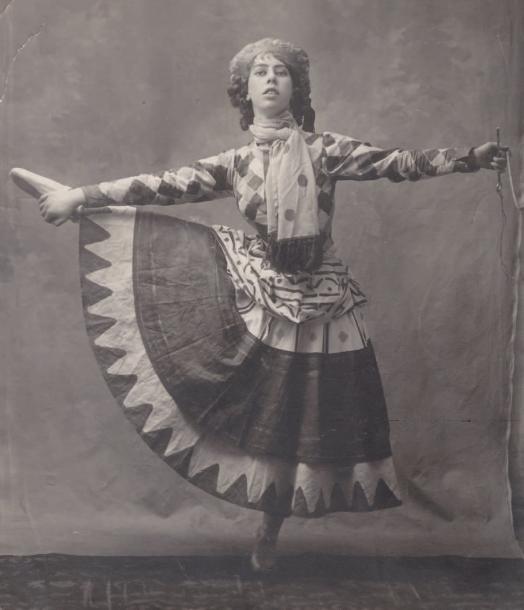
Photo: Attributed to Eugène Atget.
The great ballerina and choreographer Bronislava Nijinska performing in Stravinsky‘s Petrushka.

A sweet text message and a post on Facebook from my mentee reminded me early this morning that it’s International Women’s Day. With her example of accomplishment — and Suzanne’s and my daughter-in-law’s — an old-fashioned grandma like me is starting to pay attention to the issues behind the need for an International Women’s Day.

It isn’t news to me, of course, that women have long taken a back seat, but I have “leaned in” to the idea that one can make a virtue of invisibility. I’d make a good spy.

Even so, I feel a bit outraged that I’d never heard of the subject of today’s post, only her famous brother. Nadia Beard at the Calvert Journal enlightened me.

“Dancer and choreographer Bronislava Nijinska, a Minsk-born Pole, was an instrumental force in redirecting the choreographic cannon towards a vision of process and motion. Despite her pioneering choreography, Nijinska’s legacy is often overshadowed by that of her brother, ballet dancer and choreographer Vaslav Nijinsky. …

“The Nijinsky name, however, does not belong to him alone. In an era where static positions were the marrow of classical dance, Nijinska envisioned a modernist ballet, one which saw focus shift towards the movement which connected these positions.

Ultimately, she believed it was not the final posture that encapsulated the beauty of ballet, but the spaces in between.

“The daughter of two Polish dancers, Bronislava Nijinska was born in Minsk on 8 January 1891, and accompanied her parents to shows across provincial Russia even as a baby. It was through their parents that both Nijinska and her brother, Vaslav, first absorbed dance, learning movements outside of ballet’s traditional canon — Polish folk steps danced by her parents and acrobatics from the circus performers they met on their travels — which would influence the subversive, minimal choreography of their later years.

“Later in life, Nijinska’s contributions to performance and choreography would be dominated by her brother’s, but at the turn of the century, the pair both joined the Imperial Ballet School in St Petersburg, briefly graduating from the Imperial Ballet (now known as the Mariinsky) in 1908 before leaving together for Paris to join the Ballet Russe.

“The radical, itinerant ballet corp, founded by Russia-born arts impresario Serge Diaghlev, became legendary, a crucible for the radical performance that encapsulated the strange daring seen across the artistic spectrum of the time.

“Nijinska helped her brother choreograph some of the Ballets Russes’ earliest controversial works: L’Après-midi d’un Faune, premiered in Paris in 1912, and 1913 ballet Le Sacre du Printemps. Marriage and pregnancy precluded Nijinska from starring in some of Diaghlev’s ballets, much to the dismay of her brother, but where her brother’s creative life was cut short by deteriorating mental and physical health, Nijinska’s endured alongside family life, until she had made her mark on both sides of the Atlantic. …

“Her 1920s treatise on ballet, The School of Movement (Theory of Choreography), now lost to posterity, foregrounded the idea that movement is the essence of dance. Today this seems an obvious point, but it is so only because of the legacy of fringe luminaries like Nijinska; in early 20th century Europe, movement in dance was largely auxiliary, used in service to the final aim of achieving a complete position which could be held and admired. For Nijinska, motion became more important.”

More at the Calvert Journal, here, where you can watch a video of Nijinska’s dark choreography for Stravinsky’s Les Noces. Talk about women’s issues!

Read Full Post »

mana-lsw-08-644x1219_q100

Photo: Fred Hatt
Mana Hashimoto is a New York City–based contemporary dancer and choreographer who, despite losing her eyesight, is determined to keep dancing and making dance.

We all have obstacles that rise up in our lives, but for some of us, the obstacles are exceptionally daunting. That was true for the dancer in this story, who made up her mind that her career would not be lost when her eyesight was lost.

Victoria Dombroski interviewed her for Backstage.

“Mana Hashimoto is a New York City-based contemporary dancer and choreographer whose career has spanned from her native Tokyo to many stages worldwide. She also happens to be blind. After losing her eyesight due to optic nerve atrophy, she was determined to keep dancing despite the unexpected obstacle. Since then, she has dedicated her life to merging blindness and dance, and to create artistic works through the use of her remaining senses.

How did losing your eyesight change your trajectory as a dancer?
I trained as a classic ballet dancer and it’s very common that when you take class, you have to check in the mirror to see how you look. It becomes a sort of obsession and trap, consciously or unconsciously. I think it was a relief that I no longer had to see myself in the mirror, but instead be in the moment and be with myself and accept who I am physically, emotionally, and spiritually.

Were there certain things you learned about yourself as a dancer after losing your sight?
“I learned how to accept who I am, [to] be free, and to observe myself internally. It changed my perspective of what beauty is. Visual information can be overwhelming and we are shown what beauty should be instead of who you should be. …

What advice do you have for blind dancers and dancers with disabilities?
“I’m still a work-in-progress as a human being, but if I could advise something: keep enjoying dance. If there are some challenges, you can take them as opportunities to make your dance original. Any challenge is a door we didn’t expect we could open. …

What would you like to see more of in the New York dance community?
“I think more accessibility and openness to have visually impaired participants for workshops and classes. Once we have the right access, dance is open to anybody’s needs. I would also like to see more verbal description for dance performances. Before my performances, I invite visually impaired audiences to feel the space; they can touch and feel the props and costumes. …

What advice do you have for dancers encountering major setbacks in their dance career?
Hold onto your hope. I think it’s very important to share your difficulties along with your dreams.”

More here.

Read Full Post »

I read an article by Rebecca Milzoff in the NY Times recently that got me seeing people on the street in a new way.

Milzoff was interviewing a New York City choreographer about his latest work, and something he said stuck with me.

“ ‘I was assured when I came to live in this space on Broadway between Prince and Spring that SoHo would never come this far,’ David Gordon said, looking out the wall-to-wall windows in his second-floor loft. ‘Instead I now live in the Mall of America.’

“ ‘When I set foot out the door, there are so many people going in different directions,’ he said. ‘The choreography of the street is mind boggling.’ ”

Those words came back to me a couple days later as I waited for the morning train. There’s a point when bells start ringing because the gate is going down, and commuters stream across the parking lot with their briefcases and coffee mugs. On this particular day, they looked to me like dancers in a choreography of the everyday. The flow, the spacing between people suggested dance. The commuters had a special aura, partly because they had no consciousness of being in a dance performance.

I hope to be alert to other such happenings in the future.

It sure jazzes up the commute.

Photograph: Julieta Cervantes for The New York Times

Read Full Post »