Feeds:
Posts
Comments

Posts Tagged ‘choreography’

A NY Times article I saved from November 24, 2009, remains as inspirational as when I first read it.

In “Learning His Body, Learning to Dance,” Neil Genzlinger writes that “Gregg Mozgala, a 31-year-old actor with cerebral palsy, had 12 years of physical therapy while he was growing up. But in the last eight months, a determined choreographer with an unconventional résumé has done what all those therapists could not: She has dramatically changed the way Mr. Mozgala walks.

“In the process, she has changed his view of himself and of his possibilities.
Mr. Mozgala and the choreographer, Tamar Rogoff, have been working since last winter on a dance piece called ‘Diagnosis of a Faun.’ It is to have its premiere on Dec. 3 at La MaMa Annex in the East Village, but the more important work of art may be what Ms. Rogoff has done to transform Mr. Mozgala’s body.

“ ‘ I have felt things that I felt were completely closed off to me for the last 30 years,’ he said. ‘The amount of sensation that comes through the work has been totally unexpected and is really quite wonderful.’ ”

Choreographer Rogoff saw Mozgala perform the role of Romeo in a production by Theater Breaking through Barriers in March 2008 and knew she wanted to create a dance piece for him.

“Originally, [Ms. Rogoff] envisioned a simple study, maybe 10 minutes long. Mr. Mozgala’s expectations when he agreed to the project were equally narrow: he said that he thought that she would either merely create a dance that made use of the physical abilities he already had or, after seeing his limitations, tell him, ‘Thanks but no thanks.’ ”

It turned out that their expectations were way too narrow. Read more.

Photograph by Andrea Mohin at The New York Times shows Gregg Mozgala rehearsing with Emily Pope-Blackman.

Read Full Post »

Sunday evening I went over to Concord Academy to hear Seán Curran talk about how he creates choreography. Betsy, one of the dancers from his company, did a beautiful job of demonstrating what he meant.

As a little boy growing up in Watertown, Seán said, he waited eagerly for the mail that brought Look magazine. He liked to cut out pictures and make collages with them.

He says that his approach to choreography is similar. He arranges many snippets or dance phrases in different ways. His challenge is to edit down the many ideas so that the choreography doesn’t topple from too much weight.

I make collages, too. I have always liked the idea of taking a bunch of random things people have said and trying to make a play out of them, for example.

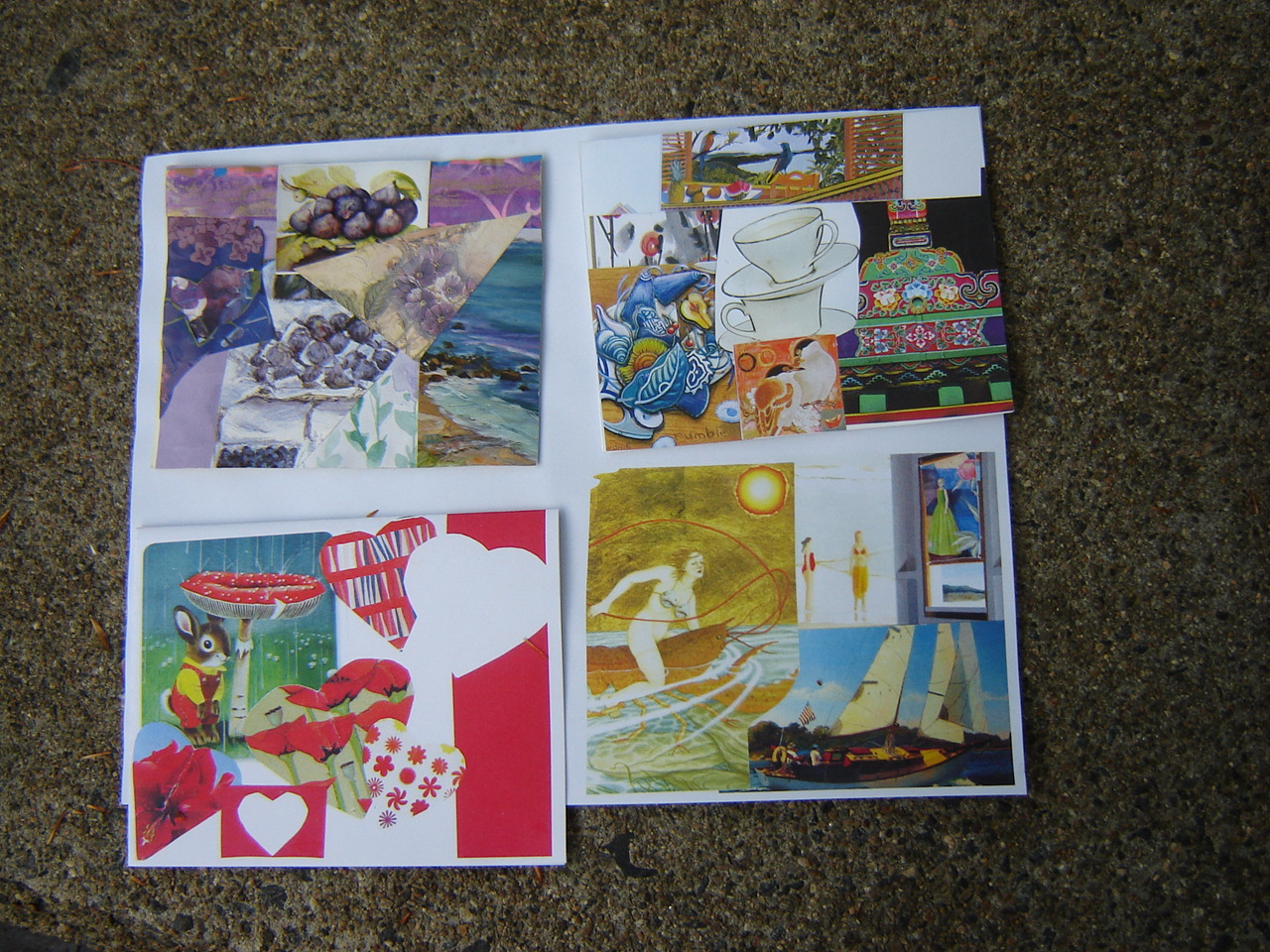
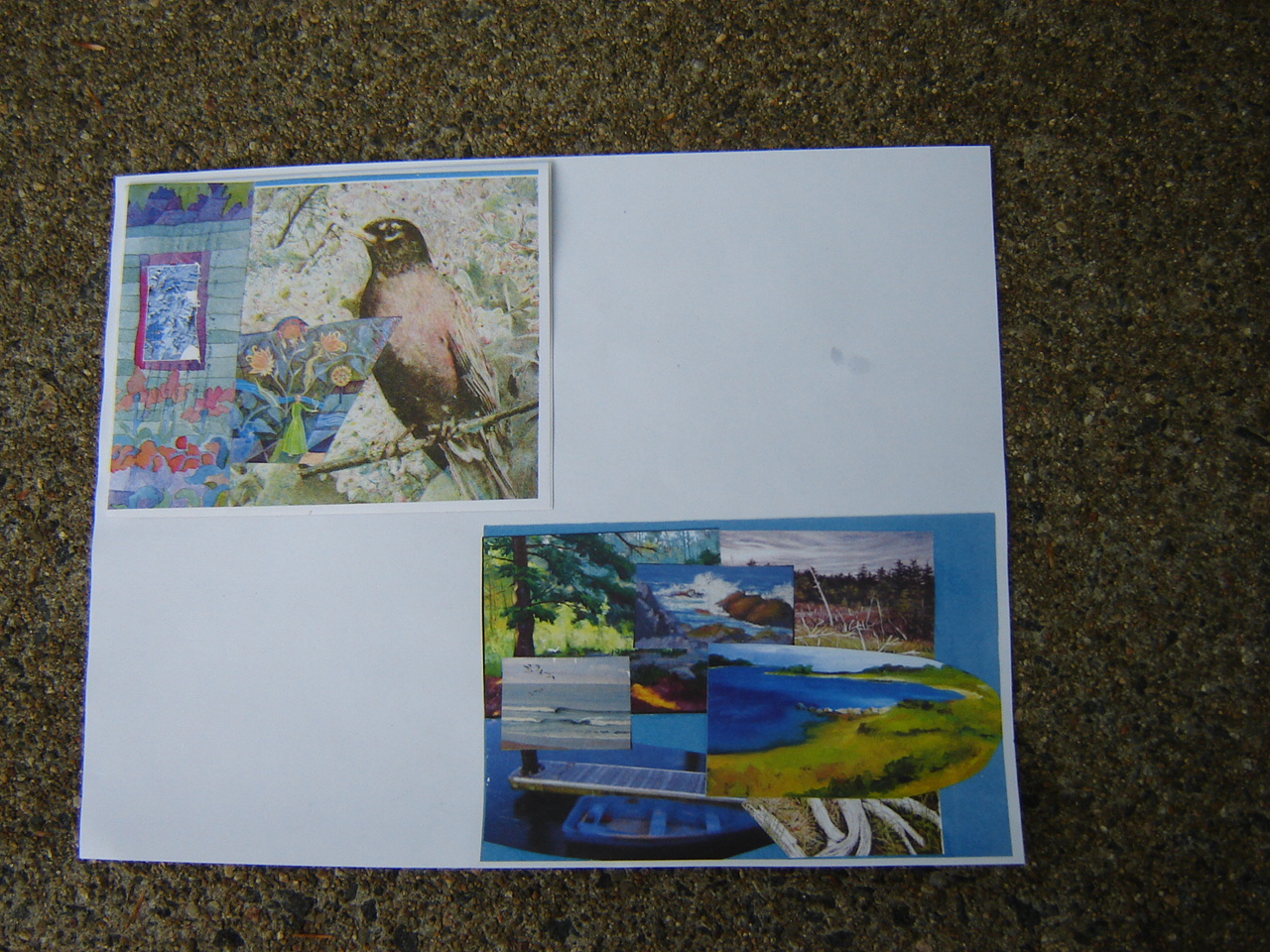
I also make collage greeting cards. I keep a box of promising pictures, cut from magazines and gallery postcards. I go through the whole pile and set aside maybe 20 items that somehow remind me of the person for whom I am making the card. Then I edit them down to the few pieces that will be best for the particular occasion.

All that happens before I cut the shapes and decide on how to arrange them. Sometimes I do a cutout of a cutout and put something else in the space: for example, I cut a vista out of a painting of a window and put a girl in the space (bottom right).

Here are examples.

Read Full Post »

I read an article by Rebecca Milzoff in the NY Times recently that got me seeing people on the street in a new way.

Milzoff was interviewing a New York City choreographer about his latest work, and something he said stuck with me.

“ ‘I was assured when I came to live in this space on Broadway between Prince and Spring that SoHo would never come this far,’ David Gordon said, looking out the wall-to-wall windows in his second-floor loft. ‘Instead I now live in the Mall of America.’

“ ‘When I set foot out the door, there are so many people going in different directions,’ he said. ‘The choreography of the street is mind boggling.’ ”

Those words came back to me a couple days later as I waited for the morning train. There’s a point when bells start ringing because the gate is going down, and commuters stream across the parking lot with their briefcases and coffee mugs. On this particular day, they looked to me like dancers in a choreography of the everyday. The flow, the spacing between people suggested dance. The commuters had a special aura, partly because they had no consciousness of being in a dance performance.

I hope to be alert to other such happenings in the future.

It sure jazzes up the commute.

Photograph: Julieta Cervantes for The New York Times

Read Full Post »

« Newer Posts