Feeds:
Posts
Comments

Posts Tagged ‘circus’

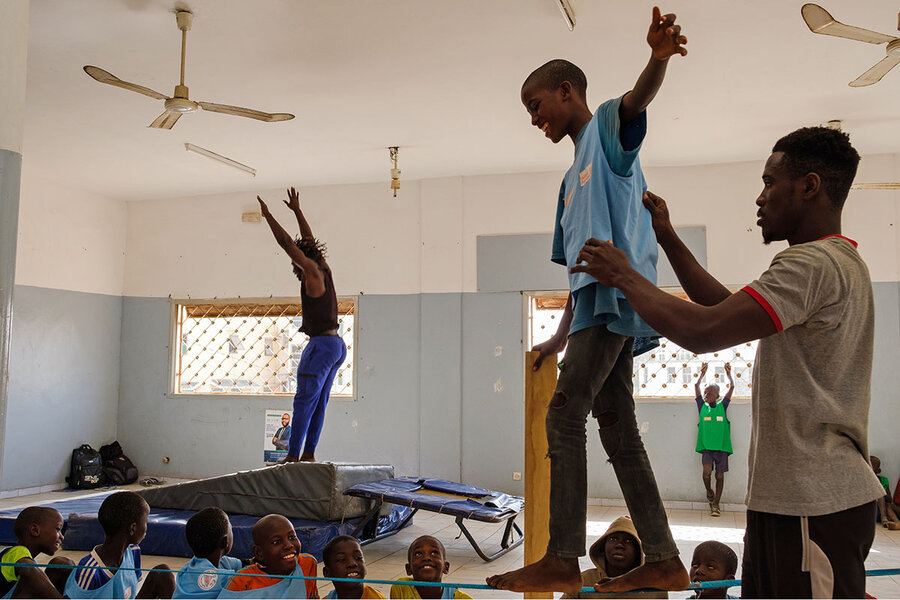
Photo: Guy Peterson.
A circus troupe offers hope to Senegal’s street children.

Poor children in Senegal often have a heartbreaking life, but one who rose above years of deprivation figured out a way to help others by sharing something that helped him. Today I’m drawing from three sources about what that was.

The BBC writes, “Every year, thousands of young Senegalese children are sent to the cities to study the Quran, only to find themselves forced into begging for money and food on the streets.”

DW.com reports about help coming from a man who was once one of their number. “In Senegal, circus skills were not really seen as a ‘proper’ or ‘respectable’ job. But that didn’t stop a former street beggar from founding Senegal’s first circus company in 2010. Today, Sencirk teaches circus acts to underprivileged kids. [The kids have even] represented Senegal with their juggling and acrobatic skills on the acclaimed TV show Africa’s Got Talent.”

Guy Peterson expands on the initiative at the Christian Science Monitor. “Under the shade of a dusty canvas tent in the sweltering heat, five men rehearse for a circus tour of France the following week.

“They make up Senegal’s only circus troupe, and each of them took long roads to get here, overcoming difficult childhoods, facing rejection by their families after they escaped abusive religious schools, and living on the street. …

“According to human rights groups, the talibés, as the boys are known, are vulnerable to exploitation and abuse from teachers. Talibés are forced to beg for money each day, and if their quota is not filled, they can be beaten and starved.

“Senegal has seen increasing youth unemployment, which leads many young adults to consider emigration if they can’t find opportunities at home. Sencirk helps them see those opportunities. 

“Modou Touré escaped [and] after taking up circus training in Europe, he returned to Dakar and founded Sencirk in 2006, providing free training to teens who escaped from their schools. The program allows them to work through traumatic experiences and to see paths toward a better future, whether that means working in the circus or reintegrating into society.

“An older performer and teacher at Sencirk, Sammi, explains, ‘We can teach them how to work together, how to grow, to believe in themselves.’ ”

According to the BBC, Sencirk’s founder “trained in Sweden for three months and toured with professional circus troupes around the world, before setting up the Sencirk tent in Dakar.

” ‘Circus is my therapy,’ says Mr Touré, now 31.

“The practice also assists him control his emotions and has the capacity to help others like him, he says.

” ‘It gives them confidence and helps them battle their demons.’ “

One 14-year-old trainee told the BBC, that “he loves everything about the circus: ‘It helps me learn and it makes me aware.’ …

“He hopes to join Sencirk as a full-time performer one day.

“Mr Touré’s troupe conducts regular free workshops at rescue homes for street children and women’s shelters to provide entertainment and identify talent.

” ‘It shows them they can go from the streets to making a living in the circus,’ Mr Touré says.

“Out of both necessity and the desire to preserve what they call the ‘Africanness’ of their shows, Sencirk uses locally found materials to make its equipment, such as trapezes, safety mats and juggling balls.

“Sencirk’s unique approach to circus is to share personal stories that other West Africans can relate to.

“One performance portrays the draws and dangers of clandestine migration to Europe. Another shares the experience of living as a talibé runaway.

“It’s a community built on resilience – a group of people working through shared trauma who are strengthened by their ability to overcome it together.”

More at the Monitor, here.
Read Full Post »

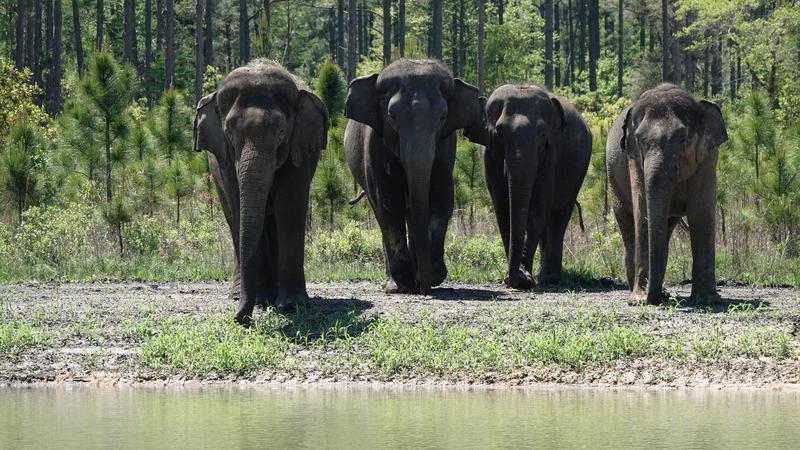
12 Asian elephants have arrived at White Oak Conservation.
Stephanie Rutan / Via White Oak Conservation

Because of the heat wave, I went out for my walk at 5:30 this morning, while it was still pleasant. I saw a bluebird, a couple rabbits, and a snapping turtle that crossed a bridge and launched herself 20 feet into the river. That was her choice.

The subjects of today’s story went a long time without having choices like the ones snapping turtles, wild rabbits, and bluebirds enjoy. Having spent many years doing tricks in the circus, they now reside at a 135-acre sanctuary where staff say they can hide for days at a time. Life is not completely natural, but it’s better than the circus.

Cathy Free reports at the Washington Post, “For about two decades, elephants that performed with the Ringling Bros. and Barnum & Bailey Circus were sent to a reserve in central Florida when they became too old to balance on two legs and parade around arenas doing tricks and dancing for large crowds. …

“In recent weeks, the former circus elephants have begun moving to a 135-acre sanctuary, one that is not affiliated with the circus that for years was accused of mistreating and abusing the gentle giants.

“Three weeks after being let loose in the White Oak Conservation center in Yulee, Fla., the first group of elephants has been exploring the new surroundings, and staff members say they don’t see some of them for days at a time. When they do spy the large animals, they say, they are swimming in the deep end of a pond or having a dust bath, followed by a nap in the shade. They also snack on watermelon and banana buffets.

“Employees say it was an emotional moment to watch the elephants walk out of their barn together for the first time into the lush acreage.

“ ‘There was more than one wet eye that day,’ said Michelle Gadd, who leads the White Oak preserve for endangered and threatened species such as cheetahs, rhinos, okapi, zebras and condors. …

“Ringling Bros. retired all of its elephants in 2016, ending a 145-year tradition, after pushback from the public about the pachyderms being forced to perform. … A year-and-a-half after the elephants were retired, the circus closed shop because of declining ticket sales. …

“Philanthropists Mark and Kimbra Walter arranged to purchase all 32 of the former Ringling Bros. elephants and have them transported 200 miles from Central Florida to Yulee, outside Jacksonville. The Walters bought the 17,000-acre White Oak sanctuary in 2013, and have been expanding it since. …

“Eventually, the elephant portion of the refuge will cover 2,500 acres and feature nine linked areas with enough water holes, forests, grasslands and wetlands to support the entire herd, said Nick Newby, 41, who leads the elephant caretaker team and helped plan the habitat.

“ ‘We wanted it to be as natural as possible, and we wanted to consider the social dynamic as well,’ Newby said. ‘Elephants are very sociable animals, so we like to study them, see what their personalities are like and then try to mix and match them with other elephants they might like to cohabitate with.’ …

“For Newby, who has worked with elephants for 18 years (mostly in zoos), there was a sense of elation as he watched the animals wander through their new home.

“ ‘It’s all about the elephants, so to see them out there doing natural elephant behaviors like swimming, was exhilarating and rewarding,’ he said. …

“Asian and African elephants are endangered in the wild because of loss of habitat and illegal poaching, [Gadd] said. The World Wildlife Fund estimates that there are about 415,000 elephants in Africa, while less than 50,000 remain in Asia.

“Wildlife conservation studies have shown that between 15,000 and 20,000 elephants are held in zoos or are still used by safari companies and circuses around the world. …

“Plans haven’t yet been developed for the public to view the elephants from afar, but Newby said the ultimate goal would be for somebody to look through a pair of binoculars at the White Oak refuge and feel as though they were watching elephants in their natural habitat.

“ ‘The gentle giants at the sanctuary are ambassadors for elephants in the wild,’ he said. ‘It’s our duty to make sure that their future is better than their past, and that their tomorrows are better than their yesterdays.’ ”

More at the Post, here.

Read Full Post »

The happy faces say it all. The circus is good for Baghdad.

An article by Michael S. Schmidt and Zaid Thaker in today’s NY Times describes the scene. “There were not any tigers because the animals were stuck in Egypt. There were dogs, however, but they were not [the promised] poodles. And the big snake, well, the snake had become sick and had to be evacuated …

“A circus coming to town may be a routine event in most cities. But in battered Baghdad, even if it was not the Greatest Show on Earth, the arrival of the circus was yet another small step in this city’s efforts at building a more normal life. …

“There is not a commanding ringmaster. What it does have, though, are dancers jumping rope, a woman swinging from a trapeze (without a net, but with a harness), and a grand finale of a man clad in an Iraqi flag plunging swords down his throat.  …

“Faisil Falleh, 56, who took his family to the circus on a recent night, said, ‘I haven’t seen anything in my life like this.’  …

“Promoter Jasim Mohammed Saeed said,  ‘Nobody is working in this business in Iraq. It is just us.’ ” Read more here.

If you want to go, it’s $12 for adults, $6 for teens, and free for children. The cotton candy — “lady’s hair” in Arabic — is $1.

Read Full Post »