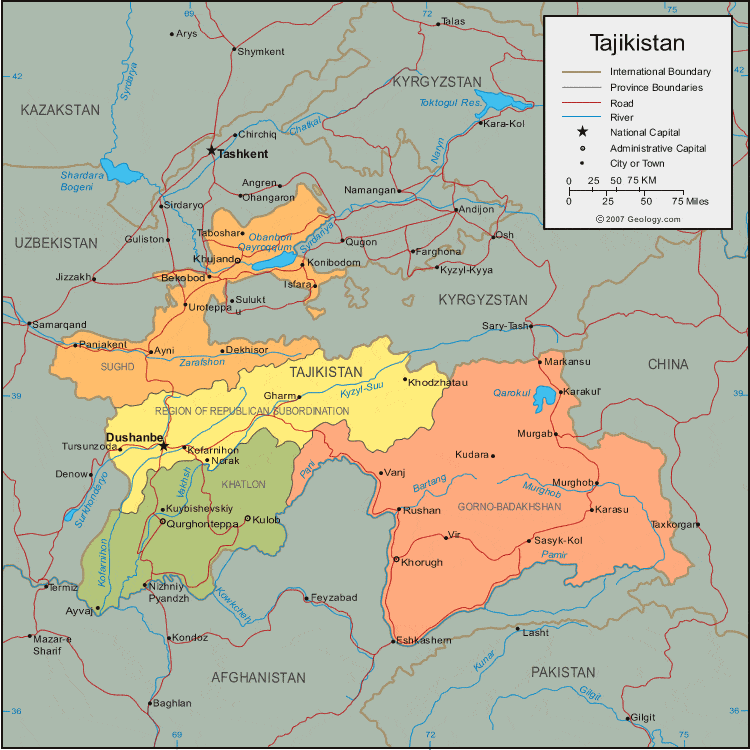
Do you mix up Tajikistan, Kyrgyzstan, Kazakstan, and Uzbekistan? I do. But while Americans go about their business completely unaware of those Central Asian countries, a vibrant culture flourishes there.
Every once in a while, I make an effort to learn something about the “stans” — for example, when I read a Uzbek novel, The Railway, a few years ago. Even that I found hard to follow.
Tara Pandeya is an American dancer who decided to immerse herself in the traditional dance of Tajikistan. She writes at Dance Magazine, “Two years ago, I was touring the world as a principal dancer in Cirque du Soleil’s production of Dralion. But after 1500 shows on a five-continent and 170-city tour, I left the commercial entertainment world to reconnect with the art form I’m most passionate about: Central Asian dance.
“I have dedicated the last 18 years of my life to dance styles from the Central Asian Silk Road region. My fascination started when I was 13 and fell in love with the miniature paintings of Central Asian dancers and the Arabic calligraphic script I saw in museums. …
“Months after leaving Cirque, I moved to Tajikistan. I had planned to stay for one month but ended up staying for a whole year and dancing as the first Westerner in Lola, the state-funded Tajik National Ensemble.
“The other dancers were confused, cautious and curious about me. In the beginning, I felt like a complete outsider. I was new to their culture, food and environment, and could not speak the language. My daily routine after a full day of rehearsals was to also take a private class to better understand the nuances of the different styles and to push myself technically. The other dancers observed my dedication, and over time I earned their trust and respect. …
“Sometimes I had issues getting into high security buildings because of my American passport, so our director had to start carrying a certified paper clearing me for entrance. We toured within the country on poorly-maintained roads via a bus provided by the state.
“There were rarely enough seats for all of us, and often the men would stand for long parts of the journey so the women could sit. …
“During rehearsal one day, a local journalist noticed me and, thinking I was Tajik, invited me to participate in a televised dance competition which brought together dancers from every region of the country.
“I made it through all four rounds of cuts and amazingly, I won. … I was stopped several times on the street by strangers — the produce guy at my local grocery store said he was excited to see me dance so beautifully in a style from his culture, and hoped that if a foreigner placed so much value on their art forms that local Tajiks would learn to appreciate these forms more themselves.
“This year, I was selected by Forecast, an international mentorship platform, to have my work produced in Berlin … [It will] express the concepts of migration, otherness and gender inequality.”
That interests me — especially as what I know of Tajikistan today is that it is a harsh dictatorship and dangerous to minorities. Anything that builds understanding among ordinary people has to be a step in the right direction.
More at Dance Magazine, here.

 Suzanne's Mom's Blog