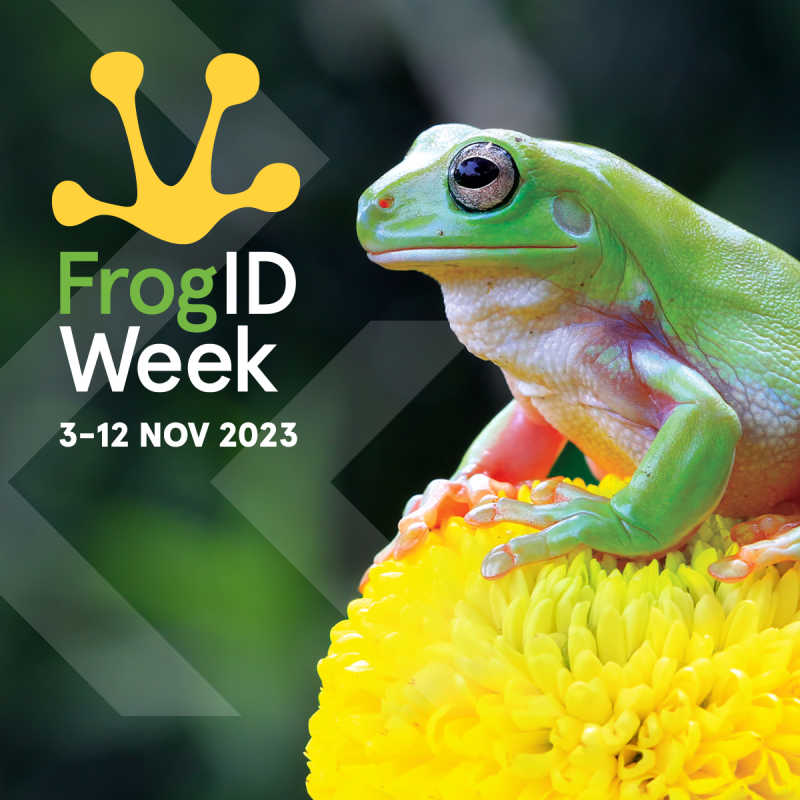
Photo: FrogID.
Sunday is the last day this year to submit your recording of a noisy frog for Australia’s special FrogID Week. But you can send in recordings year round. In southwestern Western Australia, for example, there are frog species that aren’t calling right now.
Crowdsourcing via the internet can be a great thing. In Australia, both children and adults are helping scientists conduct the annual frog census — sometimes discovering new species. This example of citizen science is spearheaded by the Australian Museum.
Ellen Phiddian reports at Cosmos, “People around Australia are once again being urged to head outside and record frog calls for FrogID Week, from 3-12 November 2023. Heralded as Australia’s biggest frog count, it’s an annual push for valuable data on Australia’s amphibians.
“ ‘This is a time of year when most frog species across Australia are breeding and calling,’ Nadiah Roslan, project coordinator of FrogID, tells Cosmos. ‘That call that we hear is actually a male frog calling out for a female frog. A majority of species – over 90% – will be calling now. So it’s a good time for us to get a snapshot of frog health and frog distribution across the continent.’
“Launched by the Australian Museum in 2017, FrogID is a free app that people can use to record frog calls. These recordings get uploaded to a Museum database, where trained listeners can identify the frogs.
“It builds on decades of citizen scientist frog recordings, which are a vital tool for ecologists to assess frog populations.
“It’s yielded a trove of data far bigger than any single team of ecologists could collect. Information from FrogID has been used to track declining frog numbers, study deadly chytrid fungus, and learn how frog calls differ.
” ‘We’re not sure how well we will go with it being an El Niño year. Frogs do like it when it’s more wet.’
“Many frog species will only call after rainfall, and they typically need wet conditions to breed. So we are expecting fewer frog calls, but hopefully thousands of submissions across every state and territory of Australia,’ says Roslan.
“Nevertheless, fewer frog calls than the past few wet years is still very valuable data.
“ ‘It’s important to get this year-on-year data and repeat recordings from locations to understand patterns and trends over time,’ says Roslan.
“Roslan says that everyone, even ‘frog novices,’ can contribute to the project. First, download the app on your phone or other smart device.
“ ‘Set up a free account so that our scientists can let you know what frog species you’ve recorded, and then go out at dusk or early evening – that’s when most frog species will call,’ says Roslan. …
“ ‘We do want as many recordings this week as possible, so [record] every day you can. Even if it’s the same frog calling. … Every call counts.’ “
I first heard this story at The World. You can listen here. There’s more information at the FrogID website, here, and at Cosmos magazine, here.
And the Australian Museum adds, “Students can join us for a free virtual excursion during FrogID Week and meet Dr Jodi Rowley online to learn about Australia’s frogs.”

 Suzanne's Mom's Blog