Feeds:
Posts
Comments

Posts Tagged ‘city planning’


Photo: NextCity
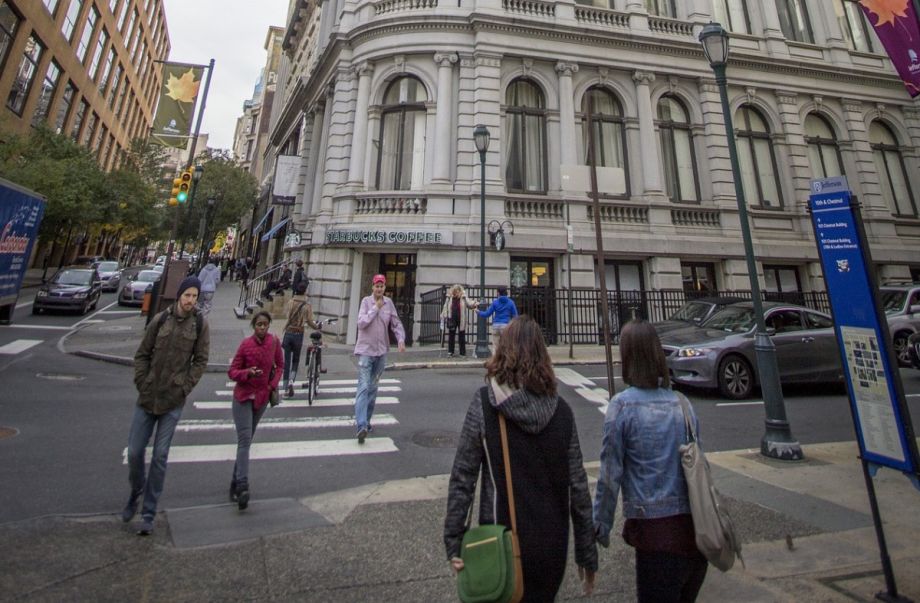
A Philadelphia street scene

The ideas of writer Jane Jacobs, well-known for her influence on city planning, continue to be tested. Is it true, for example, that having a lot of “eyes on the street” reduces crime? Jared Brey writes at NextCity about efforts in Philadelphia to find out.

“In the five-and-a-half decades since Jane Jacobs published The Death and Life of Great American Cities, her core contention — that urban vitality and safety are a function of small-scale density, a mixture of uses and ‘eyes on the street’ — has become conventional wisdom in urban theory. …

“In June, a team of researchers released a paper, titled ‘Analysis of Urban Vibrancy and Safety in Philadelphia,’ that attempts to begin a quantitative analysis of Jacobsian theory by bringing together publicly available data sets related to crime, business activity and the built environment. The study is the first of a series they have planned.

“In order to test the ‘eyes on the street’ notion, the authors — three statisticians at the Wharton School at the University of Pennsylvania and an architect — investigated the correlations between public safety and population density, population count, zoning, business activity, and business hours. They also designed a model of ‘business vibrancy,’ meant to serve as a proxy for Jacobs’ concept of eyes on the street, based on the density of businesses in certain areas and the amount of ‘excess business hours’ on them — meaning blocks with businesses open longer than what the authors calculated to be the citywide average. …

“Among the authors’ findings:

* Population density is not as strongly associated with crime rates as population count.
* More crimes occur on blocks with more businesses, but fewer in the direct vicinity of businesses that have longer-than-average operating hours.
* Crime rates are higher in neighborhoods with high rates of vacancy, but within high-vacancy neighborhoods, fewer crimes are reported in the direct vicinity of vacant properties. …

“ ‘What it says is measuring human activity is subtle and difficult,’ [co-author Shane Jensen, a statistics professor at Wharton,] says. ‘Yes, it does seem like there is something to this concept of eyes on the street, but I don’t think it’s just as simple as making sure that there’s businesses on every street corner and stuff like that. If anything, the more high-resolution you break this down, the more insight you can glean.’ ” More at NextCity.

Here’s my question: as online shopping causes retail storefronts to close, how do we preserve any “eyes on the street” at all?

Read Full Post »

congress st nook

The City of Boston has a nice opportunity for folks with ideas about making cities more livable.

The City says, “In Boston, a third of the land is open to the public. We invite you to reimagine that space. How can our streets, plazas, sidewalks, street furniture, and public buildings better serve people?

“The Mayor’s Office of New Urban Mechanics Streetscape Lab is sourcing ideas from designers, makers, artists, and engineers to improve Boston. We are asking members of our vibrant creative community to submit project ideas to make our public spaces simple, intuitive, and literally awesome. Project ideas can be entirely new creations or a new way of using an existing product. The City will review the submissions and may select up to six ideas total to implement in the following categories:

“The Streetscape: sidewalks, streets, medians, plazas, and our other civic front porches. What improvements would you make to space? What is the next iteration of our classic street furniture? Look at the sample locations to get you thinking.

“Boston City Hall: rethinking the indoor and outdoor space, signage, improving service delivery and the user experience. These designs may help inform future improvements to the building.

“Random Awesome Designs: great ideas that defy classification or location.” Guidelines here.

I see no reason you have to be an artist or an engineer. What’s to stop you from sending in a good idea? Go for it.

Dewey-Sq-_farmers_market

providence author lovecraft

Read Full Post »

Brian sent me information about Higher Ground Farm, which is putting down roots on the roof of the Design Center in South Boston.

“A roof farm is a type of green roof. A green roof is a system of layers that is laid over an existing roof. A green roof is beneficial to a building owner and the community because it protects the existing roof, doubling to tripling its life, thereby saving money and keeping materials out of the landfill.

“Green roofs also reduce a building’s energy costs by insulating in the winter and cooling the rooftop in the summer. Finally, green roofs temper the effects of two common urban environmental problems – combined sewer overflow and the urban heat island effect.

“A series of roof farms throughout the city will capitalize on the environmental benefits of green roofs while also increasing access to fresh, healthy food. Higher Ground Farm will operate several roof farms throughout the greater Boston area, utilizing previously unused space while providing additional rental revenue to a building owner.

“Roof agriculture has the potential to be a job-producing boost to the economy, and a completely environmentally sustainable business sector that can set Boston apart from other cities. Higher Ground Farm will utilize the resources of our top-notch universities to study roof agriculture, which will position Boston as a leader in the field. Finally, Higher Ground Farm will be a space where our community can reconnect to productive green space and learn about sustainable city planning.” More.

I also found a video interview about it that you will like, here.

Read Full Post »

From the Boston Globe comes a curious bit of research suggesting that videogames may allow people to “burn off the desire or the time to commit a crime.” Across U.S. counties from 1994 to 2004, a greater number of videogame stores is associated with less arson, car theft, robbery, and mortality.

Don’t you love counterintuitive findings like that? Does it mean that fantasy (or “Queen Mab” as Charles Dickens contended in Hard Times) continues to play a valuable role in our lives?  Read about the research here.

And while we are on the subject, the Innovators Insights listserv linked to an article on how playing a videogame has assisted city planners in their work.

“IBM has partnered with the Environmental Protection Agency to develop CityOne, a game simulation that provides city planners with an interactive tool to help them investigate complex energy and water interactions, learning how best to achieve certain performance goals under budget. Outside of the U.S., the tool has been used by governments in China, France, and South America.” Read more here.

These are just a couple examples. As Jane McGonigal, the author of Reality is Broken has written, today videogames are being used to “change the world.”

Read Full Post »