Feeds:
Posts
Comments

Posts Tagged ‘civil rights’

Photo: AFP via Getty Images.
Civil rights leader Martin Luther King Jr. addresses the crowd at the Lincoln Memorial in Washington, D.C., where he gave his “I Have a Dream” speech on Aug. 28, 1963, as part of the March on Washington.

On Monday, January 20, we celebrate the birth of civil rights hero Martin Luther King Jr. although his actual date of birth is January 15. Most national holidays in the US get moved to a Monday to create a long weekend. The only two exceptions I can think of are July 4, Independence Day, and November 11, Veterans Day.

I want to tell readers from other countries about MLK Jr. And there are details that many Americans don’t know either. I, for one, had no idea he was originally named Michael! Doesn’t have the same ring to it, does it?

From Wikipedia: “Martin Luther King Jr. (born Michael King Jr.; January 15, 1929 – April 4, 1968) was an American Baptist minister, activist, and political philosopher who was one of the most prominent leaders in the civil rights movement from 1955 until his assassination in 1968. King advanced civil rights for people of color in the United States through the use of nonviolent resistance and nonviolent civil disobedience against Jim Crow laws and other forms of legalized discrimination.

“A black church leader, King participated in and led marches for the right to vote, desegregation, labor rights, and other civil rights. He oversaw the 1955 Montgomery bus boycott and later became the first president of the Southern Christian Leadership Conference (SCLC).

“As president of the SCLC, he led the unsuccessful Albany Movement in Albany, Georgia, and helped organize some of the nonviolent 1963 protests in Birmingham, Alabama. King was one of the leaders of the 1963 March on Washington, where he delivered his ‘I Have a Dream‘ speech on the steps of the Lincoln Memorial, and helped organize two of the three Selma to Montgomery marches during the 1965 Selma voting rights movement. The civil rights movement achieved pivotal legislative gains in the Civil Rights Act of 1964, the Voting Rights Act of 1965 [now dismantled by the Supreme Court], and the Fair Housing Act of 1968. There were several dramatic standoffs with segregationist authorities, who often responded violently.

“King was jailed several times. Federal Bureau of Investigation (FBI) director J. Edgar Hoover considered King a radical and made him an object of the FBI’s COINTELPRO from 1963 forward. FBI agents investigated him for possible communist ties, spied on his personal life, and secretly recorded him. In 1964, the FBI mailed King a threatening anonymous letter, which he interpreted as an attempt to make him commit suicide. On October 14, 1964, King won the Nobel Peace Prize for combating racial inequality through nonviolent resistance. In his final years, he expanded his focus to include opposition towards poverty and the Vietnam War.

“In 1968, King was planning a national occupation of Washington, D.C., to be called the Poor People’s Campaign, when he was assassinated on April 4 in Memphis, TennesseeJames Earl Ray, a fugitive from the Missouri State Penitentiary, was convicted of the assassination.” More.

On that April morning in 1968, I was driving to work in the same town where, three years later, there was an FBI office break-in that uncovered government malfeasance. I was listening to the radio, when I heard King had been assassinated. I was so sad. Scared, too, about what was happening to our country, because political assassinations seemed to be becoming a trend. Maybe we would always have to expect and somehow deal with them.

It was a turbulent time, with Americans against Americans with regard to the Vietnam War. I remember attending community discussions in which the personal vitriol took my breath away.

Nowadays, I try to remember that we got through that and can get through other things.

Read Full Post »

Photo: Lenora Chu.
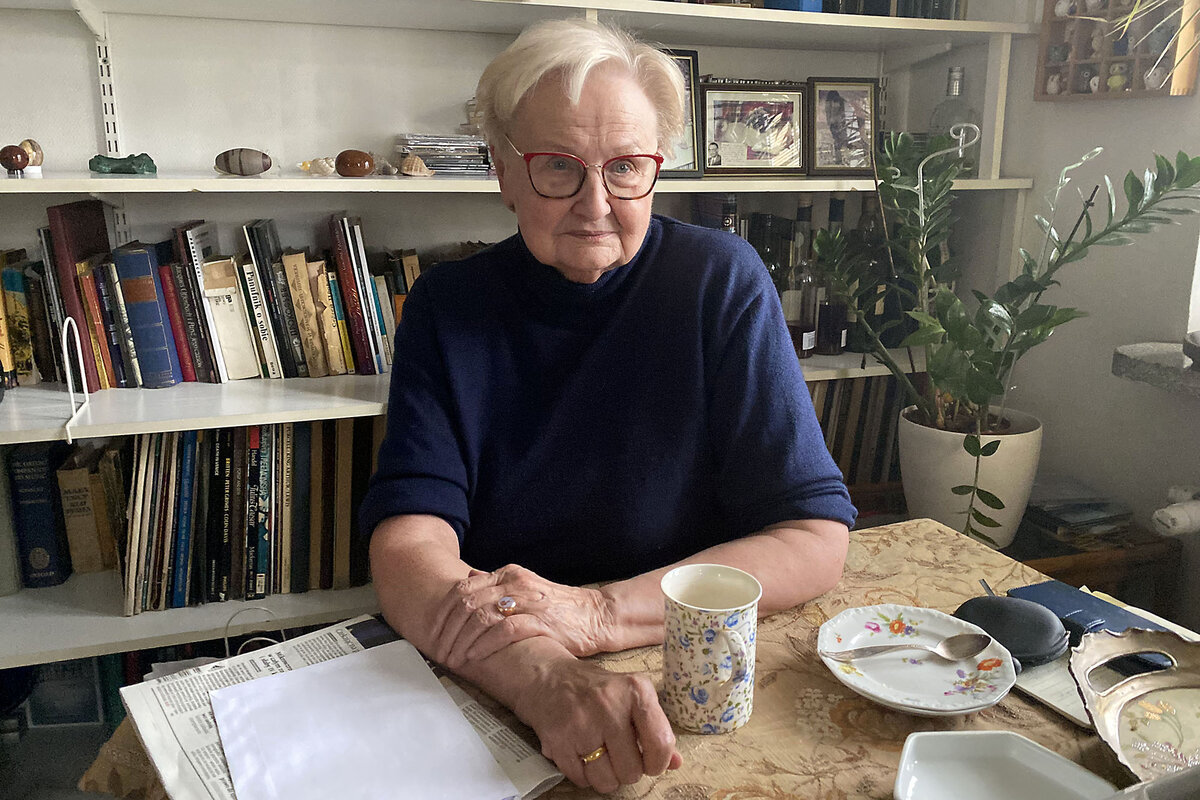
Ewa Łętowska, the elder stateswoman who helped build the legal framework of democratic Poland after communism, sits in her Warsaw flat last February.

Never underestimate the power of a woman. It may be under the radar, but woe to those who think they can always manipulate the quiet ones.

Lenora Chu of the Christian Science Monitor recalls, “It was late fall of 1987 in Poland, and the economic and social forces here were fueling tremors that would eventually fell communism across the Soviet bloc.

“Among a group of influential men – law professors – at a dinner party one evening was a Communist Party member brainstorming how to throw a bone to pro-democracy activists. The group was tasked with floating a name for a human rights ombudsman; that of legal scholar Ewa Łętowska kept surfacing. A devoted academic who had pumped out two decades of legal research on topics as benign as consumer protections and contract law, she was a respectable but safe choice.

“ ‘They said, “We want a woman, because women might be easier to manipulate,” ‘ Ms. Łętowska says in an interview in her Warsaw flat, lined floor to ceiling with books and opera records. She laughs at this memory that she possesses only because her lawyer husband was among the men feasting on schnitzel at that monthly table for regulars.

“If it was a wallflower they wanted, it turned out to be a miscalculation of historic proportion: They launched a stateswoman.

“Her trajectory as Poland’s top human rights thinker, she says, started ‘loudly, and with a bang’ when she was named the country’s human rights ombudsman soon after the dinner party, pioneering the balance between the state and the individual in the waning days of communism.

“She was an accidental influencer who, four decades later, now in her 80s, is a sought-after talking head, issuing viral social media posts about democracy. And when voters sent their right-wing government packing last October, a coalition of progressives turned to the wisdom and experience of Ms. Łętowska and her contemporaries.

“They’re looking for help to fix Poland’s institutions after the populists turned the country away from the European Union, rolled back civil rights such as abortion, took over the media and judiciary, and questioned the country’s humanitarian aid duties.

” ‘Ms. Łętowska’s value to Polish society cannot be overstated, says Helena Chmielewska-Szlajfer, a sociologist and assistant professor at Koźmiński University. ‘She’s a living legend, and she has the authority of this wise, powerful woman who set the institutions right in the beginning. She worked on this at a time it was the hardest – the intermediary stage between communism and democracy. And she still has much to say.’

“In 1980, the world saw burly Solidarity unionist Lech Wałęsa leading a revolt against communist authorities for worker rights – and eventually winning a Nobel Prize for it. But it was the progressive technocrats quietly blooming in that politically fertile time who did the less spectacular but essential work of building a democratic legal framework.

“Until then, Ms. Łętowska had forged her career as an impartial civil law professor, neither courting the communist regime nor joining the opposition. [She] now confidently says she … ‘was a state official to society, who brought more dialogue, more transparency. At the same time, I didn’t want a political future.’

“In an era when one didn’t easily trust one’s neighbor, there was little subversive in her ‘good girl’ youth to suggest she would emerge a strong voice for human rights and democracy. … On rare study trips abroad — few Polish scholars were trusted to leave the country — she might use German colleagues’ photocopiers to reproduce expensive legal tomes, like handbooks and casebooks on human rights law. …

“After law school in the 1960s, she published articles about civic law issues, rising through the ranks as a professor at the Polish Academy of Sciences’ Institute of Law Studies.

“A trip to the West – Hamburg, Germany – in the early 1980s was a turning point. She happened upon a demonstration by feminists. … From the other side of the street, she could see citizens hurling insults at the women.

“ ‘And in between you could see a line of police, with stone faces making sure no one gets hurt, being completely indifferent, and providing this space for demonstrating,’ says Ms. Łętowska. ‘It was the first time in my life I saw police not beating demonstrators – but rather protecting them. This is how I finally understood how things should be.’

‘The people of Hamburg would never know how much credit they should take, quite by accident, in my education,’ she says.

“Half a decade after that trip, she was named Poland’s first human rights official, judging the conduct of the state toward its citizens. … Should political parties have to register with the state? No, she famously wrote in 1988, when Poland was still under communist rule: ‘The constitution stated clearly: if parties want to form, let them form. Registration is required only for associations.’ …

“After the communist regime fell in 1989, she found herself among the legal scholars helping to modernize the Polish Constitution.”

More at the Monitor, here. Piotr Żakowiecki contributed to this report.

Read Full Post »

Who could resist a children’s book called Preaching to the Chickens? Maria Popova at Brainpickings, my favorite source for children’s book recommendations, wrote about it just before Christmas.

Popova said, “Civil rights icon and nonviolent resistance leader John Lewis (b. February 21, 1940) is rightly celebrated as a true ‘healer of the heart of democracy.’ He is also a testament to how the humblest beginnings can produce lives of towering heroism. Long before Congressman Lewis became a key figure in ending racial segregation in America, little John was one of nine siblings living on the family’s farm in southern Alabama. It was in that unlikely environment, heavy with labor and love, that young Lewis found his voice as a leader.

“Writer Jabari Asim and illustrator E.B. Lewis tell the improbable and inspiring origin story of this largehearted legend in Preaching to the Chickens: The Story of Young John Lewis. …

“One day, John is put in charge of the chickens and so begins his foray into leadership. His heart ablaze with the dream of becoming a preacher, the boy begins practicing before his willing — or, at least, tacitly agreeable — avian audience. E.B. Lewis’s luminous watercolors are the perfect complement to Asim’s lyrical prose, which together carry the story of how John Lewis incubated his talent for wielding words that move and mobilize mind, body, and spirit.”

Read more at Brainpickings, here. Popova, as usual, suggests other books that would make a good complement to this one.

Art: E.B. Lewis
A young John Lewis hones his oratory.

Read Full Post »

A November NY Times had this article on some activist nuns.

“Sister Nora Nash of the Sisters of St. Francis of Philadelphia. And the slight, soft-spoken nun had a few not-so-humble suggestions for the world’s most powerful investment bank.

“Way up on the 41st floor, in a conference room overlooking the World Trade Center site, Sister Nora and her team from the Interfaith Center on Corporate Responsibility laid out their advice for three Goldman executives. The Wall Street bank, they said, should protect consumers, rein in executive pay, increase its transparency and remember the poor. …

“Long before Occupy Wall Street, the Sisters of St. Francis were quietly staging an occupation of their own. In recent years, this Roman Catholic order of 540 or so nuns has become one of the most surprising groups of corporate activists around.

“The nuns have gone toe-to-toe with Kroger, the grocery store chain, over farm worker rights; with McDonald’s, over childhood obesity; and with Wells Fargo, over lending practices. They have tried, with mixed success, to exert some moral suasion over Fortune 500 executives, a group not always known for its piety.

” ‘We want social returns, as well as financial ones,’ Sister Nora said, strolling through the garden behind Our Lady of Angels, the convent here where she has worked for more than half a century. She paused in front of a statue of Our Lady of Lourdes. ‘When you look at the major financial institutions, you have to realize there is greed involved.’ ”

Read more here.

Sometimes it just takes a few small voices to verbalize what everyone has noticed and get the ball rolling.

I was thinking about that today as I read an essay by a student at my old girls high school. She had interviewed me and another of my classmates for her history (!) class, and she captured the importance I placed on my tiny role in helping my school desegregate. All I did was ask the headmistress why there were no black girls in the school (I think in the 1960s I would have said “Negro”). I believe that it was because of questions like that and her own natural inclinations — not to mention what was going on in the nation — that she took action.

At the time, I thought asking a question was pretty small potatoes, but now I think that if lots of people do a small thing, it can be big.

Read Full Post »