Feeds:
Posts
Comments

Posts Tagged ‘clay’

Photo: J. Przedwojewska-Szymańska / PASI.
The head of the male figurine is decorated with tattoos or scarification. Made between 410 and 380 B.C.

Here’s a story to tickle the frustrated archaeologist in you. I say “frustrated” because I’m not aware of any actual archaeologists who follow this blog, but many of us find the mysteries of of the field fascinating.

Sonja Anderson wrote recently at the Smithsonian about the excavation in El Salvador of “puppets that resemble modern toy dolls” with movable parts. They look like humans, but creepier.

“Researchers have discovered a trove of ancient clay puppets at an archaeological site in El Salvador, ” Anderson reports. “The five carved figurines are about 2,400 years old, and they may help shed new light on an ancient Mesoamerican society.

Jan Szymański and Gabriela Prejs, two archaeologists from the University of Warsaw, discovered the artifacts atop a ruined pyramid at the site of San Isidro. As they write in a new study published in the journal Antiquity, the items are known as Bolinas figurines: rare puppet-like artifacts that have been found in other ancient Central American sites, such as the early Maya site Tak’alik Ab’aj in Guatemala.

“All of the recently discovered Bolinas figurines have open mouths. The two smallest puppets measure around four inches and seven inches, while the other three stand at about a foot tall. These larger figurines have detachable heads and small holes in their necks and craniums. As the researchers write, this allows for ‘a string to be passed through the neck and tied on the top of the head.’ …

“Compared with neighboring countries, El Salvador’s pre-Columbian history is poorly understood, according to a statement from Antiquity. Excavations are challenging due to the country’s high population density, and volcanic eruptions over thousands of years have damaged and buried archaeological sites.

“ ‘Very little is known about the identities and ethnolinguistic affiliations of the creators of ancient settlements that predate the arrival of Europeans in the early 16th century,’ Szymański says in the statement. ‘This gets worse the further back in time we look.’

“The San Isidro site is a complex of mostly clay structures built by an unknown group, and it remains largely unexcavated. The researchers found the Bolinas figurines while digging at the top of the site’s largest pyramidal structure. Through carbon dating, they’ve concluded the five figurines were made between 410 and 380 B.C.E. [Before Current Era].

“ ‘This finding is only the second such a group found in situ, and the first to feature a male figure,’ Szymański says in the statement. The male puppet sports what appear to be facial tattoos, and the other four are female.

“The researchers think that these versatile Bolinas figurines could have been used during ‘rituals that would involve recreation of some actual events or mythical events,’ Szymański tells IFL Science’s Benjamin Taub.

“ ‘In Mesoamerican thought, still visible today, to recreate something was to actually create it,’ he adds. ‘So if a ruler decided to commission a sculpture of himself, he was effectively cloning himself, allowing himself to look over his people even when he was away.’ …

“Figurines like these have been found in Guatemala and elsewhere in El Salvador, and jade pendants unearthed nearby resemble similar artifacts discovered in present-day Nicaragua, Panama and Costa Rica, per the statement. As such, the ancient inhabitants of San Isidro may have been connected to distant peoples.

“ ‘This discovery contradicts the prevailing notion about El Salvador’s cultural backwardness or isolation in ancient times,’ Szymański adds. ‘It reveals the existence of vibrant and far-reaching communities capable of exchanging ideas with remarkably distant places.’ ”

Reading this story, I kept thinking about a clay figure from a completely different culture, the golem. Wikipedia says the golem “is an animated anthropomorphic being in Jewish folklore, which is created entirely from inanimate matter, usually clay or mud. … In modern popular culture, the word has become generalized, and any crude anthropomorphic creature devised by a sorcerer.”

There must be something in human nature that needs to invent these creatures.

More at the Smithsonian, here. No firewall.
Read Full Post »

Photo: Aardman/Netflix.
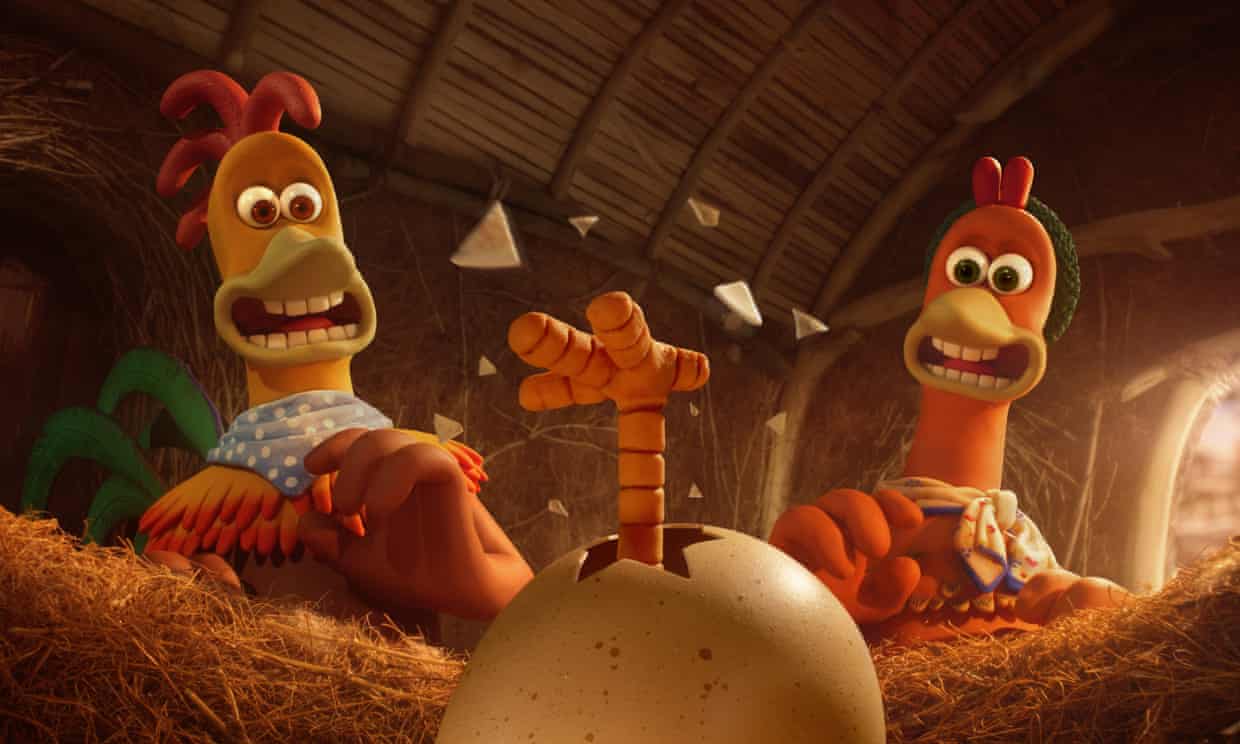
A still from Chicken Run: Dawn of the Nugget. The Wallace and Gromit studio reassures fans over rumors of a clay “shortage.”

Here’s a kind of antidote to all the serious things one worries about these days. I myself am an Olympic worrier. For example, when Suzanne went to live in New York after college, I made a little notebook for her, starting with “Things to Worry About in New York City.” (I don’t think it infected her much.)

These days, I worry about the health of people I care about, the war in the Middle East, climate change, the increase in authoritarian governments, Covid, the meanness of our political divide, plastic in the ocean, homelessness, Bangladesh, Burma, Sudan, Ukraine, hungry children, income inequality. And when I don’t know what is going on or why something is happening in my own life, I revert to a childhood way of coping by making up scenarios that are usually off base. Like my scratchy eye means I’m going blind.

So I was delighted to see that there are silly things to worry about. Couldn’t they become a kind of self-inoculation? I guess they would still have to be regarding something you actually cared about. A nice example today is the worry that Wallace and Gromit claymation fans indulged in when they thought there might be a shortage of clay.

Andrew Pulver has the story at the Guardian, the “Wallace and Gromit studio, Aardman Animations, has reassured its fans, and the film industry at large, that production of its popular films will not be grinding to a halt any time soon, saying ‘there is absolutely no need to worry.’

“After reports that the manufacturers of Aardman’s favored modeling clay had gone out of business, meaning the animators had enough supplies for only one more film, Aardman issued a statement on social media saying: ‘We are touched about recent concern over the future of our beloved clay creations, but wanted to reassure fans that there is absolutely no need to worry.’ …

” ‘We have been tinkering away behind the scenes for quite some time with plans in place to ensure a smooth transition to new stocks to continue to make our iconic productions.’

“Aardman is shortly to release Chicken Run: Dawn of the Nugget, a sequel to its hit poultry comedy from 2000, while it is still in production on a new Wallace and Gromit feature, due for release in 2024.” More at the Guardian, here. No paywall.

That’s one worry that can be put to bed. … But wait! The Guardian goes on to say, “In 2005 Aardman lost much of its archive material in a warehouse fire in Bristol.” What? Oh, no!

Read Full Post »

Photo: Pontifical Marinelli Bell Foundry.
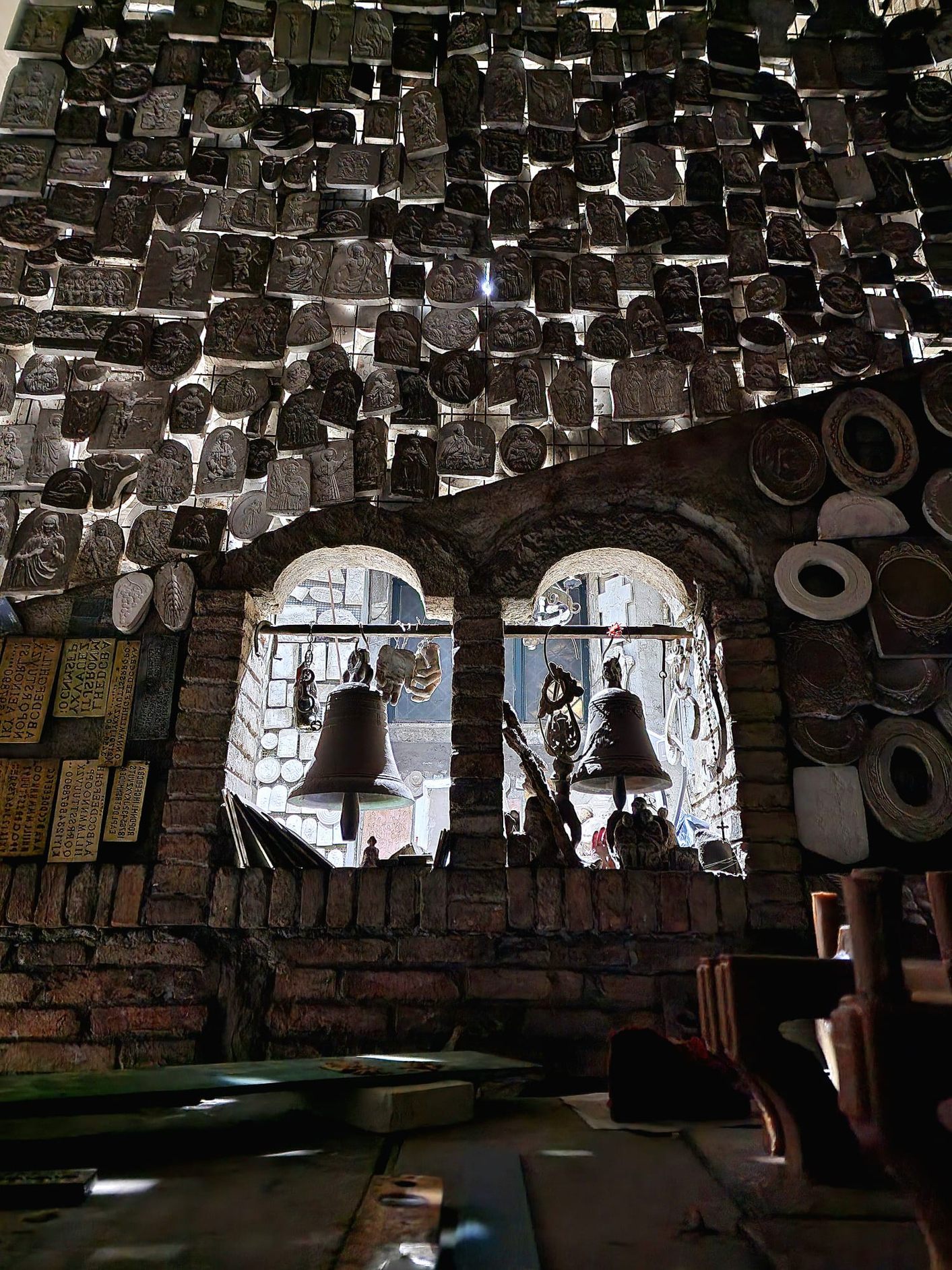
One family has been making bronze bells for over 1,000 years in the Molise region of southern Italy. The bells can be seen in the Marinelli Bell Museum. 

My brother the business writer has made a study of companies in America with impressive longevity. For example, the Hollingsworths of Hollingsworth Vose were granted a patent to manufacture paper from manila fibers in 1843, but my brother says they go back to the time of George III.

Be that as it may, the Italian family in today’s story has been in business even longer.

Asia London Palomba writes at Atlas Obscura that Pasquale Marinelli is “a bell artisan in Italy. Pasquale and his brother Armando are the 26th generation of a family who has been crafting handmade bells since the middle ages. Pouring scalding-hot liquid metal into carefully designed molds, the two sweat over glowing embers, working with 10 centuries worth of knowledge in order to spread a medieval chime around the world.

“Naturally, such historical work is done in an ancient town called Agnone. Located in Italy’s isolated and rugged southern region of Molise, the quiet stone village lies squarely in a mountainous valley, where green hills roll into each other like waves and hay barrels freckle the land like drops of gold. It’s here, teetering at the top of a rocky outcrop, where you’ll find the two brothers working in the Pontifical Marinelli Bell Foundry, which, appropriately, is the oldest family-run business in Italy and among the oldest in the world.

“The Marinellis have been handcrafting bronze bells since at least the 11th century, although archaeological findings at nearby Benedictine monasteries suggest the Marinellis’ craft could date as far back as the 9th century.

“ ‘The same techniques and models, everything from A to Z, have been the same for the last 1,000 years,’ notes Armando. ‘Deviating from these methods that have been passed down throughout the generations means shutting the door on 1,000 years of history.’ …

“Their ancestor Nicodemo Marinelli, for whom they have historical documents … is documented to have been crafting bells in an era when the sonorous instrument had a greater, even primary role in society. ‘Bells were the first mass media. They heralded the salient moments of the day: to call people to work, for lunch, to return home from work. They were a way of telling time, of warning people,’ notes Pasquale.

“For almost its entire history, the foundry and its artisans were mobile, moving around to forge bells wherever there was demand. ‘We were like nomads,’ explains Armando, ‘living away from home for months alongside the tratturi, which were like the highways of antiquity.’ …

During World War II, Nazi troops seized many of the family’s historic bells and melted them down to create cannonballs.

“The brothers’ grandfather managed to bury some of the business’ most important bells underground, which were eventually recovered after the war, although Armando suspects there still may be a handful forgotten beneath the town’s earth. …

“A Marinelli bell is made with three cups stacked within each other — think of them as Russian nesting dolls. The first cup, called the ‘soul,’ is the internal part of the bell and is created by laying brick fragments upon each other and wrapping them together with iron string. This is slathered in a thick layer of clay, then wax, and then even more clay to create the second cup, named the ‘false bell,’ which will eventually be destroyed to make way for the bronze product. Smoldering coals are poured inside these two structures to bake the clay and melt the wax from the inside out.

“Hand-drawn wax molds are then cast onto the exterior of the false bell. ‘This is a very important step, because once its realized in bronze, it’ll live on for centuries in a church or a community,’ explains Armando. While almost everyone in the family partakes in the decoration process, this work falls primarily on Ettore Marinelli, Armando’s 31-year-old son and part of the 27th generation of artisans. Also a talented bronze sculptor, he works mainly in the artist’s hall. … ‘I was practically born in the foundry. I was already molding clay at the age of three,’ says Ettore.

“The soul and decorated false bell are then covered in more clay to create the third and final cup, called the ‘mantle.’ Once dry, the mantle, with the wax designs embossed into it, is lifted and the false bell is destroyed by hand with a hammer. A bronze alloy, spiced with a smattering of tin, is heated to 1,200 degrees Celsius (roughly 2,192 Fahrenheit) and poured into the bell mold, now consisting only of the mantle and the soul, while a priest blesses the process with a sprinkling of holy water. When the alloy hardens, the mantle is broken apart with a hammer to release the bronze bell, which is then polished until it shines.”

More at Atlas Obscura, here. No paywall. Lovely photos.

Read Full Post »