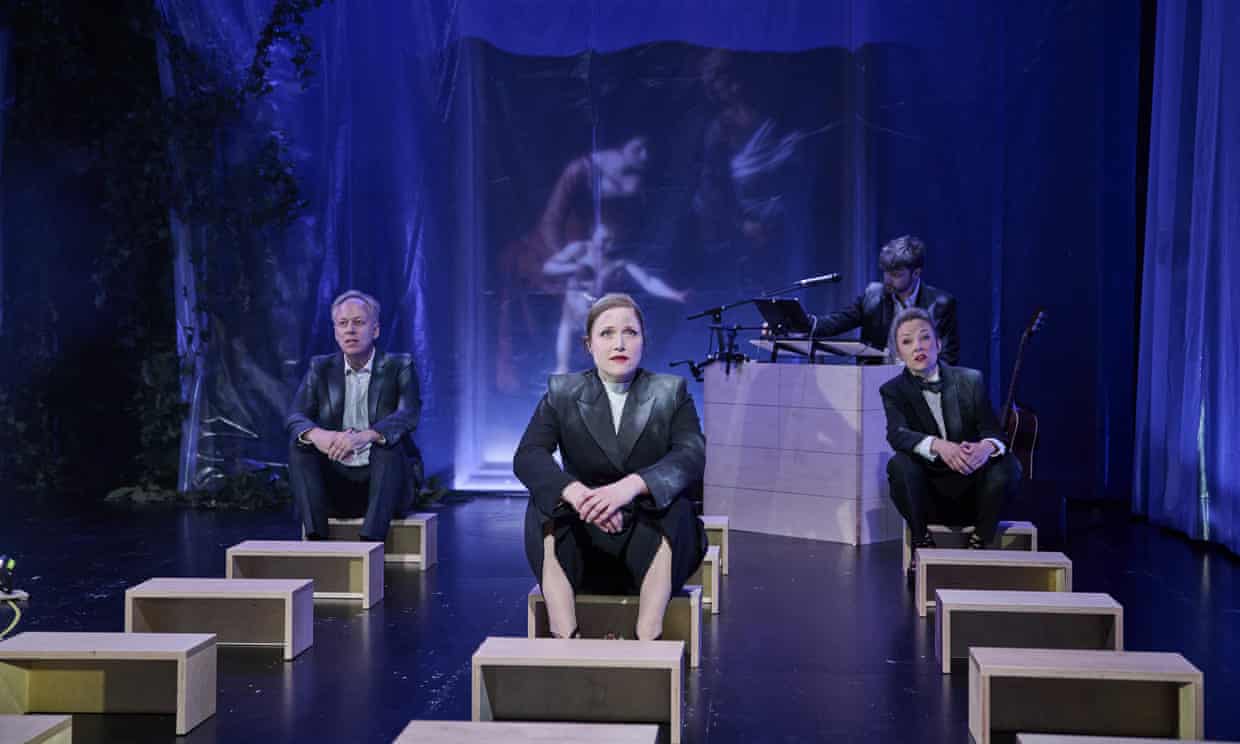
Photo: Thomas M Jauk.
This theatre’s climate impact report found wood made up half of the 41 tons of raw materials it used last year, but produced only 1% of its emissions.
What does it take to be climate neutral? This theater in Germany believes we all have role to play.
In June, Kate Connolly reported at the Guardian, “A handful of Spanish conquistadors fight through thick undergrowth to emerge in the ivy-clad ruins of a fallen civilisation during a rehearsal of Austrian playwright Thomas Köck’s Your Palaces Are Empty.
“Premiered last month at the Hans Otto Theater in Potsdam, south-west of Berlin, the bleak and unforgiving drama probes the wounds of a shattered capitalist world that has exploited its people and the planet’s resources.
“But it is not just the dystopian play that is embracing the subject of the climate crisis.
“The production itself has been declared climate neutral under a €3m [~$3.3 million] pilot project launched by Germany’s federal ministry of culture. The project, called Zero, is sponsoring the Potsdam theatrer and 25 other cultural institutions across Germany, from dance companies to libraries and museums, to completely restructure their creative modus operandi.
“ ‘It leads to restrictions,’ says the director, Moritz Peters, crouching on a wooden stool on stage as he takes a break from rehearsals. ‘But it also forces greater creativity.’
“No aspect of the process of making a play has been left unturned. From the lighting (switching to LED bulbs) to reducing travel (rehearsals are longer but less frequent to cut down on journeys) ‘everything has come in for scrutiny,’ says Marcel Klett, the managing director.
“Swapping to a green source of electricity in 2022 had already improved the theatre’s carbon footprint, reducing its annual 661 tons of emissions, or the ‘equivalent of 66 households,’ by more than 10%, but did not go far enough, Klett says. No less challenging is tackling a change in attitude. ‘Nurturing a sense that we all – from the set designer to the theatergoer – have a role to play and have to ask ourselves: “what can I concretely do?” ‘ Klett says.
“The costume designer, Henriette Hübschmann, says she initially struggled with having to abandon her usual task of creating new costumes from scratch. ‘At least half of the costumes have to come from the existing collection of props and costumes now,’ she says, on a tour of the wardrobe in the theater’s underbelly. ‘The rest should be from recycled, easily recyclable or renewable materials.’ …
“An inventory of its resources forms the basis of the theater’s first climate impact report. … It states that wood makes up half of the 41 tons of raw materials that the theater used last year, but is responsible for only about 1% of the emissions produced, while just four tons of steel and aluminum used in productions made up almost 30%. …
“Other forms of stage-set building are also being experimented with, such as growing constructions out of the organic building material mycelium. The potential use of this in other areas, such as exhibition architecture, is already being explored.
“Most [theaters], from a certain size upwards, will be required to do so from next year, under EU legislation that will treat theaters the same as all big commercial enterprises.
“Klett is hopeful of a knock-on effect among audiences and theatre staff as well as from other cultural institutes joining in. …
“He is appealing to local politicians to embrace the project by sponsoring the erection of solar panels on the theater’s roof and allowing the space – a former Prussian military stables – to be insulated, which is currently not allowed because the building is listed.
“The success of the project, though, will largely depend on the audience and the way they choose to travel to the theater. … Travel remains the theater’s single biggest polluting factor, contributing to about 50% of Hans Otto’s emissions. In response, theater tickets will double up as public transport passes in the three hours before and after the play.”
More at the Guardian, here. No paywall. Donations solicited.

 Suzanne's Mom's Blog