Feeds:
Posts
Comments

Posts Tagged ‘co2’

Does humanity sometimes do the right thing? Yes indeed. Hard to imagine but true: every country in the world signed on to combatting the danger of depleted ozone.

Scott Dance reports at the Washington Post that “a new assessment of Earth’s depleted ozone layer released [in January] shows that efforts to repair the vital atmospheric shield are working, according to a panel of U.N.-backed scientists, as global emissions of ozone-harming chemicals continue to decline.

“At this rate, the ozone layer could recover to 1980s levels across most of the globe by the 2040s, and by 2066 in Antarctica, the report concludes. Ozone loss is most dramatic above the South Pole, with an ozone ‘hole’ appearing there every spring.

“Those improvements will not be steady, scientists stressed, given natural fluctuations in ozone levels and the ozone-inhibiting influence of volcanic eruptions like the massive one from underwater Pacific Ocean volcano Hunga Tonga a year ago.

“But scientists said the latest ozone data and projections are nonetheless further proof of the success of the Montreal Protocol, the global 1987 agreement to phase out production and use of ozone-depleting substances. …

“A recent decline in observed levels of the chemical known as CFC-11, in particular — which as recently as 2018 had been observed at higher-than-expected levels and traced to China — is proof that societies can collaborate to address a confounding environmental problem, said Martyn Chipperfield, a professor at the University of Leeds who serves on the scientific panel. …

“Ozone is a molecule made of three oxygen atoms, and it proliferates in a layer of the stratosphere about 9 to 18 miles above the ground. It can exist at ground level, too, where it is a product of air pollution on hot summer days and considered a health hazard. But in the atmosphere, it serves as an essential shield protecting Earth’s life from harmful ultraviolet radiation.

“In the same way that UV lights eradicate pathogens like the virus responsible for covid-19, the sun’s radiation would make it impossible for life to thrive on Earth if not for the ozone layer’s protection.

UV-B, a high-energy form of solar radiation, damages DNA in plants and animals, disrupting a variety of biological processes and reducing the efficiency of photosynthesis.

“The Montreal Protocol, which has been approved by every country in the world, protects the ozone by outlawing the manufacturing and use of substances that destroy it when they come in contact with it in the atmosphere. That largely includes a class known as chlorofluorocarbons, or CFCs, which contain ozone-depleting chlorine and were used in refrigerators, air conditioners and aerosol cans.

“The treaty was expanded in 2016 through the Kigali Amendment to include hydrofluorocarbons or HFCs, a replacement for CFCs that do not harm the ozone but are a type of greenhouse gas that warms the planet more potently than carbon dioxide. The U.S. Senate ratified the amendment in September. …

“ ‘We can already see HFCs are not increasing as fast as we thought they would because countries are starting to implement their own controls,’ said Paul Newman, one of four co-chairs of the Scientific Assessment Panel of the Montreal Protocol.

“Still, it is possible forthcoming data on ozone levels will prompt some concerns that the ozone layer is not recovering as quickly as the report concludes, he said. Newman said he expects that will be because the Hunga Tonga eruption blasted so much material into the atmosphere. Volcanic eruptions are known to accelerate ozone depletion.

“Progress would likely also be slowed if humans pursue geoengineering to reverse global warming by injecting sunlight-reflecting particles into the upper atmosphere, Newman said. The panel, which considered the potential impact of that practice for the first time … found that, depending on the timing, frequency and amount of such injections, the particles could alter aspects of atmospheric chemistry that are important in ozone development.”

More at the Post, here.

Read Full Post »

The Power of Urban Trees

Photo: Wikimedia
A shady street in suburbia.

John has been working with the Arlington Tree Committee to inventory the town’s trees and promote the benefits of an urban canopy.

Recently, his team has connected with the lab of Lucy Hutyra, associate professor of earth and environment at Boston University, who plans to bring post-doc colleagues to Arlington to help determine the best planting strategies for combatting problems like heat islands.

A 2016 CityLab article about Hutyra’s research with BU biologist Andrew Reinmann notes that trees in urban and suburban environments actually do a better job of removing excess carbon dioxide from the atmosphere than trees in forests.

As Courtney Humphries reported at CityLab, “Forests are important asset in fighting climate change, absorbing an estimated 30 percent of the carbon dioxide we emit from burning fossil fuels. But those estimates come from big forests, says Reinmann, and we know relatively little about how patchy forests function, and whether they provide the same services that large forests do.

“A study published [in December 2016] in Proceedings of the National Academy of Sciences by Reinmann and BU environmental scientist Lucy Hutyra shows that forest fragments in New England behave differently than intact forests in surprising ways: they may pull significantly more carbon dioxide out of the atmosphere than predicted. …

“ ‘You can see how the structure of the trees all along the edge is different,’ [Reinmann] says, pointing to a stand of oaks with long horizontal branches reaching over the backyards, soaking up the additional sunlight. Slicing and dicing forests with housing developments, roads, and agricultural fields creates a multitude of forest edges and, as Reinmann and his colleagues are finding, conditions at the edge of a forest are different than deep inside it. These effects add up; currently, 20 percent of the world’s forested land is within 330 feet of an edge.

“Edge conditions can actually be a boon to the trees that remain. An earlier study from Hutyra’s lab found that urbanization makes trees in Massachusetts grow faster. …

“ ‘On, average the forest is growing 90 percent faster near the edge,’ says Reinmann. In some cases, individual trees are growing faster, and in other cases, they’re growing more densely. …

Given the growth boost at edges, Reinmann and Hutyra estimate, forests in southern New England take up about 13 percent more carbon dioxide than they’re given credit for, and store about 10 percent more carbon. …

“But, Reinmann says, ‘the really important thing to stress is that it does not mean forest fragmentation is a good thing. The carbon sink here is still substantially lower than it would be if we didn’t lose any forest.’ In other words, slicing up a forest to store carbon is a very bad idea.”

Click here for more, and here for the street tree map John’s team is building thanks to their Massachusetts Department of Conservation and Recreation grant.

Read Full Post »

My friend Kristina is an artist with a long-time interest in shells. At a Harvard-based shell club that she frequents, she meets many interesting artists and scientists — including George Buckley, a Caribbean coral reef researcher who made the video below.

Buckley says, “Little did I know in 1976 that my first visit to Bonaire to study land snails … and dive with Captain Don Stewart would lead to a career interconnected with Bonaire and to some 100 more return trips!

“Bonaire became the focus of case study after case study of marine management and biodiversity in my Harvard University environmental management program. [Dozens] of research and study groups, students, magazine writers and photographers that I brought to the island all fell in love with the landscapes and the emerald sea of Bonaire.

“The early years of the Bonaire Marine Park [BMP] and STINAPA [Dutch acronym for national park] … were a great adventure and while my efforts with the Carco Project and Marecultura were not as successful as hoped, both helped to lay the groundwork for future efforts around the world as to best practices in that field.

“The BMP’s pioneering leadership in education, moorings, gloves policies, banning light sticks and spearfishing, creating the ‘Nature Fee’ and so much more led to Bonaire’s well-deserved world-wide recognition. The efforts to save Klein Bonaire were a testament to international collaboration and stand to this day as the Hallmark of what a committed group of concerned people can accomplish. It is indeed true that Bonaire is to conservation of nature as Greenwich is to time – with credit to Captain Don.”

If you are on Facebook, check out the rest of Buckley’s post.

Photo: Sand Dollar in Bonaire


Read Full Post »

I’ve been learning a lot lately from reading ecoRI’s Tim Faulkner. Recently he wrote about entrepreneurial approaches to taking carbon out of the atmosphere. He notes that one of the more ironic opportunities, according to Thorne Sparkman of investor Slater Technology Fund, is through the oil and gas industry, which uses CO2 in extraction and now can at least bury it instead of releasing it.

“Finding ways of supplying some [CO2] from existing carbon sources is a one of the main markets in the emerging, and broadly defined, field of carbon capture and storage (CCS),” writes Faulkner.

“ ‘CO2 is everywhere, but it has not really been harnessed,’ said Emily Cole, co-founder of Liquid Light, a New Jersey-based startup that wants to reduce greenhouse gasses by transforming carbon dioxide into industrial chemicals. …

Enhanced Energy Group of West Kingstown is also looking at cutting emissions from the oil and gas industry, while increasing production. Its founder, Paul Dunn, spent 25 years designing engines for the Navy, some of which were emissions free.  He’s now building power sources that sequester CO2 before it vents into the air. …

Bioprocess Algae is converting unwanted CO2 into algae for fish and animal feed, and as nutritional supplements. The company recently relocated its headquarters from Portsmouth, R.I., to Shenandoah, Iowa, to be closer its CO2 supply source, a corn-fueled ethanol plant.”

Chief technology officer Toby Ahrens says that sequestering carbon dioxide in algae may not have large-scale prospects, but so far, it is one of the few profitable opportunities in this arena. More at ecoRI, here.

Photo: iStock
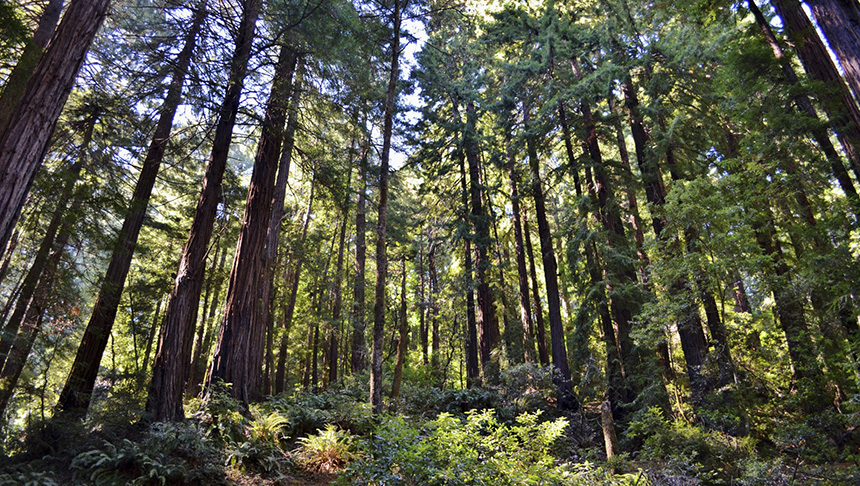
Trees are one way to sequester carbon.

Read Full Post »