Feeds:
Posts
Comments

Posts Tagged ‘codex’

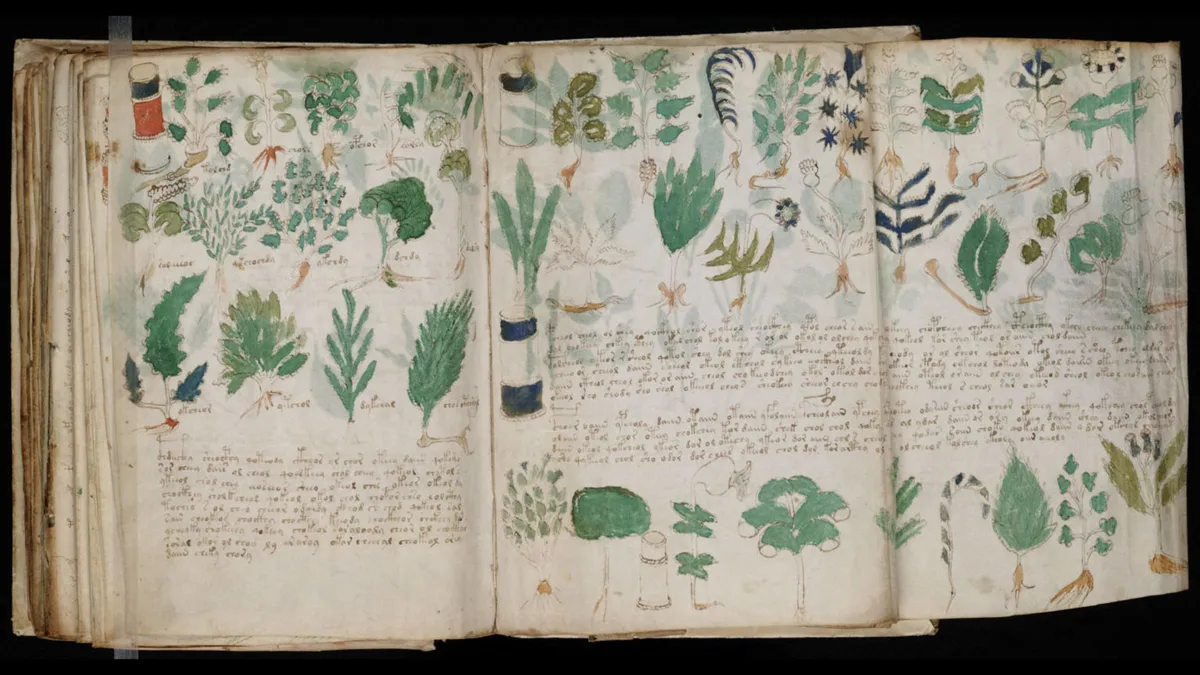
Photo: Art Collection 2 via Alamy.
The Voynich manuscript has never been deciphered. 

We love the French tv series called Astrid, whose autistic heroine can solve any puzzle and has never yet been stumped by a mysterious code. I wish Astrid could apply her unique way of thinking to the puzzle described in today’s article because skepticism about the solution remains.

Tom Metcalfe writes at Live Science, “A unique cipher that uses playing cards and dice to turn languages into glyphs produces text eerily similar to the glyphs in the Voynich manuscript, a new study shows. The finding suggests that an equivalent cipher could have been used to create the mysterious medieval manuscript.

“The new cipher — called ‘Naibbe,’ from the name of a 14th-century Italian card game — does not decode the medieval Voynich manuscript, but it offers an idea for how the manuscript was made.

“The Voynich manuscript, which has been radiocarbon-dated to the 15th century, contains roughly 38,000 words written in glyphs that have never been translated. Despite more than a century of intense scrutiny, the manuscript has not been explained conclusively. However, it continues to intrigue people, with its bizarre and inexplicable illustrations of plants, astrology and alchemy, including supposedly ‘biological’ depictions of bathing naked women.

“In the new study, published Nov. 26 in the journal Cryptologia, science journalist Michael Greshko investigated one way the manuscript may have come together. He told Live Science that he got the idea for the Naibbe cipher while researching stories about the Voynich manuscript. …

“Naibbe first uses the number from the throw of a die to break a block of Italian or Latin into single and double letters — so “gatto” (Italian for “cat”) could become “g”,”at” and “to.” The cipher then uses the draw of a playing card to determine which of six different tables is used to encrypt the letters into ‘Voynichese’ — the strange and undeciphered glyphs that are apparently grouped into words in the manuscript. The tables are ‘weighted’ by the corresponding number of cards so that the statistical occurrence of the mock-Voynichese glyphs is the same as seen in the manuscript itself.

“Greshko’s effort is among the leading attempts to explain how the manuscript was made. But it still only approximated Voynichese text, rather than fully replicating it, he said. …

“The manuscript now lies at a nexus of attempts to understand lost languages, yet experts are not entirely sure if Voynichese is even real.

“One theory, taken seriously, is that the manuscript is a medieval hoax, illustrated with suitably mysterious and salacious drawings, and that the text of Voynichese glyphs is completely meaningless.

“The hoax theory has grown stronger in recent years as more attempts to decipher Voynichese — some of which have used machine learning and other computerized artificial intelligence methods — have failed to crack the code, if there is a code.

“But theories that Voynichese is based on a real language and can be deciphered are still prominent, and Greshko’s Naibbe cipher is one of the closest attempts yet.

“The mock-Voynichese output of the Naibbe cipher has several important similarities to true Voynichese. … Those commonalities suggested that a similar method was used to create the original Voynich manuscript, Greshko said. …

” ‘Dice and playing cards were chosen as sources of randomness because it was essential for the cipher to be ‘hand-doable’ with the technology of the time. …

” ‘My hope is that this becomes adopted as a computational benchmark,’ Greshko said. ‘The points of difference between the cipher and the manuscript may point the way to how the text was actually created.’

“Former satellite engineer René Zandbergen, a renowned expert on the Voynich manuscript who was not directly involved in Greshko’s study, said he appreciated Greshko’s efforts to create an encoding method to approximate Voynichese.

“But Greshko ‘also makes it clear that he is not suggesting that this is how the manuscript text was generated,’ Zandbergen said in an email. ‘He just demonstrates that such a method can be found, and we may assume that there may be others.’ Zandbergen added that he is ‘essentially undecided’ about whether the Voynichese text is meaningful or a hoax.”

More at Live Science, here.
Read Full Post »

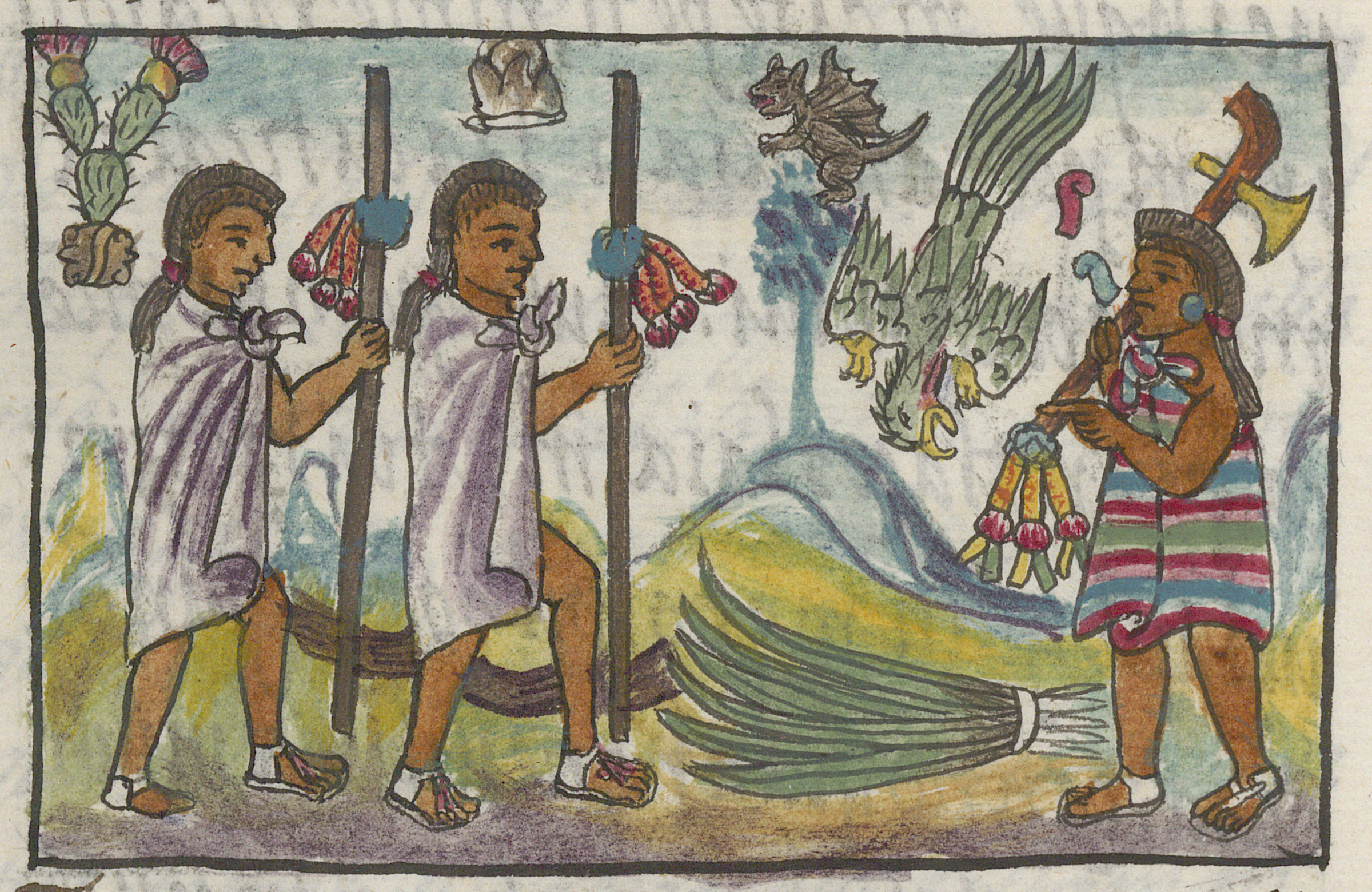
Photo: Biblioteca Medicea Laurenziana, Florence, and MiBACT.
Disguised Mexica merchants in Tzinacantlan acquiring quetzal feathers.

Thanks to work by the Getty Research Institute and indigenous partners to post an ancient codex online, some mysteries about Aztec hstory are available for all of us to plumb.

Maya Pontone opines at Hyperallergic that “the 16th-century ‘Florentine Codex offers a Mexican Indigenous perspective that is often missing from historical accounts of the period.” So how did this knowledge end up in Italy?

“After centuries of remaining largely inaccessible to the public,” she writes, “a rare manuscript featuring 2,500 pages of detailed illustrations and text documenting the history and culture of 16th-century Mexico is now available online. The Digital Florentine Codex, a seven-year project by Los Angeles’s Getty Research Institute, features new transcriptions and translations, updated summaries, searchable texts and images, and more.

“Modeled after medieval European encyclopedias, the Florentine Codex is a three-volume, 12-book collection written in Spanish and Nahuatl documenting the daily life and customs of the Mexica (Aztec) people, as well as other information including astronomy, flora, and fauna, during the time of Spanish conquest. It was originally created by Bernardino de Sahagún, a Spanish Franciscan friar who began logging information about the Indigenous communities in central Mexico with whom he worked closely.

“Although Sahagún is frequently credited as the primary author, the 12-book manuscript was created with the help of numerous elders, grammarians, artists, and scribes from the Nahua community. As a result, the codex maintains an important Indigenous perspective that is often missing from other historical accounts of the time.

“In 1577, the codex was sent to Spain, where it then somehow traveled to Italy to fall under the ownership of Cardinal Ferdinando I de’ Medici, who brought the work to Florence. The codex was stored away in one of the Medici family libraries and remained forgotten for several centuries. In 2012, a scanned edition of the work was made digitally available through the World Digital Library, and in 2015, it was incorporated into UNESCO’s Memory of the World Register.

“But, as the Digital Florentine Codex’s project manager Alicia Maria Houtrouw told Hyperallergic, the manuscript still remained largely out of reach for the public.

“ ‘Access to codex was partial in that published transcriptions and translations tackle either the Spanish or the Nahuatl column of text or just a selection of the codex,’ Houtrouw said, adding that reading these reproductions often required knowledge of both early and modern Spanish and Nahuatl. Many published versions also didn’t include the manuscript’s crucial illustrations, or if they did, excluded context.

“ ‘The Nahuatl and Spanish texts provide two complementary, though distinct, narratives, and the images go beyond the alphabetic texts, providing unspoken details and communicating yet another layer of knowledge,’ Kim Richter, senior research specialist and the principal lead of the Florentine Codex Initiative, told Hyperallergic.

“Now the public can access the entirety of the codex through an online portal released by the Getty Research Institute last [October], and learn a wide span of subjects including the origin of ancient Aztec deities, theology and philosophy, cooking, and gardening. In Book 11, Sahagún documents the plague of smallpox, writing of the ‘infinite number of people’ who succumbed to the illness.

“The final book in the codex documents the Spanish invasion of Mexico, including the Massacre in the Great Temple of Tenochtitlan that occurred on May 22, 1520, under Spanish conquistador Pedro de Alvarado. …

“The digital codex was created with the help of native Nahuatl speakers out of the Instituto de Docencia e Investigación Etnológica de Zacatecas (IDIEZ), who translated thousands of sections of the codex and wrote the summary of the Spanish conquest of Mexico.

As a result, the Digital Florentine Codex now makes available a historical narrative about Indigenous resistance and heroism in the face of Spanish colonizers that has largely been absent from many educational curricula. …

“ ‘Indigenous people in Mexico, as in the US, face discrimination — so to have access to such important historical sources restores a sense of pride and also supports language revitalization — the primary mission of IDIEZ,’ Richter said.”

See the wonderful pictures at Hyperallergic, here. No paywall.

Read Full Post »