Feeds:
Posts
Comments

Posts Tagged ‘communication’

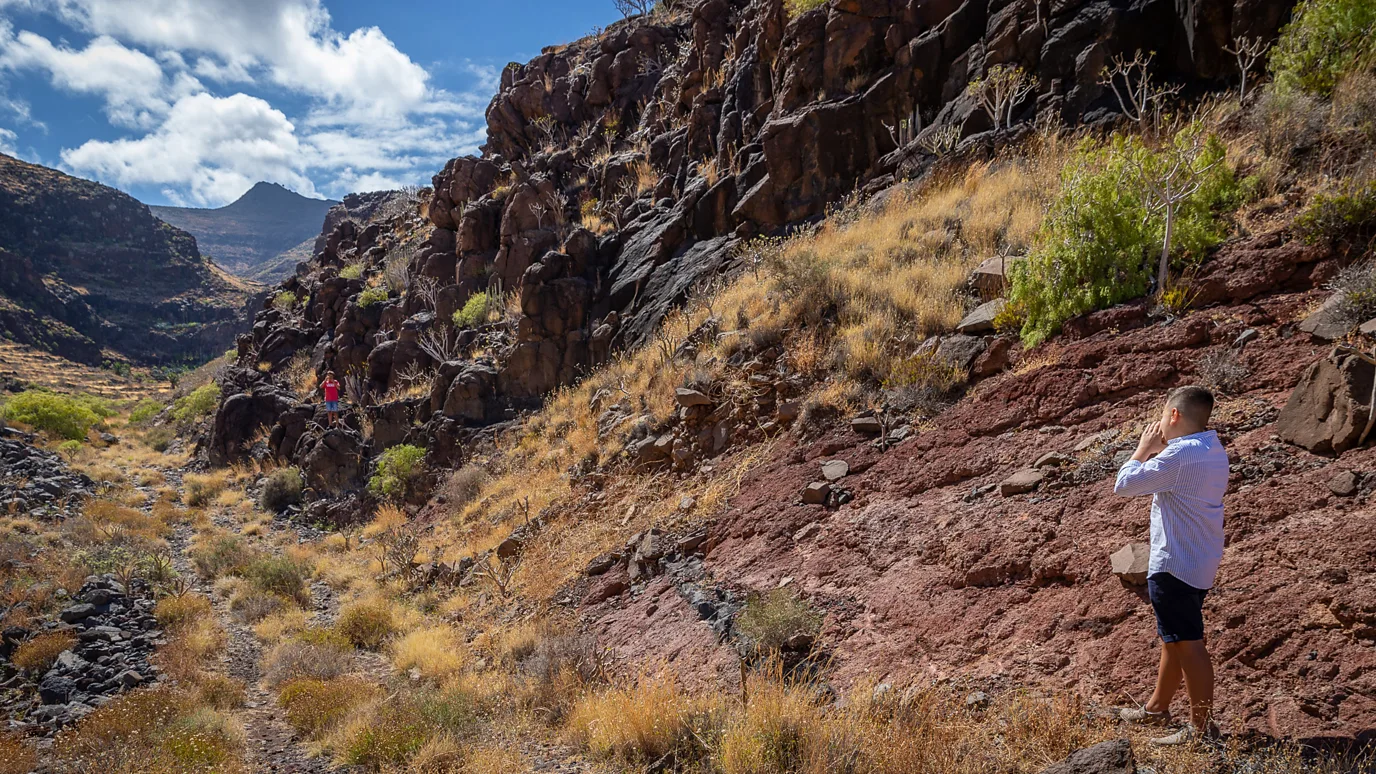
Photo: Richard Franks.
On the island of La Gomera, expert whistlers communicate across long distances.

How do you get your news? News models are emerging all the time. I get local updates from a nonprofit that has been expanding ever since its launch a couple years ago. (To read about the nonprofit wave, search on “nonprofit news” at this blog.) I also listen to the radio and use social media that provides links to mainstream media.

But what if you got news from a whistler? What would that be like?

Richard Franks writes at the BBC, “In the rugged crags of Barranco de Ávalo, a ravine on the small Canary Island of La Gomera, two local 12-year-olds were practicing their Silbo Gomero, the local whistling language. For an entrancing few minutes, Irún Castillo Perdomo and Angel Manuel Garcia Herrera’s lilting warbles reverberated around the barren gorge and soared proudly into the air like eagles in flight.

“They were accompanied by 70-year-old retired Silbo Gomero teacher Eugenio Darias, whose grandfather used to own and work on this very same land. He told me that the boys’ whistled conversation was similar to any they would have over text message or in the playground, but the focus was instead on the six differentiating sounds that make up La Gomera’s protected whistle language.

“While it’s true that most children their age would sooner pick up their phone and tap away, this small Canary Island invites them to think differently. Thanks to Darias, their threatened tongue has been a compulsory school subject since 1999 – and almost all 22,000 residents can understand it alongside their mother tongue of Canarian Spanish.

” ‘It’s important to give students the idea that they can really use it if they need to, like other languages, but also that it’s not necessary for everyday use,’ said Darias, who pioneered the Silbo Gomero learning program. … ‘Having the whistle protected within our compulsory curriculum prevents extinction altogether.’ …

“Silbo Gomero, which is one of the most studied whistling languages and was officially declared an Intangible Cultural Heritage by Unesco in 2009, uses six condensed sounds to communicate. Two differentiating whistles replace the five spoken vowels in Spanish, while just four replace the 22 consonants. Whistlers elongate or shorten the sounds to mimic the words.

“Several whistling methods exist on the island, though perhaps the most traditional is demonstrated by local sculptor José Darías. His Whistling Tree sculpture at Mirador de Igualero, a viewpoint in Vallehermoso overlooking a ravine where Silbo Gomero was most active, shows how the index finger should be bent and placed inside the mouth while whistling with an open palm beside it to amplify the sound.

“Experienced whistlers use different finger methods and can often tell who is calling by the whistle’s ‘accent’ alone – but most whistlers will introduce themselves and call the recipient’s name. When the message is understood, they whistle back ‘bueno bueno.’ …

DNA-based research published in 2019 by Tenerife’s La Laguna University has matched La Gomera’s early inhabitants, the Guanches, with Berbers (now known locally as Amazigh). These indigenous people roamed North African regions more than 3,000 years ago and communicated by whistle; it’s therefore widely believed that the Spanish settlers on the island adapted the whistling language of La Gomera’s early inhabitants to suit their native tongue. …

“Silbo Gomero lent itself to La Gomera’s demanding terrain – namely its deep ravines – allowing the locals to communicate with a drifting, piercing sound that could travel for several kilometres. From atop the ravines, the locals would announce events, request livestock be brought over, warn of impending danger, or even announce the death of a family member. ‘It saved a lot of climbing,’ said Darias.

“In the 1950s, Silbo Gomero was used so frequently that there was often a scattered queue of farmers waiting to send instructions across the valleys. … ‘Nobody wanted to climb up and down the ravines to pass on a message. Because of this, so many whistling conversations were happening at the same time, and we would have to wait our turn,’ Darias said. …

“Silbo Gomero was first in decline by the 1960s, when growing economic conditions forced many of the island’s workers to emigrate to more prosperous countries like Cuba and Venezuela, as well as the neighboring Canary Island of Tenerife. Soon after, phones became commonplace and threatened the language altogether.

“By the 1990s, modern technology ascendancy and the introduction of new roads and paths on La Gomera removed the necessity and practicality of Silbo Gomero, dangling it near extinction. …

“ ‘The whistle has been defended with greater care in the Canary Islands, [local broadcast journalist Francisca Gonzalez Santana] noted, ‘because it is an essential part of our culture: the orography of the islands, with mountain areas and canyons, and our economy that has been linked to agriculture and livestock.’

“While the whistle is now rarely heard outside of school or other official programs, however, it is occasionally used in the few parts of the island with no telephone connection. ‘I know of two goat herders who still whistle to each other,’ Darias said. … ‘Their livestock moves around in an area with no mobile network, and that’s why it’s necessary.’ “

More at the BBC, here. No firewall. You can listen to whistlers sending messages here, at the radio show called The World. And be sure to read my 2015 post, here, on a Turkish whistling language.

The world is full of amazing things.
Read Full Post »

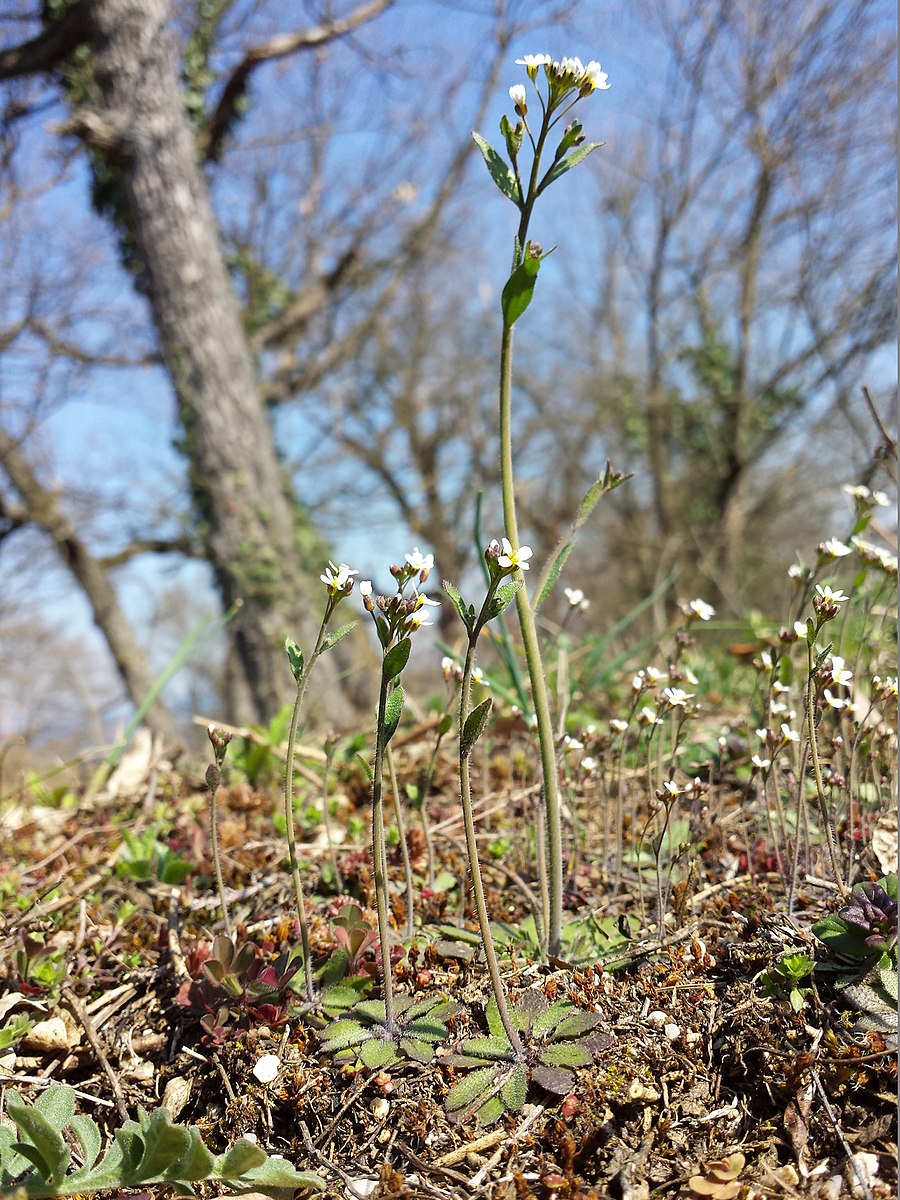
Photo: Stefan Lefnaer via Wikimedia.
In the video below, an Arabidopsis plant warns of danger from a hungry caterpillar.

I think we are lucky to be learning so much about the natural world these days. I didn’t study much science in school, but who wouldn’t love scientific research that reveals such wonders as plants’ communications systems.

Kasha Patel at the Washington Post writes that some plants actually warn their brethren when it’s necessary to increase defenses.

“Trees on our Earth can communicate and warn each other of danger,” she says, “and a new study explains how.

“Injured plants emit certain chemical compounds, which can infiltrate a healthy plant’s inner tissues and activate defenses from within its cells, the new research found. …

“For the first time, researchers have been able to ‘visualize plant-to-plant communication,’ said Masatsugu Toyotasenior author of the study, which was [published] in Nature Communications. ‘We can probably hijack this system to inform the entire plant to activate different stress responses against a future threat or environmental threats, such as drought.’

“The idea of ‘talking’ trees started to take root in the 1980s. Two ecologists placed hundreds of caterpillars and webworms on the branches of willow and alder trees to observe how the trees would respond. They found the attacked trees began producing chemicals that made their leaves unappetizing and indigestible to deter insects. …

The scientists discovered healthy trees of the same species, located 30 or 40 meters away and with no root connections to the damaged trees, also put up the same chemical defenses to prepare against an insect invasion.

“Another pair of scientists around that time found similar results when studying damaged sugar maple and poplar trees. …The trees sent chemical signals to one another through the air, known today as plant eavesdropping. Over the past four decades, scientists have observed this cell-to-cell communication in more than 30 plant species, including lima bean, tobacco, tomato, sage brush and flowering plants in the mustard family.

“But no one knew which compounds were important and how they were being sensed — until now. …

“Plants obviously don’t have ears and eyes, but past research shows they communicate with their surroundings by emitting chemicals known as volatile organic compounds, which we can smell. … Plants can produce an array of these compounds for different purposes. Some are used to attract pollinators or as defense against predators.

“However, one class of these compounds are emitted when a plant is injured: green leafy volatiles. These are emitted by, as the name suggests, pretty much every green plant with leaves, and are produced when a plant experiences physical damage. An example of this compound is the smell released from fresh-cut grass.

“In the new study, Toyota and his colleagues manually crushed leaves and placed caterpillars on Arabidopsis mustard or tomato plants to trigger the emission of various green leafy volatiles. Then, they spread individual fumes to healthy plants to see if the plants would react.

“To track the healthy plants’ responses, the team genetically modified the plants so calcium ions would fluoresce when activated inside individual cells. Calcium signaling is important for cellular functions in most living organisms on Earth, including humans. … Depending on the plant, it can trigger messages to close its leaves or digest an insect.

“After testing many green leafy volatiles, the team found only two seemed to increase calcium ions inside cells. Additionally, they found calcium signaling first increased in guard cells forming the plant’s leaf pores, or stomata — an important finding, because it shows the compounds are absorbed into the plant’s inner tissues. …

“The calcium signaling, Toyota said, is like a switch to turn on the defense responses from the plant. … For example, Toyota said the plant may start producing certain proteins to inhibit insects from munching on them, giving the insects diarrhea. …

“With this new understanding, researchers say plants could be immunized against threats and stressors before they even happen — the equivalent of giving a plant a vaccine. For instance, exposing healthy plants to insect-ridden plants or the associated green leafy volatiles could boost their genetic defenses, so farmers use less pesticides, Kessler said. The revelation could also help make plants more resilient during a drought, signaling the plants to retain more water.”

More at the Post, here.

Read Full Post »

Photo: Kensy Cooperrider
A man in the village of Gua, Papua New Guinea, points while describing a representation of Yupno history. Recent research confirms the long-held hunch that every culture uses hands in communicating.

Esperanto was meant to be a bridge between native languages, and I still believe in its potential. But three cheers for languages that don’t need bridges at all.

Blogger KerryCan mentioned one universal yesterday: music. Today’s post is about the nearly universal language of gestures — “nearly” because some gestures have wildly different meanings depending upon the culture.

Kensy Cooperrider writes at Aeon, “In the spring of 1528, the Spanish explorer Álvar Núñez Cabeza de Vaca made landfall on what is now the gulf coast of Florida. Over the next eight years, as he and a small party traversed thousands of miles, they found themselves in a new-world Babel, moving from ‘one strange tongue to another’. In their many encounters with native peoples, their own tongue, Spanish, proved of little use. But their hands served them well. ‘You would have thought, from the questions and answers in signs,’ de Vaca later recounted, ‘that they spoke our language and we theirs.’

“De Vaca is not the first or last explorer to claim successful communication with indigenous peoples through gesture. Similar reports abound. … Sometimes, the messages conveyed were surprisingly sophisticated. If you stay until morning, we will feed you. In that direction, there are goats and pigs of all sizes. The people in that direction eat human flesh. 

“The parties in these exchanges could not have known it at the time, but they were following the advice of Joseph Marie Degérando, a French philosopher with an anthropological bent. In 1800, he wrote a treatise offering practical advice for would-be explorers and ‘philosophical travellers’. …

“Degérando’s proposals swam with the tide of much of Western thinking. The notion that gesture is a natural mode of expression – one that transcends the contrivances of culture – is a very old one. In 95 CE, the Roman rhetorician Quintilian wrote that ‘though the peoples and nations of the earth speak a multitude of tongues, they share in common the universal language of the hands’. …

“[When] Europeans were impressed by the universality of gesture, they were mostly impressed by the strength of their own intuitions. They had not actually been to ‘all regions of the habitable world’. They had no photographs, videos or other visual documents to consult. …

“In the past 50 years, however, much has changed. Technical limitations have evaporated. Video-recording technologies are now cheap, portable and easy to use; video files can be readily stored, swapped and posted online in massive databases. …

“In every group yet studied, the hands at least occasionally stir and take flight as people talk. We are certainly capable of communicating without these aerialist accompaniments, but our hands tend toward motion.

“A second preliminary point is that evidently not all gestures are universal. Most, perhaps all, human communities harbour a storehouse of hand gestures with fixed meanings, which are often called ‘emblems’. Examples of emblems in the English-speaking world include the shhh gesture (an index finger held vertical across the mouth), the peace sign (an outward-facing V made with the index and middle fingers), and the thumbs up. Notoriously, such gestures can lead to confusion or worse. Another emblem, the okay gesture, made by forming a ring with the thumb and index finger, is perfectly benign in the US but a provocation elsewhere.

“Emblems might be what many think of when they first think of gestures, but in the United States and perhaps most other places they are only rarely put to use. (Try to recall the last time you shhh-ed someone, or gave a thumbs up.) What people produce much more often are gestures for ‘yes’ and ‘no’; points to people, places and things; gestures that sketch objects, actions and represent abstract ideas through visual metaphors. These are the real workhorses of gestural expression. And, as it turns out, a case can be made that these workhorses are broadly similar the world over.”

More here. It’s a thoughtful article, and I will only add that if you help immigrants learn English, as I do, the shhh gesture and the thumbs up appear frequently. In fact, teachers and students pantomime pretty much anything that is not easily accessible using Google Translate.

Read Full Post »

I remember my mother’s story about driving home to Boston with a friend and trying to cross the Connecticut River on September 21, 1938. I wish I remembered the details: where they were coming from, who was driving, whether they got across or the bridge was closed, where they spent the night.

But I will never forget the awe with which people of a previous generation spoke about the Hurricane of ’38, its unexpectedness, its devastation — and little Edrie Dodge crawling on hands and knee across her yard as the winds destroyed the farming and fishing industries of her island.

That hurricane has always held a kind of fascination for me. I was riveted reading A Wind to Shake the World, an excellent book describing places I knew and emphasizing that lack of good communication in 1938. While people in Long Island were fighting the storm, people in Rhode Island had no idea they were next.

Nevertheless, good things came of tragedy, lessons were learned. Forecasting and communication improved exponentially.

The Globe had a retrospective on the 75th anniversary.

Jeremy C. Fox wrote, “On that September afternoon 75 years ago today, the Great New England Hurricane of 1938 tore into New York’s Long Island and then Milford, Conn., and raged through Massachusetts and Vermont, leaving a path of flooded towns, flattened homes, and fires caused by downed power lines. …

“Coming before televisions, computers, or weather satellites, the storm’s speed and fury took both meteorologists and residents by surprise, according to forecasters.

“Meteorology professor Lourdes B. Avilés said the storm remains “the one to which all other New England hurricanes are sooner or later compared.”

More here.

Photo: The Boston Globe
”This enormous tree in our backyard came completely uprooted and came crashing down,” said Irene Goodwin Kane, who was 14 when the storm hit. “That was when I realized that this was really bad.”

Read Full Post »