Photo: Munza Mushtaq.
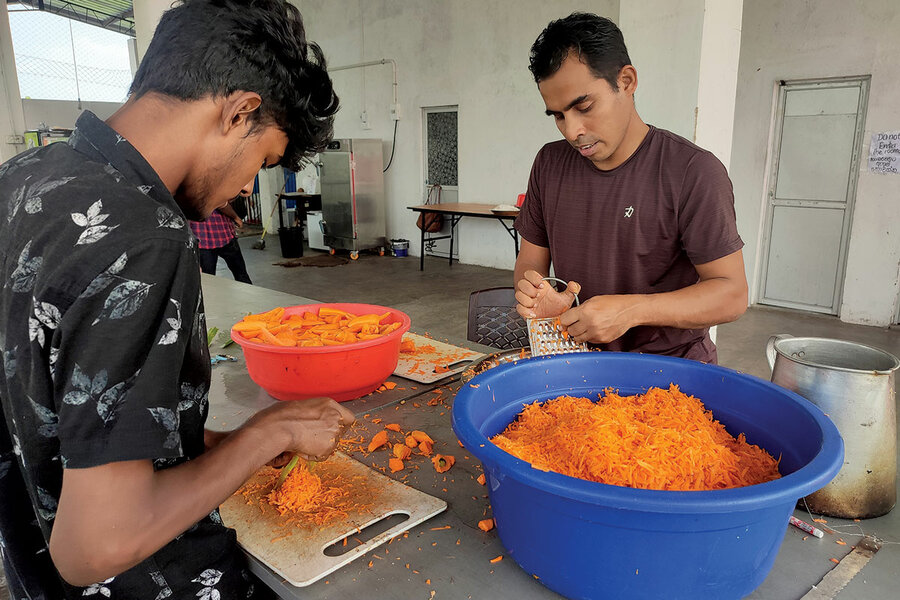
Pastor Moses Akash de Silva (right) helps prepare carrot sambol at Voice for the Voiceless Foundation’s flagship community kitchen in Sri Lanka.
Here’s a story from across the world about one way that food brings people together.
Munza Mushtaq reports at the Christian Science Monitor, “It’s just past noon, and on the sweltering rooftop of the Bethany Church in Rajagiriya, Sri Lanka, Pastor Moses Akash de Silva and a team of volunteers are grating piles of carrots while K.D. Iranie hovers over a large pan, stirring a spicy fish curry atop a makeshift firewood cooker.
“Ms. Iranie, who’s in her 60s, has served as the main cook for the church’s community kitchen since Pastor Moses started the project in June. ‘I come all five days a week,’ she says. ‘Seeing the people getting a delicious meal makes me so happy.’ …
“At 12:30 p.m. sharp, after trays of fresh food are carried down four flights of steps, Pastor Moses signals a volunteer to open the church’s grilled gates. At least a hundred men, women, and children eagerly file in, following the aromas of turmeric-infused fluffy yellow rice, fish and pumpkin curries, carrot sambol, and papadums. More will arrive with time. For many, this is their first proper meal in days.
“Sri Lanka’s worst-ever economic crisis has left nearly 30% of its 22 million people food insecure, according to the World Food Program, with food inflation soaring to 73% in November. The Voice Community Kitchen helps out by providing some 6,000 free lunches every week across roughly two dozen locations throughout Sri Lanka, while also bringing together different ethnoreligious communities that have historically struggled to find common ground. Pastor Moses says the initiative was born of pragmatism, compassion toward all Sri Lankans, and a desire to model the same generosity he experienced as a young person.
“ ‘I have gone for days without food, so I understand how these people feel,’ he says. ‘It does not matter to us what religion they are from, or if they have family, or what they do. If they are hungry, they are welcome to eat at our community kitchen.’
“Raised in an orphanage in the hill capital of Kandy, Pastor Moses moved to Colombo at age 17 seeking better opportunities. He lived at a bus stop for three days before finding work as a cleaner at a polyethylene factory. It’s there he met the senior pastor of Bethany Church, Dishan de Silva, who took him in.
“Pastor Moses explains with a bright smile how he lived with the senior pastor for seven years, eventually adopting his mentor’s surname. … The community kitchen idea came to [Senior Pastor de Silva] earlier this year when Voice Foundation volunteers were distributing dry rations to families on the outskirts of Colombo.
“ ‘In one house we met a mother with a 2-year-old child who had been surviving on ripened breadfruit and water spinach for three days due to the shortage of cooking gas in the market,’ he says. ‘That was when we thought, there was no point giving dry rations if people were unable to cook.’
“So they started cooking up meals themselves. Many of the current community kitchens are based in schools, while others, such as the flagship Bethany Church program in a Colombo suburb, serve lunch every day to a mix of children and adults. At least 60% of the people who come to the kitchen do not eat breakfast or dinner due to financial hardship, according to the Voice Foundation.
“There is only one rule at the Voice Foundation’s community kitchens: Guests can eat as much as they want, but they can’t take food outside the premises.
“At the Bethany Church, there is not a single garbage bin. According to Pastor Moses, there’s no need – there are never leftovers.
“ ‘The community kitchen attracts different people from different walks of life, including beggars, street cleaners, security guards, and anyone else who needs a meal,’ Pastor Moses says.
“N.K. Karunawathie works at a bank nearby. Even as the cost of living skyrockets, her salary has remained stagnant, meaning her family can ‘no longer afford three meals a day,’ she says. To help make ends meet, she and her husband, both Buddhists, have been visiting the Voice Community Kitchen since it started this summer. …
“For a small country, Sri Lanka frequently faces religious-based conflict. Apart from a quarter-century-long war with the Liberation Tigers of Tamil Eelam, which strained the relationship between the majority Buddhists and minority Hindus, the country has also seen a rise in attacks against Muslims since 2013. The Easter Sunday bombings in 2019 further exacerbated tensions.
“Mehdi Ghouse started volunteering at the kitchen months ago after learning about the project on social media.
‘It doesn’t matter that I am Muslim, or this project is run by the church. What matters is the satisfaction we all get when we see people eating and leaving happy,’ he says.
“Not only are all religions welcome at the Voice Community Kitchen, but experts also say such initiatives could be key to improving ethnoreligious engagement and lead to better conflict mediation in the future. …
“For Pastor Moses, the community kitchen’s mission is simple: Feed the hungry. But he does hope the work will have a ripple effect by inspiring generosity among all who engage with the project.
“ ‘I am who I am because of the upbringing I had in the orphanage and the help I got throughout the years since I came to Colombo,’ he says. ‘I hope others who volunteer here and those who I have taken under my wings will follow my footsteps by serving the people.’ “
More at the Monitor, here.


 Suzanne's Mom's Blog