Photo composite: Alessio Mamo.
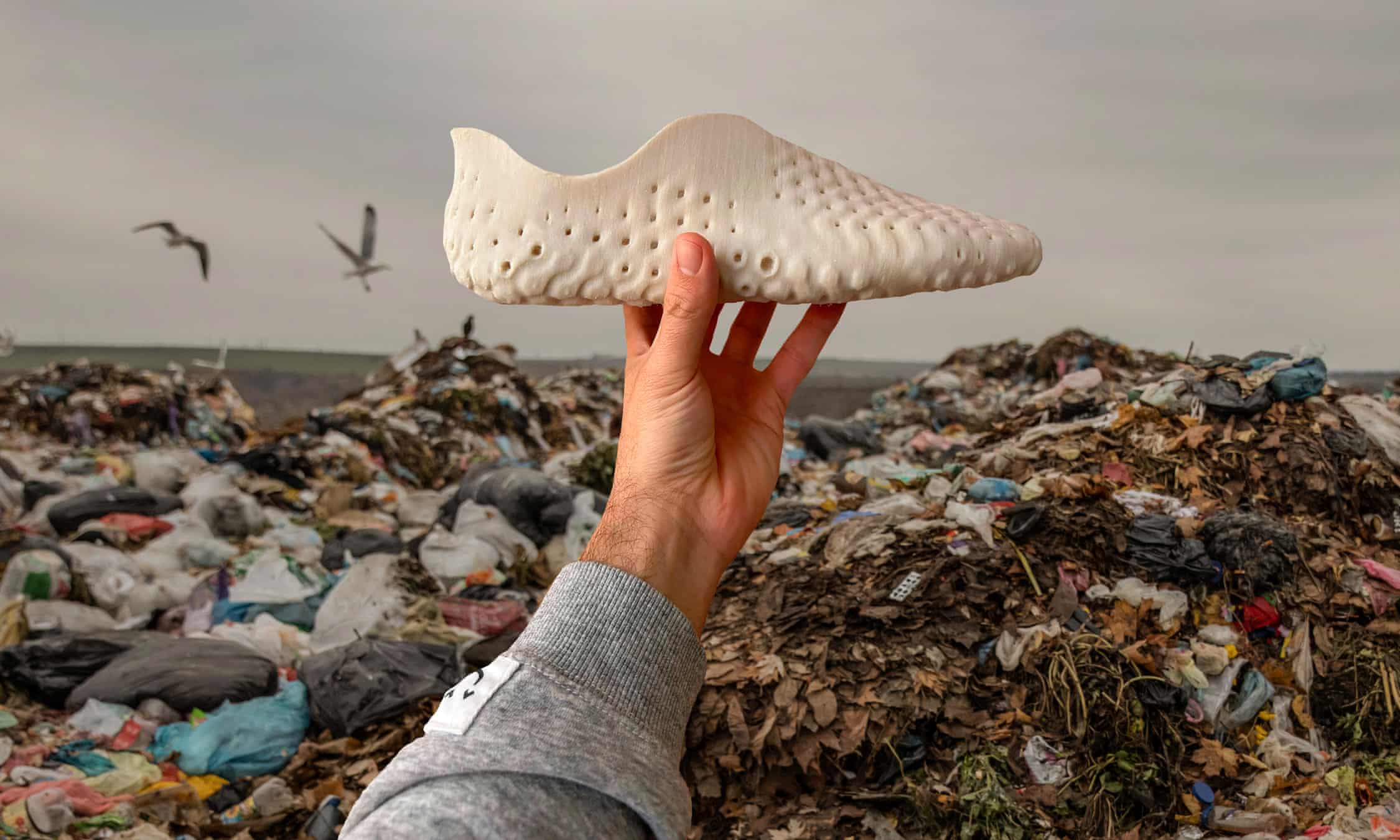
Compostable shoes are being created using 3D printing.
Overthinking things can lead to a kind of paralysis. You want to do the right thing for the environment, you look for clothes not made with synthetics, wear the clothes many years, finally give them to Goodwill for others to use, and recycle raggedy textiles safely. But you know that a lot of this is still going to end up on the beaches of some African country. How can you do more? Do enough?
And what about shoes?
Well, one step at a time. You have to trust that every little bit helps.
At the Guardian, Patrick Greenfield writes that there is now such a thing as a compostable shoe. “The shoes may not immediately strike you as the future of mainstream fashion. Pale and porous, they resemble a cross between a beige Croc and the long-net stinkhorn fungus found on forest floors. Their creators, however, hope this will be the next huge breakthrough in sustainable footwear: the world’s first 3D printed, made-to-measure, compostable shoe, which can be broken down at the end of its life, in an attempt to stem the flow of millions of shoes into landfill each year.
“Fashion is among the world’s top polluting industries. It is responsible for about 10% of global carbon emissions and consumes huge amounts of water and land for production. Modern shoes are among the hardest items to produce sustainably because of their complexity, say industry experts, and there are few reliable statistics about the number manufactured every year for the world’s 8 billion humans. There is an almost total dearth of statistics about their environmental impact.
“Most shoes are composed of a mixture of synthetic fabric, rubber, plastic and metal, which is often held together with strong adhesives, and they are incredibly difficult to dispose of. The vast majority are bound for landfill once used, where they could take hundreds of years to break down. There are efforts to pioneer recyclable trainers [sneakers] for the world’s $70bn (£55bn) industry, with some brands offering services if customers post back.
“To produce its new compostable model, the London-based shoe company Vivobarefoot has joined forces with a material science company, Balena, to create prototypes of the shoes, which are not yet available for sale. They will be manufactured based on in-store foot scans and then printed over 30 hours. Once they have worn down, the footwear can be returned for composting at an industrial facility. …
“Says Asher Clark, a co-founder of Vivobarefoot. ‘This is about reimagining the way things are done from linear, offshore production to the world’s first scan-to-print-to-soil footwear. It is a vision for cutting out a lot of waste in supply chains and providing an end of life solution for the footwear industry.’
“There are caveats to the sustainability claims of the shoes, says Clark, which will be sold for between £200 [$255] and £260 [$331]. BioCir flex, the patented thermoplastic used to make them is 51% biological materials, 49% petrochemical. It cannot be thrown on a compost heap at the end of the garden to break down – it needs to go to a composting plant. …
“ ‘There is a trade-off between the biodegradability and durability: that is the key tension. The external factors that break down physical products are things like light, heat and moisture,’ he says. ‘The challenge is to make a shoe that will handle all those elements but also respond to the elements that start to break it down at the end of its life.’ …
“Glue and other binding materials can make shoes difficult to recycle, even when new substances are used for their main components, such as cactus ‘leather’ – a material made from the leaves of the nopal cactus – and grape-skin derivatives, says Luca Mosca, fashion lead at the sustainability consultancy Quantis. He says it is still hard to say what constitutes an environmentally friendly shoe, and that consumers should use them for as long as possible. … ‘Shoes are very complicated products.’ ”
More at the Guardian, here.

 Suzanne's Mom's Blog