
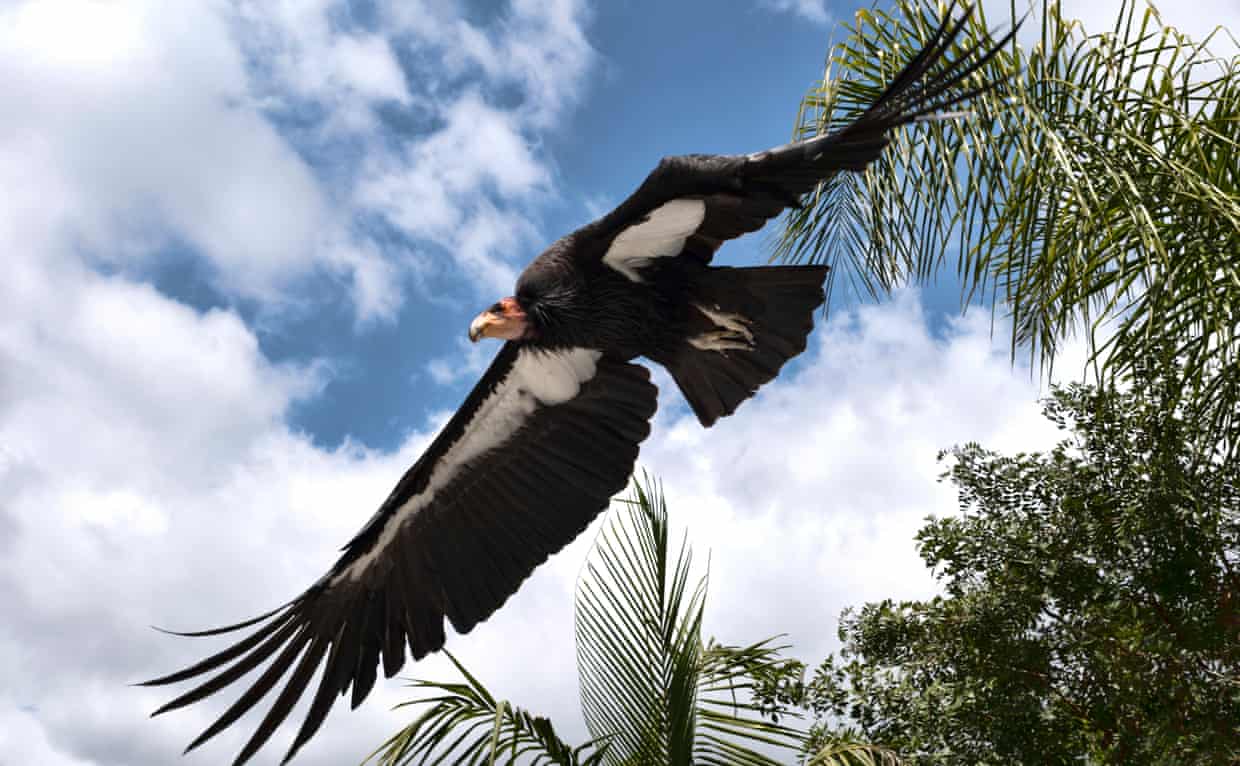
Photo: BLM.
“The US California Condor Recovery Program, initiated in the 1970s, represented an enormous change in the strategy of species conservation,” writes Knowable Magazine.
They are not as appealing as, say, hummingbirds, but the California condors had a lot of environmentalists worried in the 1970s, including a young boy I knew who grew up to be a respected biologist and scientific photographer.
I remember him talking a lot about condors when we were carpooling. And I thought, “Well, condors. An odd obsession for a child.”
Thank goodness people get obsessed about the least beautiful denizens of our planet.
Iván Carrillo tells the condor story at Knowable Magazine via the Tucson Sentinel.
“The spring morning is cool and bright in the Sierra de San Pedro Mártir National Park in Baja California, Mexico, as a bird takes to the skies. Its 9.8-foot wingspan casts a looming silhouette against the sunlight; the sound of its flight is like that of a light aircraft cutting through the wind. In this forest thick with trees up to 600 years old lives the southernmost population of the California condor (Gymnogyps californianus), the only one outside the United States. Dozens of the scavenging birds have been reintroduced here, to live and breed once again in the wild.
“Their return has been captained for more than 20 years by biologist Juan Vargas Velasco and his partner María Catalina Porras Peña, a couple who long ago moved away from the comforts of the city to endure extreme winters living in a tent or small trailer, to manage the lives of the 48 condors known to fly over Mexican territory. Together — she as coordinator of the California Condor Conservation Program, and he as field manager — they are the guardians of a project whose origins go back to condor recovery efforts that began in the 1980s in the United States, when populations were decimated, mainly from eating the meat of animals shot by hunters’ lead bullets.
“In Mexico, the species disappeared even earlier, in the late 1930s. Its historic return — the first captive-bred condors were released into Mexican territory in 2002 — is the result of close binational collaboration among zoos and other institutions in the United States and Mexico.
“Beyond the number on the wing that identifies each individual, Porras Peña knows perfectly the history and behavior of the condors under her care. … She captures her knowledge in an Excel log: a database including information such as origin, ID tag, name, sex, age, date of birth, date of arrival, first release and number in the Studbook (an international registry used to track the ancestry and offspring of each individual of a species through a unique number). Also noted is wildlife status, happily marked for most birds with a single word: ‘Free.’ …
“The California condor, North America’s largest bird, has taken flight again. It’s a feat made possible by well-established collaborations between the US and Mexico, economic investment, the dedication of many people and, above all, the scientific understanding of the species — from the decoding of its genome and knowledge of its diseases and reproductive habits to the use of technologies that can closely follow each individual bird.
“But many challenges remain for the California condor, which 10,000 years ago dominated the skies over the Pacific coast of the Americas, from southern Canada to northern Mexico. Researchers need to assemble wild populations that are capable of breeding without human assistance, and with the confidence that more birds are hatched than die. It is a tough battle against extinction, waged day in and day out by teams in California, Arizona and Utah in the United States, and Mexico City and Baja California in Mexico.
“The US California Condor Recovery Program, initiated in the 1970s, represented an enormous change in the strategy of species conservation. After unsuccessful habitat preservation attempts, and as a last-ditch attempt to try to save the scavenger bird from extinction, the United States Fish and Wildlife Service and the California Fish and Game Commission advocated for a decision as bold as it was controversial: to capture the last condors alive in the wild and commit to breeding them in captivity. …
“On April 19, 1987, the last condor was captured, marking a critical moment for the species: On that day, the California condor became officially extinct in the wild.
“At the same time, a captive breeding program was launched, offering a ray of hope for a species that, beyond its own magnificence, plays an important role in the health of ecosystems — efficiently eliminating the remains of dead animals, thus preventing the proliferation of diseases and environmental pollution.
“This is what is defined as a refaunation project, says Rodolfo Dirzo, a Stanford University biologist. … Refaunation, Dirzo says, involves reintroducing individuals of a species into areas where they once lived but no longer do. He believes that both the term and the practice should be more common. …
“The California Condor Recovery Program produced its first results in a short time. In 1988, just one year after the collection of the last wild condors, researchers at the San Diego Zoo announced the first captive birth of a California condor chick.
“The technique of double or triple clutching followed, to greater success. Condors are monogamous and usually have a single brood every two years, explains Fernando Gual, who until October 2024 was director general of zoos and wildlife conservation in Mexico City. But if for some reason they lose an egg at the beginning of the breeding season — either because it breaks or falls out of the nest, which is usually on a cliff — the pair produces a second egg. If this one is also lost or damaged, they may lay a third. The researchers learned that if they removed the first egg and incubated it under carefully controlled conditions, the condor pair would lay a second egg, which was also removed for care, leaving a third egg for the pair to incubate and rear naturally.
“This innovation was followed by the development of artificial incubation techniques to increase egg survival, as well as puppet rearing, using replicas of adult condors to feed and care for the chicks born in captivity. That way, the birds would not imprint on humans, reducing the difficulties the birds might face when integrating into the wild population.
“Xewe (female) and Chocuyens (male) were the first condors to triumphantly return to the wild. The year was 1992, and the pair returned to freedom accompanied by a pair of Andean condors, natural inhabitants of the Andes Mountains in South America. Andean condors live from Venezuela to Tierra del Fuego and have a wingspan about 12 inches larger than that of California condors. Their mission here was to help to consolidate a social group and aid the birds in adapting to the habitat. The event took place at the Sespe Condor Sanctuary in the Los Padres National Forest in California. In a tiny, tentative way, the California condor had returned.
“By the end of the 1990s, there were other breeding centers, such as the Los Angeles Zoo, the Oregon Zoo, the World Center for Birds of Prey in Boise, Idaho, the San Diego Zoo and the San Diego Zoo Safari Park. Then, in 1999, the first collaboration agreements were established between the United States and Mexico for the reintroduction of the California condor in the Sierra de San Pedro Mártir National Park. The number of existing California condors increased from just over two dozen in 1983 to more than 100 in 1995, some of which had been returned to the wild in the United States. By 2000, there were 172 condors and by 2011, 396.
“By 2023, the global population of California condors reached 561 individuals, 344 of them living in the wild.” Lots more at Knowable Magazine via the Tucson Sentinel, here.
I salute the cleverness and devotion of scientists. May they live long and prosper!

 Suzanne's Mom's Blog