Photo: chrisstockphoto/Alamy.
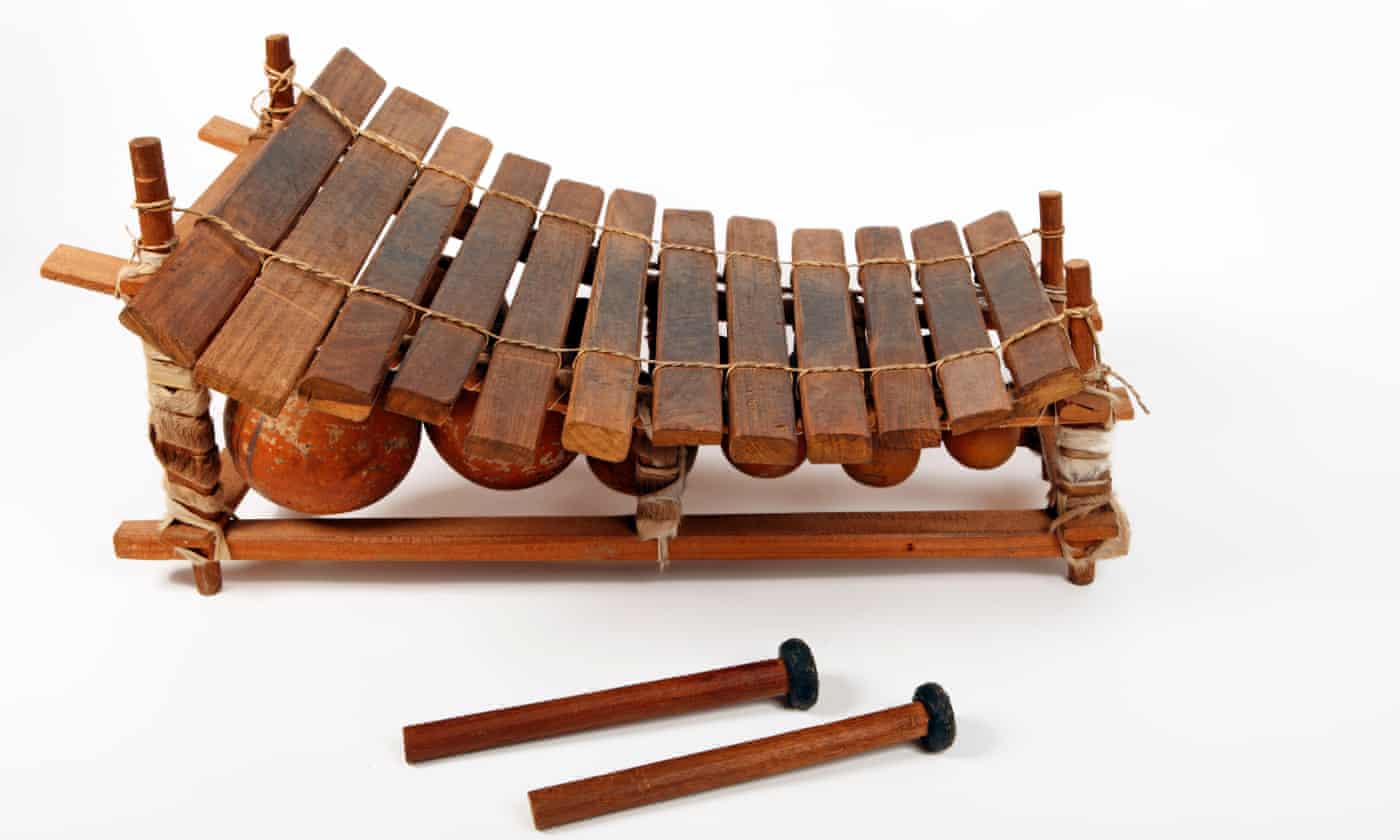
Traditional west African instrument, the balafon.
Having fun today learning about unusual musical instruments, whose fans, though small in number, are nevertheless as devoted as those who love the sound of a French horn or steel drum.
Kevin LeGendre reports at the Guardian, “In the 2022 film Alice, the titular heroine – a slave living on a 19th-century-style plantation in Georgia – discovers that she is really living in the 1970s. The soundtrack reflects the latter period … with interludes that feature an instrument that was first heard in the days of plantations: the contrabass clarinet.
“The instrument is played by James Carter, a 54-year-old musician from Detroit who has been a significant figure in jazz since the early 90s. ‘I just loved the “muddy earth” sound it has,’ he says.
‘All that air flowing through it made you feel like you’re the lord of the underground. The contrabass clarinet has such expressive range; it reminds me of bullfrogs in the night, yet it is also a kind of wise old sage, it’s so commanding.’
“You can hear what he’s talking about on his 2003 album, ‘Gardenias for Lady Day,’ a tribute to the vocal great Billie Holiday. On Strange Fruit, Holiday’s anti-lynching anthem, Carter draws from the contrabass clarinet a series of primeval, haunting wails that entirely suit the subject matter. The low-end horn is like an engulfing darkness. …
“For those who play the sorts of instruments that are rarely seen in orchestras and jazz bands, there are practical hurdles to overcome, such as honing posture and technique to successfully negotiate the shape, size and structure of these uncommon inventions. Not to mention the cost and complexity of servicing and maintaining such devices. …
“First used in 19th-century classical orchestras and military bands, the contrabass clarinet is one of the more obscure members of the woodwind family. It has long held an appeal for jazz musicians intent on creating a wide tonal spectrum in their work. One of Carter’s major sources of inspiration, Anthony Braxton, an innovative Chicago-born composer-improviser, raised the profile of the instrument when he used it at prestigious international festivals in Montreux and Berlin back in the mid 70s.
“ ‘He was way ahead of his time,’ says Carter, whose arsenal of reed instruments also includes F-mezzo, soprano, tenor and baritone saxophones. ‘When he hits a low C, it takes you to another dimension. I wanted to experience the same thing when I played it myself.’
‘With its broad, upright frame, like a giant paperclip, the contrabass clarinet requires its players to have physical strength as well as technique. … Says Carter, “You have to make your lungs work a little bit harder with it, but that’s also the beauty. You feel everything you put into it.’
“As much as Carter, who has worked with jazz and rock stars such as Herbie Hancock and Ginger Baker, hails the wonders of the contrabass clarinet, he is keen to acknowledge the role that specialist woodwind makers such as Benedikt Eppelsheim have played in its evolution. The renowned German instrument maker, who died earlier this year, fitted it with trill keys – small levers that facilitate the shaking and warbling of notes – and additional octaves that ‘let the instrument sing more.’
“[Most] exciting are those custom-made devices that were never put into mass production. Such is the case of a one-off low-register beast played by Paul Rogers that straddles eras, genres and cultures. A hybrid of the baroque-period viola da gamba, double bass and Indian sitar, this unnamed instrument has seven rather than four playing strings, as well as 14 ‘sympathetic strings’ – non‑playing strings tucked under the playing strings to produce greater resonance.
“ ‘It’s a weird combination of many things,’ says Rogers. ‘I told a French luthier, Antoine Leducq, what I wanted and he took about a year and a half to make it. The shape of the instrument is like a small canoe. It’s like a medieval thing, really. But I listen to all sorts of music – medieval classical, Asian and African music – and with this instrument I can really find some of those sounds. …
“Yahael Camara Onono [loves] the balafon. It is one of many traditional west African instruments featured in Balimaya Project, the ensemble he leads that has built a sizeable audience in Britain in the past few years through its blend of Mandé rhythms, jazz, funk and spoken word. Similar in appearance to a xylophone, the balafon has keys made of strips of wood that resonate through small calabashes (gourds) tied underneath. The instrument must be handled with care.
“ ‘You have to be in the right atmospheric conditions because it’s quite fragile,’ says 31-year-old Onono, a percussionist and historian of west African instruments. ‘Heat and humidity affect every part of the instrument, so traveling from one continent to another is tricky.’ “
“When the Dust Settles by Balimaya Project is out now on New Soil/Jazz Re:Freshed.” If you are in London on the 17th of this month, check them out at the Barbican.
More at the Guardian, here. No paywall. Contributions encouraged.

 Suzanne's Mom's Blog