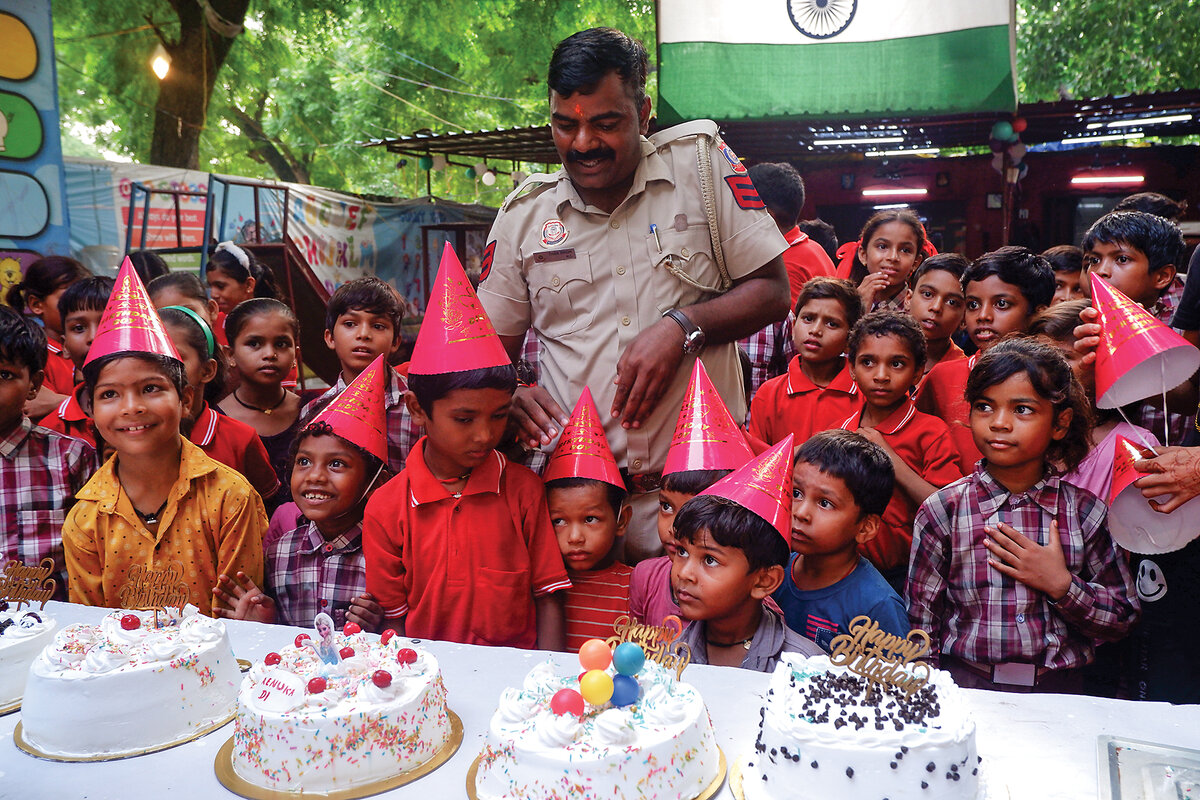
Photo: Shefali Rafiq. Students celebrate a classmate’s birthday at an informal school, or pathshala, set up by police officer Than Singh (center), in a Delhi, India.
Today’s story is about one compassionate person in India who wanted to make a difference in children’s lives. Shefali Rafiq and Saqib Mugloo wrote the photo essay for the Christian Science Monitor.
“It wasn’t until Than Singh came along that learning became a favorite pastime for the children who typically roam Delhi’s streets begging, rifling through garbage, or engaging in petty crimes.
“In 2015, the Delhi police officer started a pathshala, or place of learning, where he teaches 80 students a day in a temple set up near the Red Fort. ‘It was heartbreaking to see children scavenging for plastic bottles in the trash,’ he recalls. ‘That’s when I decided to do something.’
“More than half of India’s children are malnourished, and about 30% of those ages 6 to 18 do not attend school. Mr. Singh, who grew up poor in northwestern Rajasthan state, is determined to change these statistics. ‘My dream is to see every underprivileged child in school,’ he says with a broad, charming smile, adding that he is confident that, with God’s help, he will make it happen.
“He starts his day early, patrolling the busy lanes of Old Delhi, the capital’s historic heart, as part of his duties. But every day after work, he holds classes at his pathshala, where students eagerly await him. Among them are Ajay Ahirwar and Neelu Ahirwar (no relation).
“Ajay says he aspires to become a high-ranking officer in the government so that he can improve the conditions of his family and those living like him. Neelu is fond of her teacher and the pathshala. ‘I would rather be here, even on holidays, than at home,’ says the young girl, who aspires to become an officer in the Indian Police Service.
“Initially, only four children attended Mr. Singh’s pathshala. He contributed money from his salary to buy books, notebooks, pencils, and schoolbags. Nine years down the line, he has now taught hundreds of children.
“ ‘Beyond basic lessons, I try to instill manners and discipline in these students,’ Mr. Singh says. ‘Even if they come to this school just for a meal, I’ll be happy because, seeing others, they may also want to study.’
“Mr. Singh organizes extracurricular activities, too, including cricket. For those children who do attend school in the city, he celebrates good exam results at his pathshala. ‘I just want these children to stay away from all the bad influences they’re vulnerable to,’ he says, referring to the crimes that affect Delhi.
“ ‘Our aim in the world is to spread goodness and happiness.’ ”
More at the Monitor, here. Wonderful photos. No firewall.
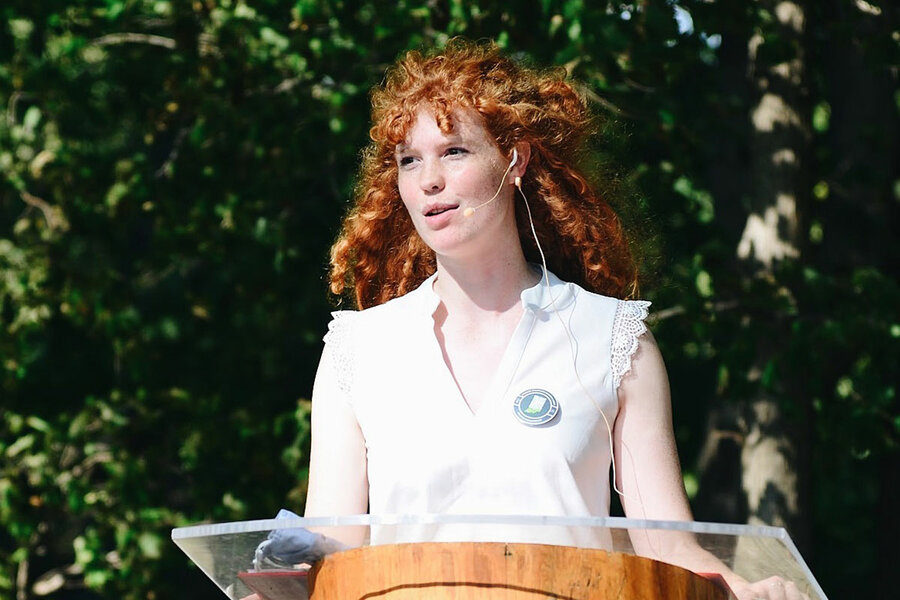
Photo: Chenyao Liu. Elsa Barron speaks at Hoosier Interfaith Power and Light’s Faith Climate Summit, where she was moderating a panel on environmental justice, Oct. 10, 2021.
No group of people is monolithic. All individuals have their own individual views. Which is why we should never assume anything about people who identify with a particular group.
An ESL teacher I work with attends a congregation where almost everyone’s politics are X although hers are Y. She sends her daughter to their school because she loves it overall, but she teaches her daughter some differences at home.
I’m sharing an article that gets into religion just because I thought it was interesting, but if it offends anyone, I hope you know you can tell me. It’s about a small but growing group of American evangelical environmentalists.
Erika Page has the story at the Christian Science Monitor.
“Should I stay or go? It was a question Elsa Barron had wrestled with on her own for years. Now, at a public panel on faith and the climate at the COP26 summit in Glasgow, Scotland, she was on the verge of voicing it aloud to a crowd of strangers.
“The panelists, faith leaders from the All Africa Conference of Churches, hadn’t named names. But Ms. Barron had gleaned the message. One of the biggest impediments to climate action in their communities was … her home community: evangelical Americans, who hold an outsize influence in missionary ministries in Africa.
“She had bitten her tongue through the Q&A session, nervous about being vulnerable in such a high-profile crowd. But just as the moderator moved to close the event, she felt her hand shoot up.
“ ‘I grew up in that community,’ she recalls admitting to the panel, heart racing. ‘What is needed from me in this moment?’
“For evangelical environmentalists, the temptation to leave the church behind and take their climate concerns elsewhere is high. This is especially true among younger generations, who [are] more likely to worry about climate change than their elders. Ms. Barron, for one, stood on the brink of abandoning her faith just a couple of years ago.
“So the response she got from those panelists at COP26 last November has stuck with her.
“ ‘If you have the opportunity to be rooted in your community, asking questions, pushing for change, and advocating for communities that don’t have an inroad to these spaces, then that’s probably the biggest thing you can do,’ she remembers being told.
“The choice to stay and fight has not been easy, demanding resolve, patience, and the courage to speak up, again and again. But at a time when writing off those with differing views has become commonplace, Ms. Barron has found that her empathy and love for her community [have] helped her work with, instead of against, those on the ‘other’ side of the climate divide.
“ ‘It takes a lot of courage to not just pick one side or the other, especially in such an extremely polarized society,’ says Melanie Gish, author of God’s Wounded World: American Evangelicals and the Challenge of Environmentalism. …
“In the United States, climate awareness and urgency have grown steadily in recent years. … Even among white Evangelicals, thought has been shifting. A poll conducted by Yale and other groups in 2020 found that 44% of them attributed global warming to human activity, up from 28% when the Pew Research Center asked a similar question in 2014.
“And the National Association of Evangelicals just renewed a call to action to mitigate the environmental crisis from a ‘biblical basis,’ updating a report from 2011. Yet climate skepticism remains disproportionately high among evangelical Christians, even compared with other religious groups. Some evangelical leaders have pitted environmental movements against religion, painting the former as a politically motivated threat to a faith-driven life. Many simply don’t see church as the place to address environmental concerns. …
“[At the University of Notre Dame, Ms. Barron read] one little book that hit her ‘like a ton of bricks.’ The text was Laudato Si, the 2015 encyclical on ‘care for our common home’ written by Pope Francis. She still remembers her visceral response to her first read.
“ ‘It felt like, “Oh my goodness, how did I miss this?” ‘ she says. Until then, her religion and her love for the natural world had existed in separate spheres. Now, she began to see the environmental crisis as a deeply spiritual crisis, built on a foundation of greed, extraction, and irreverence. And with that understanding came an accompanying spiritual obligation.
“ ‘If we don’t care about it and don’t do something about it, we’re failing to fulfill two of our callings as people of faith: to care for creation and to love our neighbors,’ she says over Zoom from her family’s home in Illinois.
“That’s the idea behind ‘creation care,’ an environmental movement grounded in biblical direction, such as the duty to ‘tend and keep’ the Garden of Eden. … The ideas have been more readily adopted outside the U.S., especially in places on the front lines of climate change. …
“Even though creation care, also known as environmental stewardship, has become more widely accepted in the U.S., being a young evangelical environmentalist can be lonely. …
“[Ms. Barron’s] mother texted her about a group called Young Evangelicals for Climate Action. YECA was founded with the support of the Evangelical Environmental Network in 2012. In addition to the group’s advocacy, the organization trains youth fellows on writing op-eds, talking to representatives, leading projects in their own communities, and engaging effectively with church members and leadership.
“Ms. Barron says she held back none of her trepidation in her application essay to be a fellow – and was welcomed into the fold. For the first time, she met a host of evangelical environmentalists grappling with similar questions, while working to shift the culture on climate within their own churches and college campuses. …
“ ‘It starts with conversations; it starts with one-on-ones … telling your church leaders and pastors what you’re passionate about,’ says Tori Goebel, national organizer and spokesperson for YECA. ‘It’s not necessarily about facts and statistics and different scientific figures, but rather it’s just sharing stories and connecting to shared values.’ ”
More on Evangelical environmentalists at the Monitor, here.

 Suzanne's Mom's Blog