Feeds:
Posts
Comments

Posts Tagged ‘coral reef’

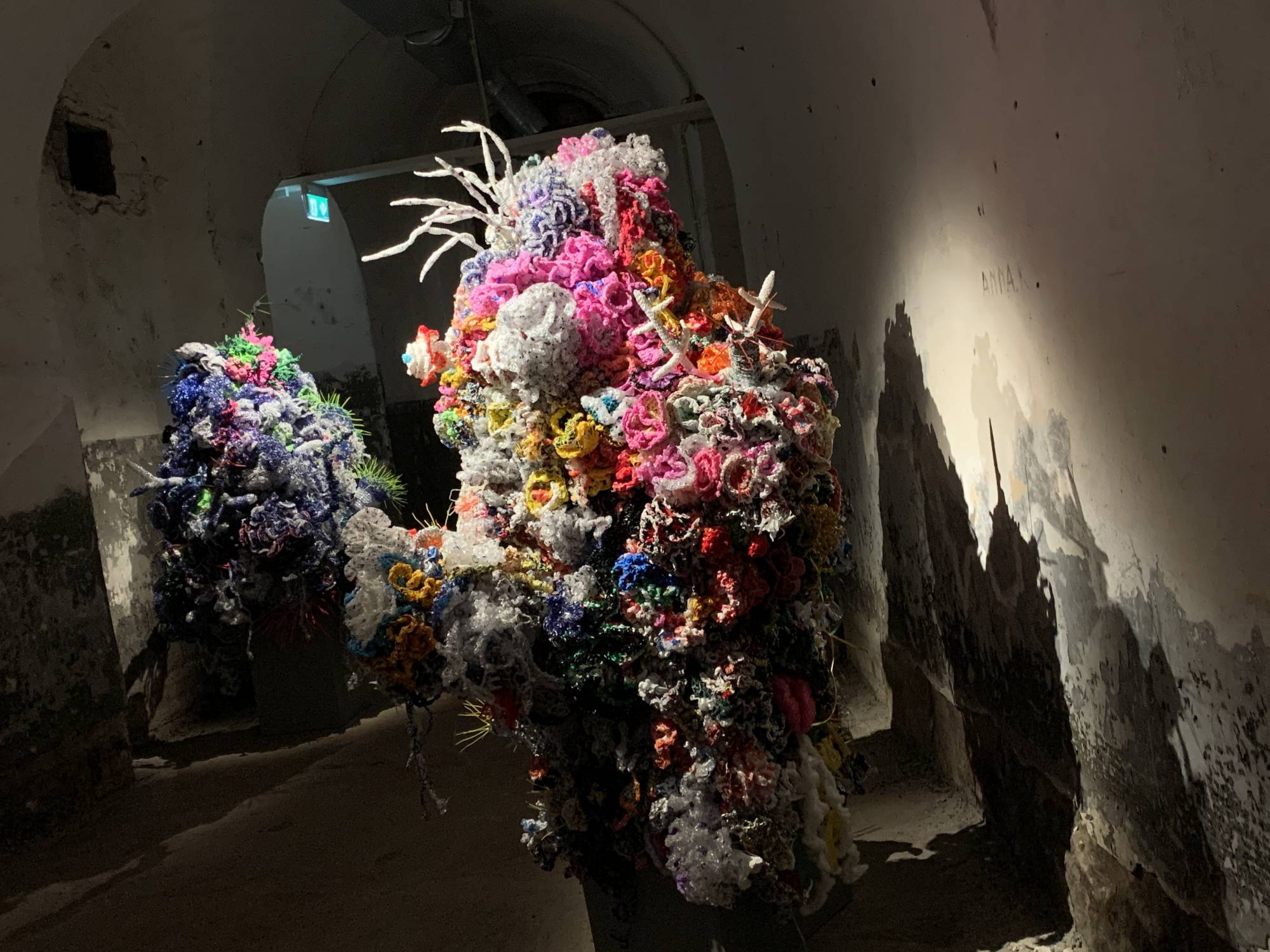
Photo: Institute For Figuring.
Coral Forest – Helsinki, crocheted from recycled plastic. A collaboration between Christine and Margaret Wertheim and the Helsinki Satellite Reefers, hosted by Helsink Art Museum and Helsinki Biennial 2021.

Remember my post on how crochet art was drawing attention to dying coral reefs? (See it here.) Well, after my friend Kristina told me about seeing some of the new additions to the crochet project, I decided to post a follow-up.

Siobhan Roberts reported at the New York Times in January, “Every year after the full moons in late October and November, Australia’s Great Barrier Reef begins its annual spawning — first the coral species inshore, where waters are warmer, then the offshore corals, the main event. Last year, this natural spectacle coincided with the woolly propagation of two new colonies of the Crochet Coral Reef, a long-running craft-science collaborative artwork now inhabiting the Schlossmuseum in Linz, Austria, and the Carnegie Museum of Art in Pittsburgh.

“To date, nearly 25,000 crocheters (‘reefers’) have created a worldwide archipelago of more than 50 reefs — both a paean to and a plea for these ecosystems, rainforests of the sea, which are threatened by climate change. The project also explores mathematical themes, since many living reef organisms biologically approximate the quirky curvature of hyperbolic geometry. …

“The surface of a sphere displays constant positive curvature; at all points, the surface bends inward toward itself. And a hyperbolic plane exhibits constant negative curvature; at all points, the surface curves away from itself. Reef life thrives on hyperbolism, so to speak; the curvy surface structure of coral maximizes nutrient intake, and nudibranchs propel through water with frilly flanges.

“In the artworks, marine morphologies are modeled — crocheted — with loopy verisimilitude. A bit like Monet’s water lilies, the crochet corals are abstract representations of nature, said Christine Wertheim, an artist and writer now retired from the California Institute of the Arts. Dr. Wertheim is the driving artistic force behind the project, which she created with Margaret Wertheim, her twin sister, a science writer who is in charge of scientific and mathematical components as well as management. …

“Crochet Coral Reef exhibitions typically have two main components: The Wertheims provide an anchor, of sorts, with works from their collection that they have crocheted over the years. They also incorporate pieces by select skilled international contributors. One is a ‘bleached reef,’ evoking corals stressed by increases in ocean temperature; another, a ‘coral forest’ made from yarn and plastic, laments the debris that pollutes reef systems.

“Then in response to an open call, volunteers far and wide crochet a pageant of individual specimens that agglomerate in a ‘satellite reef,’ staged by a local curatorial team with guidance from the Wertheims. … All contributors are credited.

“The largest satellite reef thus far coalesced in 2022 at the Museum Frieder Burda in Baden-Baden, Germany, with some 40,000 coral pieces by about 4,000 contributors. The Wertheims call this the Sistine Chapel of crochet reefs (documented in a splashy exhibition catalog). But the show at the Linz Schlossmuseum, which is dedicated to natural science as well as art and culture, is reminiscent of the work of the painter Giuseppe Arcimboldo, whose collage portraits from depictions of fruits, vegetables and flowers are ‘fantastically heterogeneous, also very funny and clever,’ Ms. Wertheim said.

“The Linz satellite reef unites some 30,000 pieces by 2,000 crocheters. The disparate parts take colorful inspiration from traditional Austrian ‘craftswomanship,’ as the exhibit text puts it, and there is a vast, glittery coral wall that gives a nod to the artist Gustav Klimt. In the Wertheims’ view, however, the crochet coral project is proof that it is not always lone geniuses who create great art, but also communities. In the art world, that is a radical idea, they noted, yet in science big collaborative projects and papers with thousands of authors are not unprecedented. …

“The mathematical dimension of the story intersects (from afar) with research by the applied mathematician Shankar Venkataramani and his students at the University of Arizona. They use idealized models to study hyperbolic surfaces in nature. [The] benefit, he said, is that it helps optimize processes like circulation and nutrient absorption. …

“When Margaret Wertheim, who studied math, physics and computer science at university, learned hyperbolic geometry, she found it ‘a bit bamboozling.’ She took the principles more on faith than understanding. Yet through crocheting models, she said, ‘you really do learn in a very deep way what a hyperbolic structure is, and in a way that I think is very powerfully pedagogical.’ “

More at the Times, here. Gorgeous photos.

See also Crochet Coral Reef, here. As the website notes, “Every crafter who contributes to the project is free to create new species of crochet reef organisms by changing the pattern of stitches or working with novel materials. Over time, a Darwinian landscape of wooly possibility has been brought into being. What started from simple seeds is now an ever-evolving, artifactual, hand-made ‘tree of life.’ “
Read Full Post »

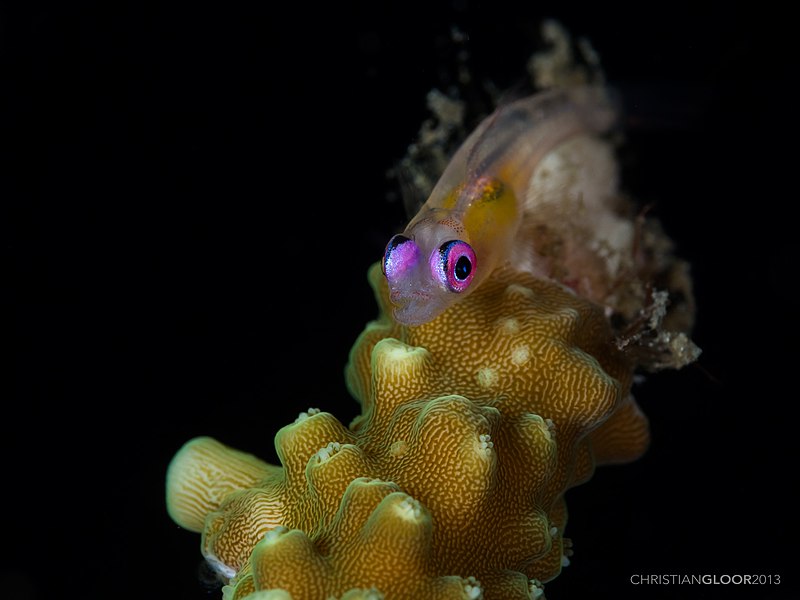
Pinkeye Goby / Bryaninops natans

Photo: Christian Gloor
By living fast and dying young, red eye gobies fuel reef fish biomass production, which helps explain why reefs can flourish in nutrient-poor waters.

You don’t have to be big to be important. Consider the tiny red-eyed goby, a fish that is vital to coral reefs. For years, scientists couldn’t figure out how there could be such lush biodiversity on coral reefs in clear, low-nutrient waters.

Turns out the answer was hiding under their noses.

Leila Miller writes at the Los Angeles Times, “It’s one of the enduring mysteries of marine biology: How can coral reefs sustain such diverse ecosystems when they are surrounded by clear, low-nutrient waters? Now scientists think they’ve found the answer, and it’s been hiding in plain sight all along.

“The coral reef food chain is powered by some of the ocean’s smallest vertebrates — tiny fish that are gobbled up so quickly they’ve been easy to overlook.

“These fish are small enough to fit in the palm of your hand, but they play an almost heroic role in sustaining coral reefs, according to a study published this month in the journal Science. In fact, these little swimmers account for almost 60% of the fish flesh eaten on reefs, researchers found.

“ ‘They’re really like high-octane fuel for larger fish,’ said study leader Simon Brandl, a marine ecologist at Simon Fraser University in Burnaby, Canada. …

“Coral reefs are like underwater rain forests — they’re incredibly diverse and are home to more than 6,000 species of fish, Brandl said. Yet the nutrients needed to maintain this abundance of life seemed to be lacking. …

“Brandl and his colleagues make a strong case that high turnover of tiny fish is an important part of the story, said Douglas McCauley, a marine biologist at UC Santa Barbara who did not work on the study. …

“The tiny fish hatch from eggs, and within a day or so, the larvae are old enough to find their own food. Then they have to grow up and reproduce within a month or two — before they get eaten. …

“The females have another problem to contend with: low egg counts. Their small bodies can produce only about 100 eggs at a time, on average, while larger fish may lay tens or hundreds of thousands.

“ ‘It didn’t seem to add up,’ said senior author David Bellwood, a marine biologist at James Cook University in Townsville, Australia. ‘How on Earth did they survive?’

“In a word: larvae. … While the larvae of most coral reef fish wander out into the open ocean to escape predators on reefs, the larvae of cryptobenthic fish hang out near the reef as they mature. This seems to dramatically enhance their survival and return rates, Brandl said. …

“It may seem surprising that scientists didn’t know where more than half of the fish food supply was coming from, but at any given moment, the tiny fish make up only a minuscule percentage of the total fish flesh on a reef. The key was to see that the population replenished itself so quickly, [Luke Tornabene, a fish biologist at the University of Washington in Seattle who worked on the study] said.”

Read more at the Times, here.

Hat tip: Matt Stiles‏ on Twitter.

Read Full Post »

prcorals_grupo_vidas

Photo: Bobby Bascomb
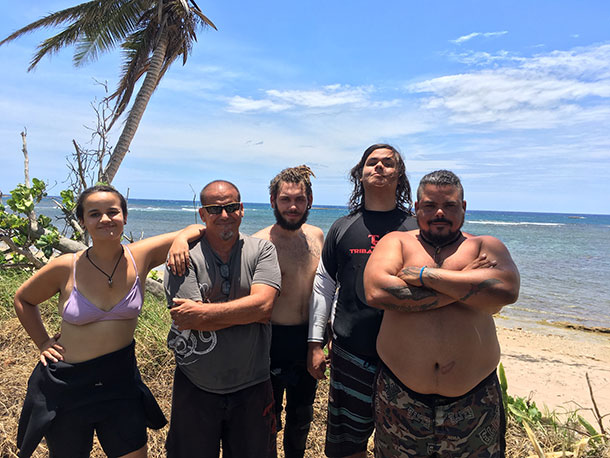
The Grupo Vidas crew taking a break from their coral restoration work in Puerto Rico.

Perhaps inadvertently, media stories lead one to believe that all Puerto Ricans are passively waiting for the Mounties to rescue them from the destruction of Hurricane Maria. The Mounties surely better get their act together, but residents of the island are not counting on them. They’re taking matters into their own hands. I plan to post soon about the women who are rebuilding the island’s farming industry, but today the topic is restoring damaged coral reefs.

The National Public Radio (NPR) show Living on Earth has the story.

“Roughly 10 percent of Puerto Rico’s corals were broken and damaged by Hurricane Maria in 2017. Corals are a first line of defense against storm surges and a critical habitat for juvenile fish but face an uphill battle against warming seas, ocean acidification and ship groundings. As Host Bobby Bascomb reports, Puerto Ricans are finding ways to give corals a fighting chance by reattaching healthy fragments. …

“BASCOMB: Chunks of coral were broken off by rough seas and ocean swells. But on a recent trip to Puerto Rico, I discovered there’s still hope for thousands of battered bits of coral lying around the sea floor.

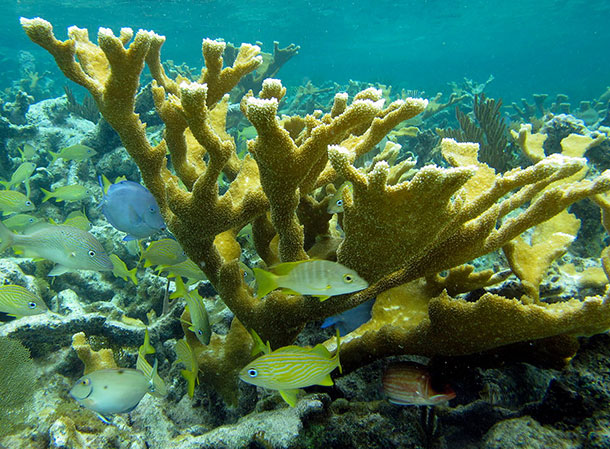
“I’m standing on a tall dune near Vega Baja on Puerto Rico’s north coast. The ocean stretches out in shades of dark blue, turquoise, and pale aquamarine. But interspersed among the usual colors of a tropical ocean are patches of brownish orange – elkhorn coral.

“Salvador Loreano is a worker with the environmental NGO Grupo V.I.D.A.S. Their main task is coral restoration.

“S. LOREANO: Our goal right now is to plant coral fragments here because you know that Maria, Hurricane Maria, came here and devastated the island. This caused great damage to the coral reef because the first time we went to there after Maria, the reef was like destroyed, like we see big coral colonies upside down and a lot of dead coral.

“BASCOMB: As long as they remain submerged under water, these coral, which are colonies of tiny invertebrate animals, have a 20 percent chance of survival. But that increases to more than 90 percent if they are attached to a larger structure, not getting banged around by the surf or smothered with sand.

If a piece of coral is at least 2 inches long and 80 percent healthy, it can actually be reattached to an existing reef. …

“MARIOLA LOREANO: [Here’s] a slate where we write our tallies, basically, which is all of the fragments that we’ve successfully planted, a bag for any trash that we find inside the ocean, and a buoy so it floats. …

“BASCOMB: We put on our mask, snorkel, and fins and walk backwards into the bath-warm water, stepping over the sharp black sea urchins. … A rainbow of fish greets us – green fish with florescent blue heads, black fish with yellow stripes, green fish with pink stripes. They’re all juvenile fish, and the reef is a critical habitat for them. …

“A worker named Ernesto is already hard at work. He uses a wire brush to scrape algae off a piece of coral the size of a ping pong paddle and does the same to a suitable spot on the reef. Just like gluing two objects together, you need to start with a clean surface on both sides. Then he pulls a plastic zip tie out of his sleeve and uses it to attach the coral in place.

“He uses pliers with a florescent pink handle to pull the zip tie tight and cut off the excess plastic, which he sticks in his other sleeve. This piece of coral is now one of hundreds just like it pinned to the reef with zip ties. And in two to three weeks, it will grow onto the reef enough to stay put on its own. …

“BASCOMB: If hurricane damage was the only issue, this work wouldn’t be necessary. But much like the world’s coral reefs in general, this reef has a lot of challenges. Grupo V.I.D.A.S. worker Ernesto says one of the biggest problems is algae blooms from sewage runoff. In many places the coral is essentially smothered, leaving it a ghostly gray color. …

“E. VÉLEZ GANDÍA: It’s like Day of the Dead but under the water.

“BASCOMB: There is a very large dead coral at the entrance to the reef in the shallowest, warmest water. Ernesto believes that one died not from algae blooms but from stress of a warming ocean. … Ernesto talks about the death of that coral as one might talk about a member of the family passing away.

“VÉLEZ GANDÍA: And we got a lot of love for him. We saw him alive, very alive. He is one of the oldest in our reef, but he start dying. We saw the process of his death. So, we just admire him and remember him. It’s very sentimental, I don’t know, but it’s deep in the heart.”

More at Living on Earth, here. And you can read another article about ways to save reefs at Earther, here.

Photo: Sean Nash
Elk horn coral are part of a vital reef ecosystem that provide habitat for fish. In Puerto Rico, many were damaged after Hurricane Maria.

prcorals_elk_horn_coral

Read Full Post »

My friend Kristina is an artist with a long-time interest in shells. At a Harvard-based shell club that she frequents, she meets many interesting artists and scientists — including George Buckley, a Caribbean coral reef researcher who made the video below.

Buckley says, “Little did I know in 1976 that my first visit to Bonaire to study land snails … and dive with Captain Don Stewart would lead to a career interconnected with Bonaire and to some 100 more return trips!

“Bonaire became the focus of case study after case study of marine management and biodiversity in my Harvard University environmental management program. [Dozens] of research and study groups, students, magazine writers and photographers that I brought to the island all fell in love with the landscapes and the emerald sea of Bonaire.

“The early years of the Bonaire Marine Park [BMP] and STINAPA [Dutch acronym for national park] … were a great adventure and while my efforts with the Carco Project and Marecultura were not as successful as hoped, both helped to lay the groundwork for future efforts around the world as to best practices in that field.

“The BMP’s pioneering leadership in education, moorings, gloves policies, banning light sticks and spearfishing, creating the ‘Nature Fee’ and so much more led to Bonaire’s well-deserved world-wide recognition. The efforts to save Klein Bonaire were a testament to international collaboration and stand to this day as the Hallmark of what a committed group of concerned people can accomplish. It is indeed true that Bonaire is to conservation of nature as Greenwich is to time – with credit to Captain Don.”

If you are on Facebook, check out the rest of Buckley’s post.

Photo: Sand Dollar in Bonaire


Read Full Post »