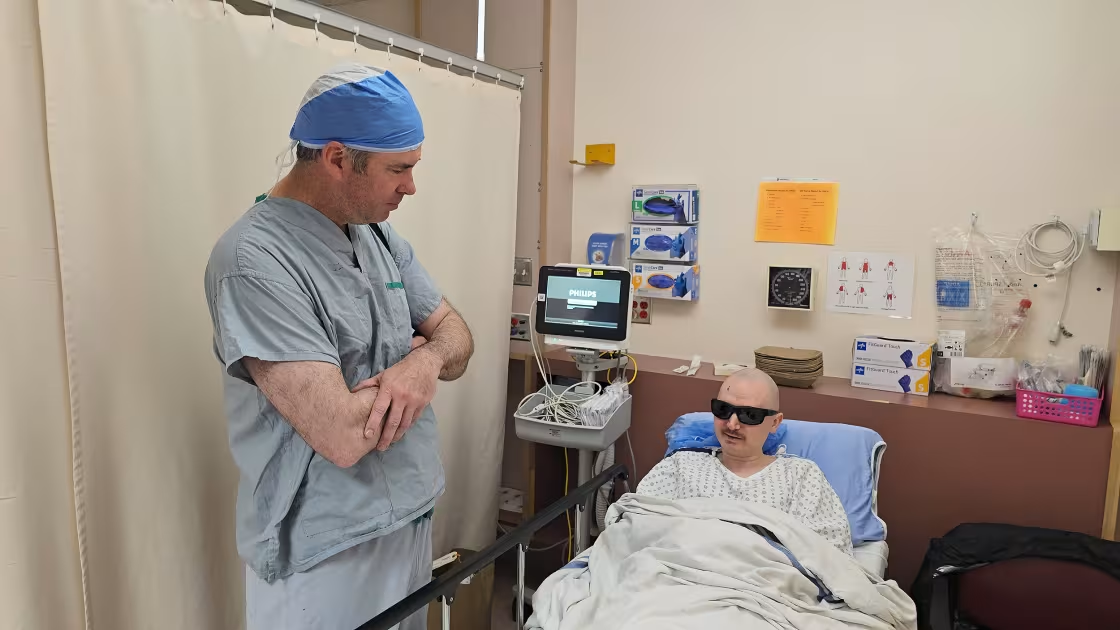
Photo: Phil Chapman.
Dr. Greg Moloney, left, and Brent Chapman talk before the second stage of Chapman’s tooth-in-eye surgery.
Today’s story is about a fascinating kind of surgery for a very specific kind of eye problem. It came about because surgeons needed a hard material that patients’ immune systems wouldn’t reject. Surprisingly, it’s been used since the 1960s.
A. Pawlowski reports the story at Today.
“Brent Chapman can see again,” she writes, “after doctors pulled out one of his teeth, flattened it, drilled a hole in it, placed a lens inside and implanted the tooth in one of his eyes. It seems bizarre, but the complex operation — informally known as tooth-in-eye surgery — can help restore vision in patients with the most severe forms of corneal blindness.
” ‘It kind of sounded a little science fictiony. I was like, “Who thought of this?” Like this is so crazy,’ Chapman, 34, who lives in North Vancouver, British Columbia, tells TODAY.com about his first impression of the concept.
“ ‘Usually, the reaction is shock and surprise and frank disbelief that it even exists,’ says Dr. Greg Moloney, his eye surgeon and an ophthalmologist at Providence Health Care’s Mount Saint Joseph Hospital in Vancouver. The technique was developed in the 1960s, and Moloney estimates several hundred people around the world have undergone the procedure.
“It’s for patients who have a healthy back of the eye, but have suffered severe damage to the front of the eye — the cornea — from a chemical burn, a fire or explosion, or an autoimmune reaction where the immune system attacks the eye.
“In those cases, doctors need a way to restore a clear window to the back of the eye — like changing a severely damaged windshield in a car, Moloney says.
“It turns out a tooth with a lens implanted in the eye is the solution.
“Chapman was 13 years old when he lost his vision. He was playing in a high school basketball tournament, felt a little ill and took a couple of ibuprofen pain relievers. Healthy until then, Chapman had a life-threatening skin reaction to the medication known as Stevens-Johnson syndrome.
“In a coma for 27 days, Chapman recovered, but his eyes were forever impacted. His left eye is irreversibly blind, while his right eye suffered severe damage to the cornea. He spent the next 20 years traveling the world trying different procedures to preserve any vision he had left, including 10 cornea transplants. But they worked only for a short period of time. …
“Humans have been trying for hundreds of years to figure out how to put an artificial cornea on the front of an eyeball — the biggest issue is getting it to stay in place so that the body doesn’t reject it, Moloney notes. A patient’s own tooth solves that problem.
It’s a hard structure that can survive in this harsh environment, and the body understands it as part of itself, allowing it to grow into place, the doctor explains. …
“The ideal candidate for tooth-in-eye surgery — officially known as osteo-odonto-keratoprosthesis — is blind in both eyes from a disease that has affected the surface of the eye, but still has a healthy optic nerve and retina.
“The first stage of the two-step operation took place in February when Chapman had one of his teeth pulled. It had to be a healthy tooth that’s ‘bigger and then quite robust in order to hold the lens,’ Dr. Ben Kang, his oral surgeon, tells TODAY.com.
“He extracted one of Chapman’s upper canine teeth, then shaped and flattened it down with a drill so that it became rectangular. A hole drilled in the middle of the structure allowed the lens to be installed inside. …
“The tooth was then put back into Chapman’s cheek and implanted in a fat pocket underneath his eye for three months so that the body could grow tissue around it. Moloney would use it to stitch and anchor the structure to the front of his patient’s right eye.
“That second stage of the surgery took place in June. After waking up, Chapman could see hand motions right away, but it took a couple of months for his eye to heal after the surgery and for his vision to sharpen.
“ ‘We tried some glasses and I had this moment where I was like, wow, OK, I’m really seeing well now,’ Chapman recalls. ‘Dr. Maloney and I made eye contact, and it was quite emotional. I hadn’t really made eye contact in 20 years.’ “
Read more at Today, here, and still more at Wikipedia, here.

 Suzanne's Mom's Blog