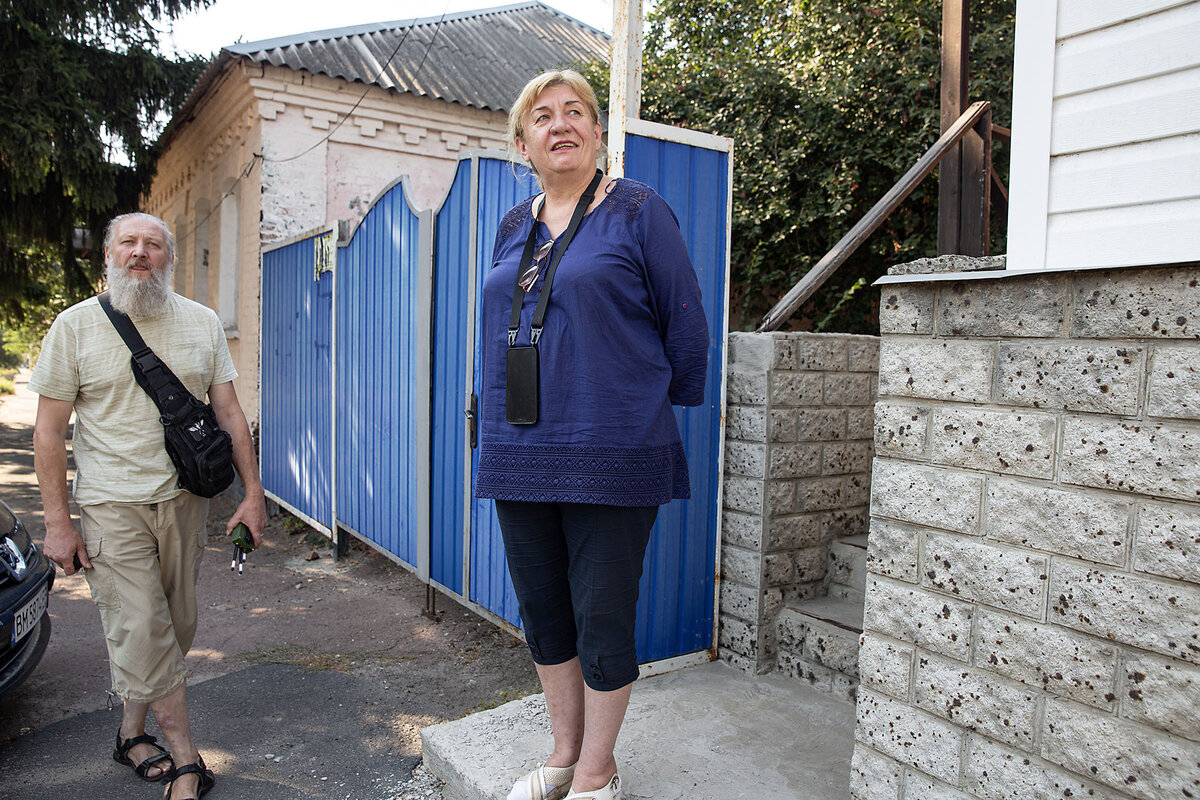
Photo: Dominique Soguel.
Nataliia Kalinichenko and her husband, Yurii, outside the office of the print weekly Bilopilshchyna, which they have continued to publish despite the war.
And while we’re on the subject of Ukraine, I want to share a story while it’s fresh, because in a war zone, you never know how long a piece of good news will last.
Dominique Soguel (with support from Oleksandr Naselenko) reports at the Christian Science Monitor, “The streets of [Bilopillia, Ukraine], just seven miles from the Russian border, are nearly deserted. Air-raid sirens have been a round-the-clock reality for weeks, and people take them seriously: When the warnings blare, everyone lies flat to take cover or scrambles to underground shelters.
“But for Nataliia Kalinichenko and her husband, Yurii, there’s no break from getting the news out to the community. They have safety routines; Ms. Kalinichenko asks friends or relatives to monitor social media platform Telegram for news of incoming Russian attacks, while Mr. Kalinichenko uses a drone detector while driving. But their mission is to keep locals informed through publication of their print weekly, Bilopilshchyna.
“Before the war, the newspaper featured 12 to 16 colorful spreads with articles on local entertainment, politics, and practical information like bus schedules. Now, it is a stark black-and-white publication filled with military and civilian obituaries and snapshots of local buildings destroyed by Russian attacks.
“ ‘With the onset of Russia’s invasion, our community’s information needs changed dramatically, as did our ability to meet them,’ says Ms. Kalinichenko, who joined the newspaper in 1996 and became its editor-in-chief a decade later. ‘Safety became the primary concern.’ …
“The information landscape has transformed over the past 2 1/2 years. Televisions, once tuned to Russian and Ukrainian channels, lost their appeal. The first Russian strike on the town’s television tower in March 2022 marked the beginning of a series of barrages. Telegram, which now tracks incoming missiles, has become a lifeline – though it requires electricity and an internet connection. Both have been hard to reliably access amid Russia’s offensive. …
“Inevitably, the community has shrunk. The agricultural district of Bilopillia was once home to about 16,000 residents. Now the figure is between 3,000 and 8,000, according to Ms. Kalinichenko. Residents come and go depending on attacks and electricity supplies. New arrivals from other regions temporarily swell the numbers.
“The Kalinichenkos are determined to stay put and keep the paper running as a team. On the walls of their office hang photographs documenting the paper’s history, including a period when it was known as the Flag of Stalin. Piles of newspapers are testament to disruptions in postal delivery services, and a collapsed ceiling from a recent blast prevents Ms. Kalinichenko from sitting at her usual desk.
“At a nearby shop, salesperson Nina Davydova and her teenage daughter, Victoria, discuss the toll of constant strikes. Though Victoria gets her news only through Telegram, Nina says Bilopilshchyna is still popular.
“ ‘People really like to buy the newspaper,’ she says, pointing out that she has already sold six copies this morning, even though Russian attacks were particularly intense. ‘Grandmothers will buy five to six copies so that they can bring it to their neighbors who cannot walk.’
“The newspaper sells at 20 locations in the Sumy region, which shares a 28-mile border with Russia. While many readers have fled, they continue to pay for a subscription in order to remain connected to their homeland, says Ms. Kalinichenko. Even in its reduced format, it serves as a vital source of information for local agricultural communities.
“Serhii, a sardonic shopkeeper, displays the latest copies alongside shrapnel that damaged his shop, which sits a few blocks from Nina’s. ‘If people would not buy it, I would not sell it,’ he says. ‘About five people buy it every day. But people also come from surrounding villages on market days to buy 10 copies at a time.’
“Articles pay tribute to slain soldiers and quote analysts to dispel rumors and dismantle Russian disinformation. One recent instance involved pollution of the river Seim – caused by industrial activities upstream in Russia. Russian trolls on Telegram spread the notion that drinking water had also been compromised, but that was not actually the case. Experts quoted in the paper helped debunk that notion.
“ ‘For villagers with no internet, it is an important source of information and local news,’ says Serhii.
“That assessment is echoed by customer Dymtro Potiomkyn, who grew up with the paper on the family table. He recalls it being a way for people to buy and sell goods locally. Today, it publishes information about what kind of social help is available locally. He buys the paper in person, while his mother gets it delivered by mail.
“ ‘This newspaper is crucial for villages that are right on the border with Russia,’ says Mr. Potiomkyn, who runs a funeral business in the region. ‘Some have been without electricity or internet for years. It’s literally their only source of Ukrainian news.’ “
I know from my own four-month remote gig with a Ukrainian news outlet that Telegram is important to the information landscape there. I also know about Ukrainians’ concern that the outside world gets false information from social media posted by Russians. That’s why Americans like me were helping Ukrainian journalists put their own Twitter and Facebook updates in colloquial English. My experience here.
More at the Monitor, here. No paywall. Subscriptions are reasonable.

 Suzanne's Mom's Blog