Feeds:
Posts
Comments

Posts Tagged ‘croatia’

Photo: Kaitlyn Dolan/The Washington Post.
An autograph book so huge it takes two people to carry was assembled by Joseph Mikulec of Oroslavje, Croatia. It was a hit in the US a century ago, then forgotten.

Today’s story is about how one man turned his wanderlust into a pilgrimage that captured the imagination of so many people that his travels paid for themselves. A century later, the autographs documenting those travels are feeding the dreams of his tiny Croatian village.

Petula Dvorak reports the story for the Washington Post.

“Viktor Šimunić snap-snapped the metal latches on the security case shut to keep the precious book safe. … About a foot thick, the book is leather-bound and worn. The pages crackle, and it looks like a magical book of spells from a fairy tale. It weighs about 60 pounds and cost the small town that purchased it nearly a quarter-million dollars.

“ ‘It is history of that time,’ said Šimunić, the mayor of the Croatian town that bought the book. ‘And it is about a dream.’

“It is the autograph book of Joseph Mikulec, a humble farmer who set off from the Croatian town of Oroslavje to see the world in 1901. He became a global sensation, followed by news reporters, featured in newsreels and welcomed by dignitaries. He visited at least 33 countries, traveling more than 200,000 miles — all on foot, with the book in tow: in a bag, on his shoulder, and eventually in its own custom-made stroller. …

“Mikulec died in 1933, his story and his book largely forgotten over the past 100 years, until two things happened:

“Šimunić, the 34-year-old mayor of Oroslavje who traveled the world before returning to his hometown, heard about Mikulec from a local teacher two years ago. He was riveted by the story, the élan and hubris of someone from his sleepy, 14th-century village.

“Unbeknownst to Šimunić, across the Atlantic, a rare-manuscript dealer named Nathan Raab was puzzling over the remarkable leather book held together with a thick leather horse strap, which a man had lugged into his Philadelphia office in 2021.

“The man was a descendant of the ACME grocery magnate who bought it from Mikulec in 1925. Raab was unsure what exactly it was, but guessed it had a tremendous backstory.

“Cracking open the well-worn spine revealed a time capsule.

“ ‘I take pleasure in giving this letter to Joseph F. Mikulec as evidence he called at the White House on this day,’ says the Feb. 1, 1915, entry by President Woodrow Wilson, one of six U.S. presidents who signed Mikulec’s book.

“Mussolini, Ford, Tesla, Edison, King Edward VIII and British Prime Minister David Lloyd George were among 60,000 others who stopped whatever important business they were doing to sign the autograph book.

“It became Mikulec’s life mission. As he became increasingly famous, world leaders, artists and luminaries from Egypt to New Zealand were thrilled to sign what was becoming a global ‘Who’s Who.’ Some wrote full letters and included stamps, seals and photos.

“It was a time when [usually] all it took was Mikulec’s charisma to get past one grumpy guard.

“ ‘I walked up to 10 Downing Street, London, the other day,’ Mikulec told the Evening Star in December 1919. He wanted to see Prime Minister David Lloyd George, but he was out and Mikulec left his book for him to sign.

“ ‘When I came back the autographs of most of the cabinet were in my book, and there were two photographers waiting to snap me on the way out,’ he said.

“Mikulec gave lectures, bringing the world to the people who shared his wanderlust. He funded his adventures by charging admission to some of his story hours and selling postcards of himself to his legions of fans. …

“ ‘I would say he was like an archetype of today’s influencer or travel blogger,’ said Roberto Kuleš, president of Oroslavje’s city council and a member of the five-man delegation that traveled to the East Coast last week to buy the book from Raab as part of a grand plan. …

“Mikulec was born in 1878 to a poor farmer who lived near Oroslavje, a small town on the outskirts of Zagreb. He was expected to work in the fields. But he declared his wanderlust in his youth. …

“The townsfolk told the dreamer: ‘“’You must get married. You must have children. You must stay home. You must work and be ordinary,’ Šimunić said.

“Mikulec managed to leave his family farm in 1901 to work in Italy and Malta. When his father died in 1905, the 27-year-old hopped on a steamboat to South Africa to begin a trip that would last nearly three decades. From there, he went to South America, where he camped in rainforests and survived on wild fruit, roots and nuts. …

“His lectures included ‘the tale of the snake that stabbed him near Matildas, of the Indian woman who pummeled him in Argentine, of Roosevelt and Wilson as they talked to him, of the bones of the whale on the Brazilian coast so enormous he could barely lift one rib, of Moros whose chests were so roughened by climbing shaggy trees that they looked like crocodiles, the Detroit Free Press wrote in June 1919. …

“There were actually three books in total — the other two much smaller. One that had been with Mikulec’s distant family is on display in the Croatian History Museum in Zagreb, which acquired it in 2023. Croatian historians had been buzzing at the news that the biggest book, the one presumed gone, surfaced in Philadelphia.

“As Šimunić learned more about Mikulec’s story, he was inspired by the global impact a farmer from a small village had made. He commissioned a statue of Mikulec with the book on his shoulder. And he longed to buy the biggest book, the famous one in Philadelphia.

“He called Raab and asked for a digital copy of the pages.

“ ‘I told him, you don’t know me, I’m a little mayor from a little city,’ he said. ‘But we have good intentions.’ …

“It was electrifying to finally see the book last week in Philadelphia, Šimunić said. Raab said he, too, was moved by the moment. ‘It’s touching for us to know that it’s going back home,’ he said in his company’s podcast episode about the book. ‘Where it belongs.’ “

More at the Post, here.
Read Full Post »

Photo: Colin Dutton/The Guardian.
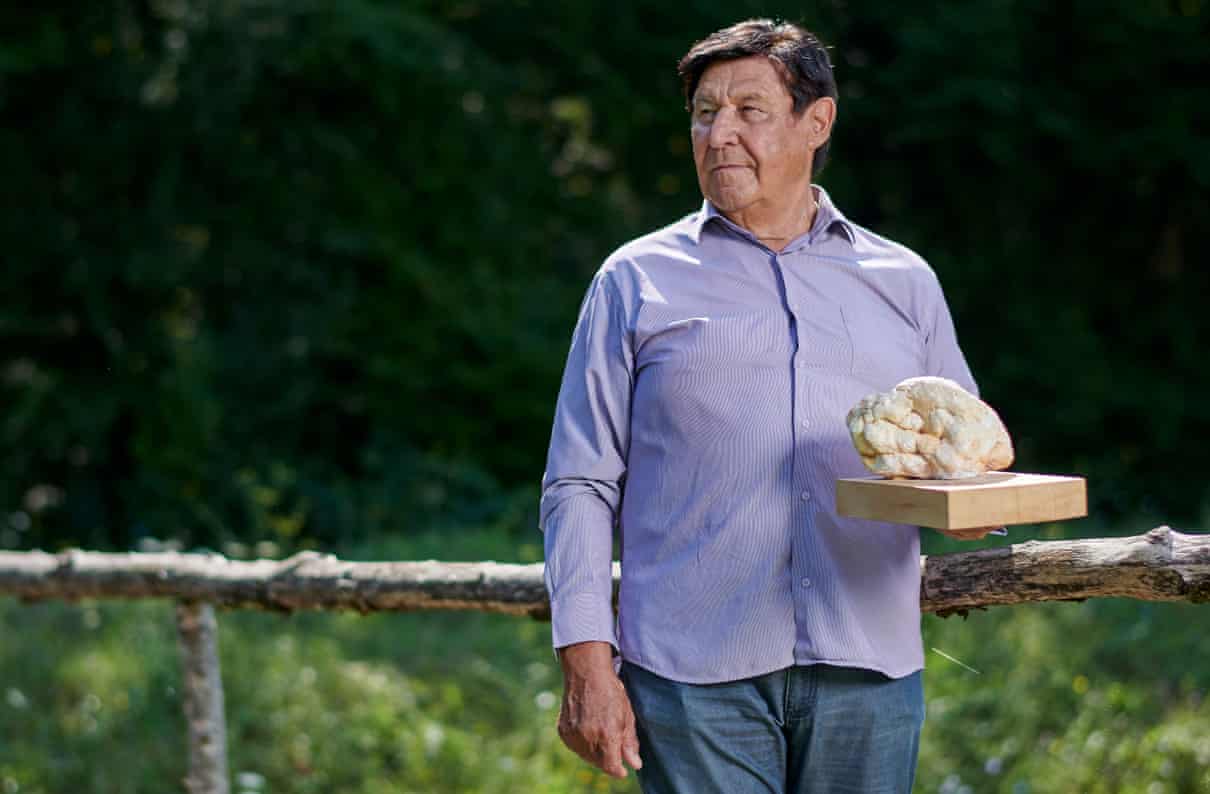
Giancarlo Zigante, of Croatia, with a replica of the giant truffle he found in 1999.

Here’s something fun my husband told me the Guardian had started doing: soliciting interesting stories from readers. Truffle hunter Giancarlo Zigante’s story was told to Sophie Haydock.

“It was 2am when I left the house that night in November 1999. I was heading out into the Motovun forest in Istria, in the north-west of Croatia, to hunt for truffles. Serious truffle hunting is done at night – it’s better for the dogs, as the moisture carries the smell of the truffle better, and also it’s harder to be followed.

“It was a freezing night – the temperatures at that time of year dip below zero. Being a truffle hunter is not an easy job: it’s usually wet and muddy in the forest. You often get scratched and dirty, and can return empty-handed. Still, I had a gut feeling that the night would be a good one, so with Diana, my trusty German pointer, I set off.

“A truffle is an edible fungus that grows underground, often in the roots of oak trees. A good hunter might be able to see subtle signs of a truffle beneath the soil, but it’s down to luck – and, of course, a well-trained dog, who can indicate when you’re at the right spot.

“In Istria, it’s possible to find four types of truffle (one white and three black). But it’s Tuber Magnatum Pico, a white truffle with pale yellow skin and a pungent smell, that is the most precious and expensive. …

“I started truffle hunting in the early ’80s, when I was still in my 20s. I was the first person in my family to do anything with truffles. It started as a hobby, to supplement my income, and it grew from there. I really connected with it. I was a tool-maker for the medical industry before, but fell in love with the truffle-hunting lifestyle.

“My spot was the Motovun forest – I’ll never reveal the exact location. Because of the money that can be made from truffles, rivalries have sprung up, sometimes deadly: people in other countries have been shot. …

“When truffle hunting, you lose track of time – it behaves differently. So I don’t know how long it was, perhaps a few hours, before [Diana] indicated a new patch of earth. I got on my knees and started digging, down to about 20cm [~8 inches]. I could see it was a big one, so I was careful not to damage it. It took 15 minutes to dig it out.

“I weighed the truffle straight away and knew I had something special on my hands. It weighed 1,310g [2.8 pounds]. In the morning I spoke with Guinness World Records, who confirmed that it was the biggest truffle ever recorded. I could have sold it for €1m and made my fortune, but I knew instantly that I didn’t want to do that. It’s great to be rich, but I felt the truffle could have more impact if it was shared. The truffle was found in Istria and should be consumed here, not sold to a rich person abroad.

I invited 200 people from Istria to a feast, on me, and we ate it between us. The night was very special; an amazing atmosphere. Even the president of Croatia was there. Every white truffle tastes amazing – but this one was different. …

“I was like a hero in my community. It put Istrian white truffles on the gastronomic map. Three years after finding the truffle, I decided to start my own restaurant. Now there’s a bronze statue of the truffle at my restaurant in Livade, a village in Istria. It’s a great conversation starter – people think it’s a statue of a brain. They can’t imagine a truffle could be that big. …

“My truffle is no longer the largest ever found: the record was broken in the US in 2014. But that one, weighing 1,786g, was sold to the highest bidder.”

More at the Guardian, here.

Read Full Post »

Here’s a story from Total Croatia News, which I am not quite sure how I found. Probably a link on ArtsJournal or Facebook or Twitter. I can’t claim to read it regularly.

Daniela Rogulj wrote back in December that with its open digital library, Croatia is the first Free Reading Zone. The top 100,000 digital books from around the world — both bestsellers and academic books — are available without any cost, card, or code.

You do need to be within Croatia’s borders, and you have to download the free “Croatia Reads” app on Android or IOS smartphones and tablets.

The concept was tested early last autumn at Zagreb’s Velvet Café, and it worked. The generous support of sponsors enables publishers and authors to be paid when books are read.

More at Total Croatia News, here, and at Publishing Perspectives, here.

Now I’m wondering what’s on the book list. (Asakiyume: Offer your book?)

Photo: Digital Media Diet
The digitizing of books has enabled Croatia to become the world’s first Free Reading Zone. If you are in Croatia, download the “Croatia Reads” app for access to 100,000 bestselling and academic books.


Read Full Post »

Photo: Odd Music
Croatia’s
Morske Orgulje — or, Sea Organ.

An architectural construction in Croatia enables the sea to play music as it flows in and out. I learned about it at the Huffington Post, where Carla Herreria has a report on the Morske Orgulje — or, Sea Organ.

“A 230-foot long instrument on the coast of Zadar, Croatia, that plays mesmerizing harmonies using the movements of the sea, the Sea Organ was conceived in 2005 by architect Nikola Bašić, after a new jetty was built to welcome cruise ships. …

“On its surface, the organ looks like large marble steps leading into the Adriatic Sea. Below, however, lies a series of narrow channels that connect to 35 organ pipes. Each set of steps holds five organ pipes each and is tuned to a different musical chord.

“As waves and wind push air through the channels, a song pours through the organ pipes and out onto the steps above. The sounds produced rely completely on the wave energy’s random time and space distribution.”

More at Wikipedia, here, and at the Huffington Post, here.

Read Full Post »

Sometimes I wish I lived closer to where the migrants are pouring into Europe. When I read, for example, about all that Germany is doing, how organized the country is about getting people acclimated, helping with housing and language, it makes me want to sign up. In Samos, Greece, Suzanne’s friend’s family spent weeks buying and distributing food, diapers, and other necessities.

Mark Turner writes at UNHCR Tracks about a chef who acted on his impulse to do his bit. He “packed his knives, drove to Croatia and started cooking.

“After serving up 6,000 piping-hot meals for refugees, the Swedish chef’s big wooden spoon is looking worse for wear.

“ ‘It wasn’t broken when I began,’ says Victor Ullman, a 27-year-old from Lund, displaying a large wedge-shaped hole as he pulls it from a simmering pot.

“But long days and nights serving stew to thousands of Syrians, Afghans, Iraqis and many others have taken their toll. ‘As long as I am awake, I am cooking,’ he says. …

“We’re in Bapska, Croatia, a few hundred metres from the border with Serbia, where tens of thousands of refugees have [crossed], seeking safety in Europe.

“They arrive by foot, in baby strollers, in wheelchairs, hour after hour, day after day, wet, hungry, exhausted, on an epic trek towards the unknown.

“And all along the way they are met by an army of volunteers from across Europe, drawn by an overwhelming desire to help.

“There’s Florian, the small farmer from Austria; Ghais, a Syrian who made it to Europe last year; Livija, a trainee pizza maker from Berlin; Stefan, a long-distance walker (‘3,200 kilometres in 82 days!”’); Danjella, a former refugee from Bosnia.

“There are activists and BMW workers, students, sociologists and physiotherapists, sporting fluorescent yellow waistcoats marked with their name and spoken languages, reassuring the crowds, united by a sense of shared humanity.”

Victor “also feeds the aid workers and the Croatian police, who he says are good guys doing their best. ‘They call me the crazy Swede,’ he adds.

“Victor shows me a pair of boots given to him by one policeman, after he’d given his own shoes away to a refugee. ‘I love these shoes,’ he says. ‘They’re like a memory from here – one of them. Spread the love!’ ” More here.

(Jane D: thanks for the lead on twitter.)

Photo: Igor Pavicevic

Read Full Post »

You never know what curiosity is going to turn up on AndrewSullivan.com, which is why I am a paying member of that blog (the posts are mostly free, except for a few jumps). Here Andrew links to a story about bees that are sniffing out deadly landmines.

As Olivia Solon writes at Wired, “A team of Croatian researchers are training honeybees to sniff out unexploded mines that still pepper the Balkans.

Nikola Kezic, a professor in the Department of Agriculture at Zagreb University, has been exploring using bees to find landmines since 2007. Croatia, Bosnia-Hercegovina and other countries from former Yugoslavia still have around 250,000 buried mines which were left there during the wars of the early 90s. Since the end of the war more than 300 people have been killed in Croatia alone by the explosives, including 66 de-miners.

“Tracking down the mines can be extremely costly and dangerous. However, by training bees — which are able to detect odours from 4.5 kilometres away — to associate the smell of TNT with sugar can create an affective way of identifying the locations of mines.

“Kezic leads a multimillion-pound programme sponsored by the EU, called Tiramisu, to detect landmines across the continent. … The movements of the bees are tracked from afar using thermal cameras. Bees have the advantage of being extremely small and so don’t run the risk of setting off the explosives in the same way that trained mammals such as dogs or rats do.” More at Wired.

Andrew also links to posts on a mysterious illness affecting bee populations, an international concern. The cause, still under investigation, may relate to a pesticide.

Photo:: United States Department of Agriculture

Read Full Post »