Feeds:
Posts
Comments

Posts Tagged ‘crochet’

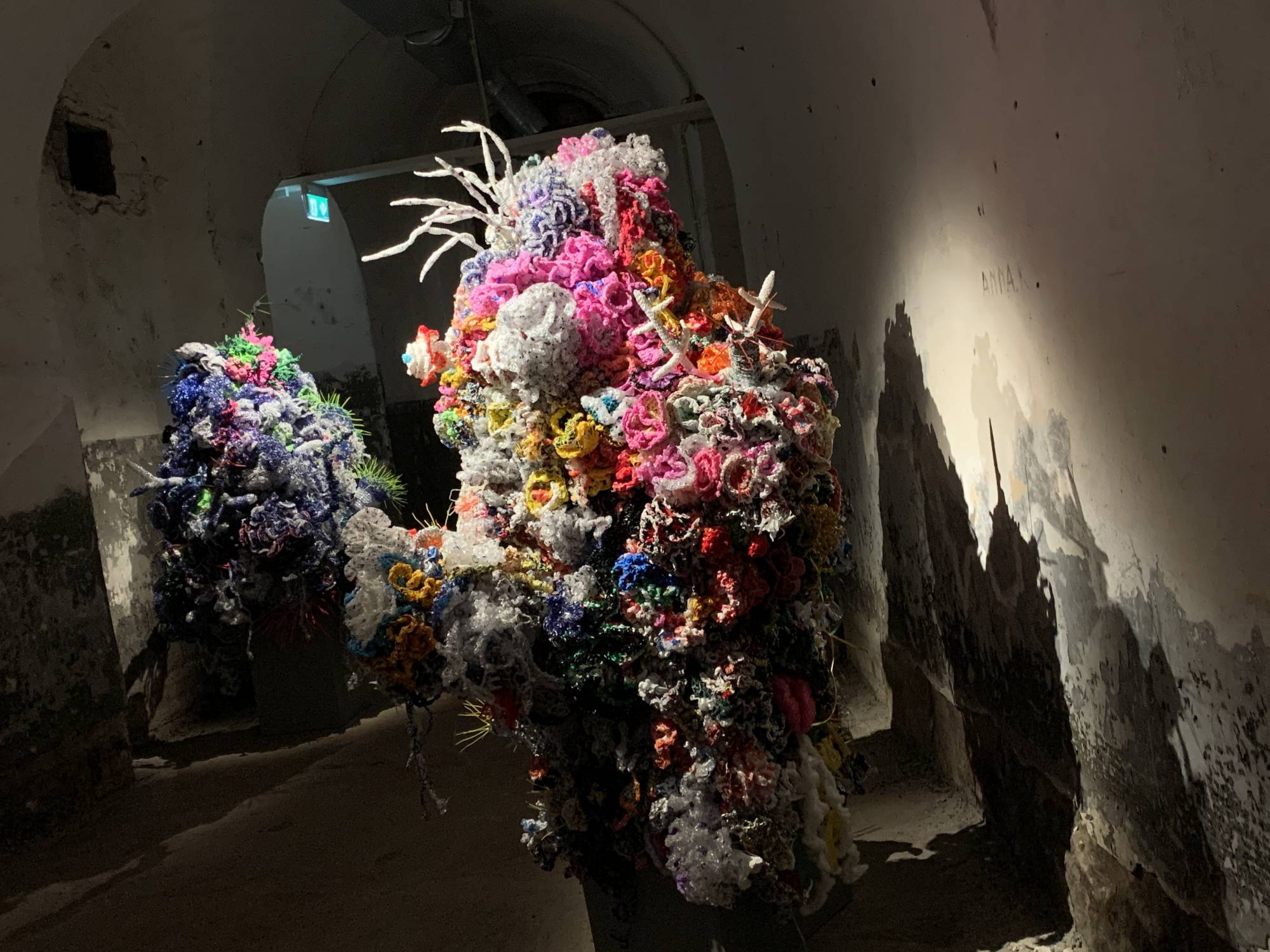
Photo: Institute For Figuring.
Coral Forest – Helsinki, crocheted from recycled plastic. A collaboration between Christine and Margaret Wertheim and the Helsinki Satellite Reefers, hosted by Helsink Art Museum and Helsinki Biennial 2021.

Remember my post on how crochet art was drawing attention to dying coral reefs? (See it here.) Well, after my friend Kristina told me about seeing some of the new additions to the crochet project, I decided to post a follow-up.

Siobhan Roberts reported at the New York Times in January, “Every year after the full moons in late October and November, Australia’s Great Barrier Reef begins its annual spawning — first the coral species inshore, where waters are warmer, then the offshore corals, the main event. Last year, this natural spectacle coincided with the woolly propagation of two new colonies of the Crochet Coral Reef, a long-running craft-science collaborative artwork now inhabiting the Schlossmuseum in Linz, Austria, and the Carnegie Museum of Art in Pittsburgh.

“To date, nearly 25,000 crocheters (‘reefers’) have created a worldwide archipelago of more than 50 reefs — both a paean to and a plea for these ecosystems, rainforests of the sea, which are threatened by climate change. The project also explores mathematical themes, since many living reef organisms biologically approximate the quirky curvature of hyperbolic geometry. …

“The surface of a sphere displays constant positive curvature; at all points, the surface bends inward toward itself. And a hyperbolic plane exhibits constant negative curvature; at all points, the surface curves away from itself. Reef life thrives on hyperbolism, so to speak; the curvy surface structure of coral maximizes nutrient intake, and nudibranchs propel through water with frilly flanges.

“In the artworks, marine morphologies are modeled — crocheted — with loopy verisimilitude. A bit like Monet’s water lilies, the crochet corals are abstract representations of nature, said Christine Wertheim, an artist and writer now retired from the California Institute of the Arts. Dr. Wertheim is the driving artistic force behind the project, which she created with Margaret Wertheim, her twin sister, a science writer who is in charge of scientific and mathematical components as well as management. …

“Crochet Coral Reef exhibitions typically have two main components: The Wertheims provide an anchor, of sorts, with works from their collection that they have crocheted over the years. They also incorporate pieces by select skilled international contributors. One is a ‘bleached reef,’ evoking corals stressed by increases in ocean temperature; another, a ‘coral forest’ made from yarn and plastic, laments the debris that pollutes reef systems.

“Then in response to an open call, volunteers far and wide crochet a pageant of individual specimens that agglomerate in a ‘satellite reef,’ staged by a local curatorial team with guidance from the Wertheims. … All contributors are credited.

“The largest satellite reef thus far coalesced in 2022 at the Museum Frieder Burda in Baden-Baden, Germany, with some 40,000 coral pieces by about 4,000 contributors. The Wertheims call this the Sistine Chapel of crochet reefs (documented in a splashy exhibition catalog). But the show at the Linz Schlossmuseum, which is dedicated to natural science as well as art and culture, is reminiscent of the work of the painter Giuseppe Arcimboldo, whose collage portraits from depictions of fruits, vegetables and flowers are ‘fantastically heterogeneous, also very funny and clever,’ Ms. Wertheim said.

“The Linz satellite reef unites some 30,000 pieces by 2,000 crocheters. The disparate parts take colorful inspiration from traditional Austrian ‘craftswomanship,’ as the exhibit text puts it, and there is a vast, glittery coral wall that gives a nod to the artist Gustav Klimt. In the Wertheims’ view, however, the crochet coral project is proof that it is not always lone geniuses who create great art, but also communities. In the art world, that is a radical idea, they noted, yet in science big collaborative projects and papers with thousands of authors are not unprecedented. …

“The mathematical dimension of the story intersects (from afar) with research by the applied mathematician Shankar Venkataramani and his students at the University of Arizona. They use idealized models to study hyperbolic surfaces in nature. [The] benefit, he said, is that it helps optimize processes like circulation and nutrient absorption. …

“When Margaret Wertheim, who studied math, physics and computer science at university, learned hyperbolic geometry, she found it ‘a bit bamboozling.’ She took the principles more on faith than understanding. Yet through crocheting models, she said, ‘you really do learn in a very deep way what a hyperbolic structure is, and in a way that I think is very powerfully pedagogical.’ “

More at the Times, here. Gorgeous photos.

See also Crochet Coral Reef, here. As the website notes, “Every crafter who contributes to the project is free to create new species of crochet reef organisms by changing the pattern of stitches or working with novel materials. Over time, a Darwinian landscape of wooly possibility has been brought into being. What started from simple seeds is now an ever-evolving, artifactual, hand-made ‘tree of life.’ “
Read Full Post »

I’ve been doing this blog daily for more than nine years, and sometimes in covering an activity that seems hopeful, I’ve overlooked a possible downside — or I learn later that things have changed. I try my best to add an update to a previous post so as not to have misleading information out there in the world.

The topic for today — turning unwanted plastic bags into sleeping mats for homeless people — was written up a year ago at the Detroit News and, according to Facebook, is still going strong. I’m drawn to the idea of doing something useful with the scourge of plastic bags, and I like the idea of giving people experiencing homelessness something they might want. For sure, it would be better to give them homes, so that’s an obvious downside. But I like that the self-named “Bag Ladies with a Cause” are really trying to help. Read about the initiative and let me know what you think.

Jocelynn Brown started her report at he Detroit News admitting, “Whenever I throw away a good, clean plastic bag, I’m always overcome with guilt, knowing there are groups like ‘Bag Ladies With a Cause’ that are putting them to good use as a way of making a difference in the lives of homeless individuals.

“Donna Harki of Lincoln Park and Jeannine Ayers of Wyandotte had worked with two groups … helping them turn plastic bags into what’s referred to as ‘plarn’ (plastic yarn), and then using it to crochet sleeping mats that would later be distributed to persons living on the streets of Detroit. …

“Word about the group got out. … ‘We just ask them for whatever free time they have,’ said Harki. … ‘It only costs your time, and we try to make the process fun, and keep them (the bags) out of the landfills.’ 

“Not everyone in the group is a crocheter, but everyone has a skill that will help with the assembly line-like production. …

“Each finished mat measures approximately 6 feet long by 3 feet wide, and it takes 700 bags to make just one. Additional plarn is used to crochet a strap that’s attached to the mat so it can be rolled up and carried as a backpack. …

“Harki has cranked out close to 100 mats in the past two years. She recently made one with a pocket attached at one end, which becomes a pillow when stuffed by its owner with maybe a shirt and pair of socks. If she already has the plarn, she said she can crochet a mat in a week, if she works on it every night. 

“How is plarn made? First, the plastic bag should be neatly flattened into its original shape with creases, folded twice length-wise, and then the handles and bottom are cut off. The remainder of the bag is cut into 3-inch wide strips/loops and then looped together, as you would rubber bands.

“A size Q crochet hook is used to crochet the mats, and in terms of bags used for making the plarn, Harki said, ‘We use any plastic bags, as long as they’re clean. … We (also) have an academy school in [Brownstown] that collects bags for us. … We had a fifth grader (from Summit) crochet her own mat! …

” ‘We deliver the mats. So far, we have given (to) ChristNet (in Taylor), a band of churches who alternate helping the homeless with (the) cold. We also have donated to FDDR (Feeding Detroit & Downriver) … an organization that feeds the homeless six days a week, year round. They know who sleeps outside, so they know who to give them to.’ ” More at the Detroit News, here.

Want a children’s book about women in Africa who’ve making good things out of plastic bags for years? Check out One Plastic Bag, by Miranda Paul, here.

Read Full Post »

BN_YarnBombing1.jpg

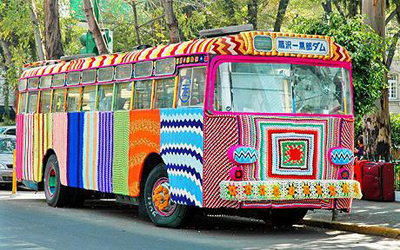
Highlights of yarn bomber Magda Sayeg’s early work include a knitting/crochet-covered bus in Mexico City.

Over the years, I’ve shared photos of guerilla-knitting projects around the world — anonymous knitted and crocheted decorations in unexpected places. Although the story is mostly a visual one, I like having some text for my posts and managed to find this interview with yarn artist Magda Sayeg.

Liza Graves at StyleBluePrint spoke with Sayeg by phone.

“Have you noticed a statue in your city covered in knitting? Or perhaps some trees, or a stop sign? This is known as yarn bombing and Magda Sayeg, a globally recognized textile artist, is known as the mother of yarn bombing. …

“Graves: When did you start knitting?

“Sayeg: Oh, maybe 15 or 16 to make a scarf for a then-boyfriend. … That first door knob? That took about three minutes. It was fast and quickly satisfying and I started doing more. …

“Graves: I recently saw an entire city block that was ‘yarn bombed’ in Columbia, South Carolina. How would I know if this was yarn bombing or a sanctioned art installation?

“Sayeg: Most likely it was sanctioned. When something is done at that level, where you can tell it took coordination on many levels … usually somebody approved something.

“Graves: What was the reaction to your first yarn bomb and when was it?

“Sayeg: That was the door handle on my boutique, in 2004, and it was surprisingly positive. … Then, I did a stop sign pole down the street. Then, several stop sign poles. Houston’s urban environment was my playground. Houston was a great city for this. It’s overdeveloped and there was not a lot of civic pride, at the time at least. As a citizen, you felt powerless. Old homes were being torn down for condos … Beautiful art comes from dark places. If you’re happy, are you motivated? When you are frustrated, you act accordingly. I was frustrated.

“Graves: Does anyone get upset about it? …

“Sayeg: Sure, there has been some backlash. Some people would say that it gets ugly and dirty. Some say it’s littering. … It’s silly for anyone to get mad about this. We are bombarded by advertising that says ‘lose weight now’ and auto insurance or other things. This has no financial profit. It’s sweet. It should not be vilified in any way. …

“Graves: Where are you? [Laughing] It’s so loud!

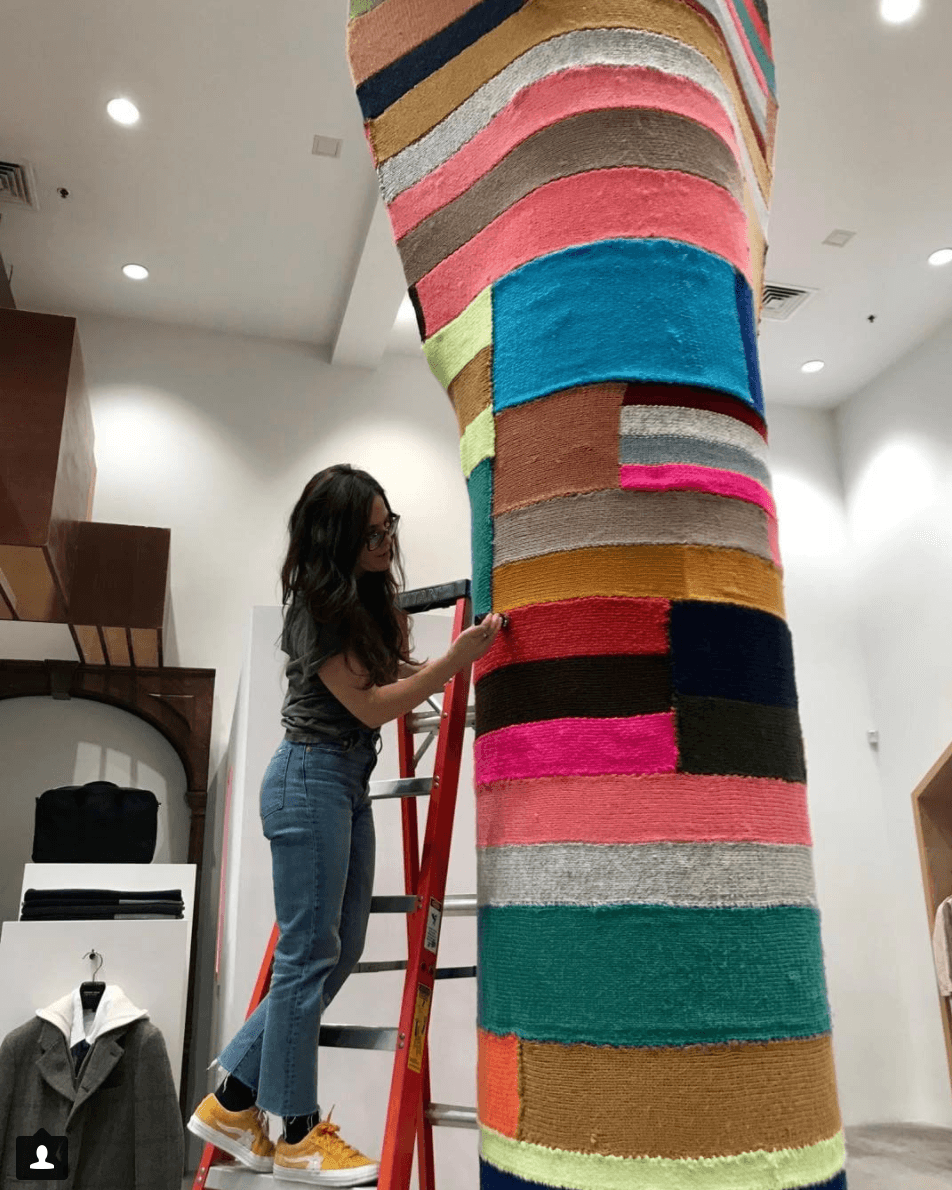
“Sayeg: Dover Street Market! I’m in a department store. I believe so strongly in this piece. I have so much gratitude and love for this store. I have a permanent installation here and over time, it just needs a little bit of love. We need to defuzz it and that’s what we’re doing here today.

“Graves: Do you miss anything about the South [after moving from Texas to New York]?

“Sayeg: I think we have a southern hospitality that is hard to explain unless you are southern. … I miss the accents. Texmex is something I totally miss and I will never get the same here. … And, the word y’all. Y’all means ‘all,’ and I’ve always defended that. …

“Graves: Any advice or quotes? …

“Sayeg: You can come from dark places and you can come out shining. I could live the rest of my life complaining. Now, I’m a globally recognized artist. My mother still comes from the belief that women are here for men. She doesn’t care that my TED Talk has had over a million views … she cares that I’m not married. My want is to let women know that nothing is insurmountable. You can get to the other side alive and well and be proud of yourself.” More here.

On Instagram, the artist is @magdasayeg. And there are other great pictures at Sayeg’s website, here.

Photo: Ben Sayeg
Sayeg defuzzing her knitting installation in a New York department store.

magda-sayeg-dover-market

Read Full Post »

Photograph: South End Knitters

Today I am thinking about the South End Knitters, the stealth street artists who wrap their knitting around parking meters and fire hydrants and telephone poles.

Writes Linda Matchan in the Boston Globe, “The South End Knitters’ weekly meetings at a Washington Street café seem innocuous, but don’t be fooled. Over knitting needles and yarn at the long table they’ve commandeered, they are contemplating something far more mischievous than a sweater. They’re graffiti knitters, and they’re plotting their next target. …

“As with graffiti, no two tags in the yarn-bomber subculture are alike. They range from sleeves on parking meters to tubes on tree limbs to sweaters on statues: A recent high-profile example is the neon pink sweater that the New York street knitter Olek crocheted in December for the 16-foot ‘Charging Bull’ statue on Wall Street.”

What put me in mind of the South End Knitters was an extraordinary post at the WordPress blog Pickled Hedgehog Dilemma, which describes a crochet effort that is drawing a lot of attention to the plight of vanishing corals.

Concerned about the effect of global warming on reefs, Margaret Wertheim and her twin sister got an idea that involved “crocheting corals. They used a crocheting technique invented by mathematicians in 1997 to model hyperbolic shapes called hyperbolic crocheting. … This ended up being a perfect technique for producing coral reproductions. …

“They crocheted a lot of corals,” continues Pickled Hedgehog, ” then they did something to change the world. They shared their corals with art museums. They got a community in Chicago to crochet with them. Then the crafting became a movement and groups all over the world started to crochet corals.”

Read Pickled Hedgehog Dilemma’s illustrated summary here. And if you have the time, this TED talk is super.

Pickled Hedgehog Dilemma

Read Full Post »