Feeds:
Posts
Comments

Posts Tagged ‘cultural’

Photo: Richard Conway/Bloomberg CityLab.
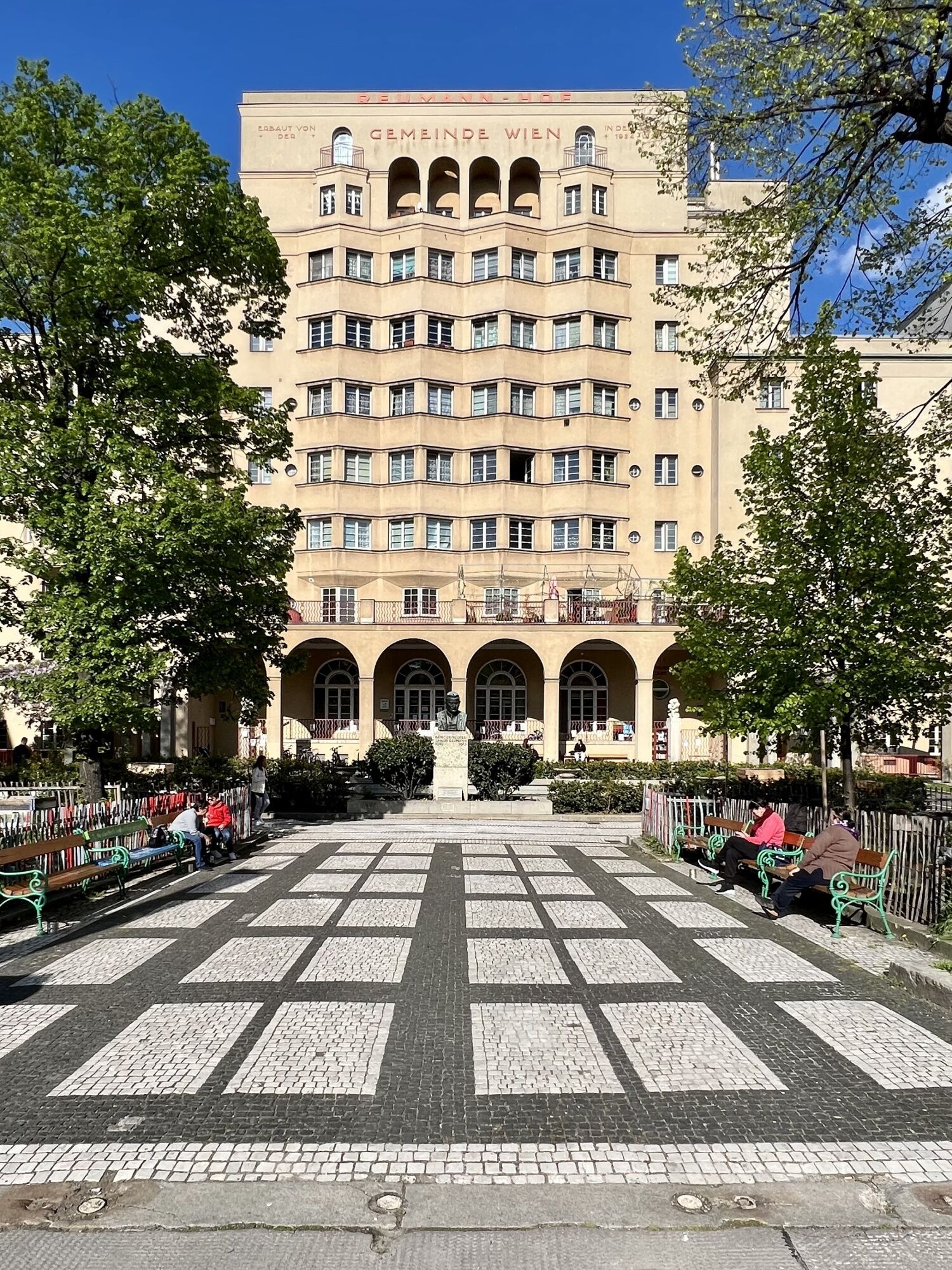
The 478-unit Reumannhof, public housing completed in 1926, was named for Vienna’s first Social Democratic mayor, Jakob Reumann.

Making sure all residents have decent housing is a challenge for cities around the globe. Richard Conway at Bloomberg CityLab says Vienna pretty much figured it out in the 1920s. He maintains it’s the reason Vienna is such a livable city today.

“The housing crunch that the growing city of Vienna faced a century ago,” he writes, “might seem strikingly familiar today: Private developers in the Austrian capital were good at building elegant luxury residences and substandard tenements for the poor, but they’d failed to create enough units to allow average residents to live in decent comfort at an affordable price.

“In response, Vienna’s Social Democratic government pursued a solution that modern cities still struggle to emulate: a massive construction program for public housing.

“The municipal apartment complexes they built, known as Gemeindebau, provided new homes at a volume and level of quality never seen before, and rarely seen since. The long-term results not only saw conditions for the average Viennese skyrocket, they also provided a hugely influential example for cities from Moscow to Manhattan.

These cities-within-a-city included medical facilities, schools, libraries, post offices and theater spaces.

“The Viennese Gemeindebau — plural Gemeindebauten — emerged in a city already in flux. Following Austria’s defeat in World War I, the country’s empire had dissolved and its monarchy was replaced by a democracy, in which the Social Democratic Workers Party (SDAPÖ) had the largest number of seats, both nationally and in Vienna. Once in power, the Social Democrats started addressing an issue central to their base: the overcrowding plaguing the new republic’s capital.

“In the 40 years leading up to 1918 … working-class families often lived in tenements known as Bassena, so named after the communal sinks found in their hallways. While they could look grand from the street, six or seven people might pack into a single apartment; often, each household shared a toilet and a sink and lacked electricity or heating beyond coal and wood stoves. They weren’t cheap, either: About 25% of a tenant’s wages went toward monthly rent, according to a 2022 MIT study.

“Starting in 1919 and continuing through to 1934, the Social Democrats launched a series of wide-reaching urban reforms focused on improving living conditions, education and social services. This period of SDAPÖ rule, widely known as Red Vienna, was informed by non-Bolshevik Austro-Marxism, which emphasized democracy, parliamentary politics and public investment. The Gemeindebauten, or municipal housing projects, were born.

“In the early days of the administration, there were two competing types of Gemeindebau. The first was associated with the settler movement: a group of low-income Viennese and refugees displaced from Austria’s fragmenting empire who occupied squatter settlements on the city’s periphery in an era of postwar political and social disruption. Viennese authorities eventually took over these informal communities, formalizing and planning them using elements of the Garden City philosophy.

“It was a second, much more common type of Gemeindebau, however, that came to define Vienna — the superblock-scaled Volkswohnungspaläste (‘people’s apartment palaces’). …

“Neither elaborately decorative like Vienna’s prewar tenements nor strikingly spare like the glass-and-steel apartments of the later International Style, the Gemeindebau often straddled an intriguing line between late 19th historicism and 20th century modernism. …

“Like older tenements, the buildings were typically aligned with streets, accessorized with some decorative features such as fancy brickwork or statuary and grouped around shared common yards. But while Bassena courtyards tended to be narrow, treeless and drab, the huge courtyards of the Gemeindebauten were spacious enough to serve as as combined garden, sports facility and public square, all accessible and sheltered from street noise. …

“In general, the shared areas within the superblocks were in fact as important as the individual homes, reflecting the Viennese administration’s social philosophy. These cities-within-a-city included medical facilities, schools, libraries, post offices and theater spaces. Curved staircases connected large floors — often as many as seven — and spacious landings. …

“The individual apartments, while varying in layout, shared key features. They included a living room, a bedroom, a kitchen, and some had small entrance hallways inside the front door. Almost all units featured running water, while many had large windows and balconies. Each apartment usually housed an individual family.

“Vienna employed nearly 200 architects to build more than 380 Gemeindebau complexes between the wars, a construction boom that created 60,000 new municipal apartments. In her book The Architecture of Red Vienna 1919-1934, Harvard professor Eve Blau describes how the municipal government was able to do this through expropriation, the use of tax policies to reduce land values and zoning laws. By 1931, it owned a third of the city’s area.

“Working-class citizens might now expect to live in airy apartments and access shared facilities. Indeed, the urban philosophy of Gemeindebauten is neatly captured by a term carved by artist Mario Petrucci into a statue outside a housing project: … ‘Light in the home. Sun in the heart.’ This was more than just a slogan; it represented an entire worldview.”

More at CityLab, here. No paywall. Interesting pictures.

Read Full Post »

2953

Photo: Achilleas Zavallis
Will these ancient, mudbrick, high-rise buildings survive the war in Yemen?

When I read fantasies to grandchildren, I explain that although passing through a wardrobe into another reality is not true, the feelings of the characters and the challenges they confront are. In fact, sometimes the issues of our world are made clearer through a fantasy lens.

Some fantasies I read just for my own pleasure. Having just finished Book Two of Philip Pullman’s The Book of Dust, I’m thinking about the way selfish monetary interests fuel the real world’s endless Middle East wars. In Pullman’s trilogy, a certain rose oil from the region of the old Silk Road has been found to have priceless properties, and behind-the-scenes power brokers are focused on trying to control it. Rose oil is a stand-in for whatever countries in the real world try to control, frequently another kind of oil.

One of the fiercest Middle East wars wars today is being fought in the small country of Yemen, and the report below is about amazing cultural sites we might not have heard about but for this disaster. I hope that spreading stories about the risks for civilians and cultural treasures will lead to more people demanding peace.

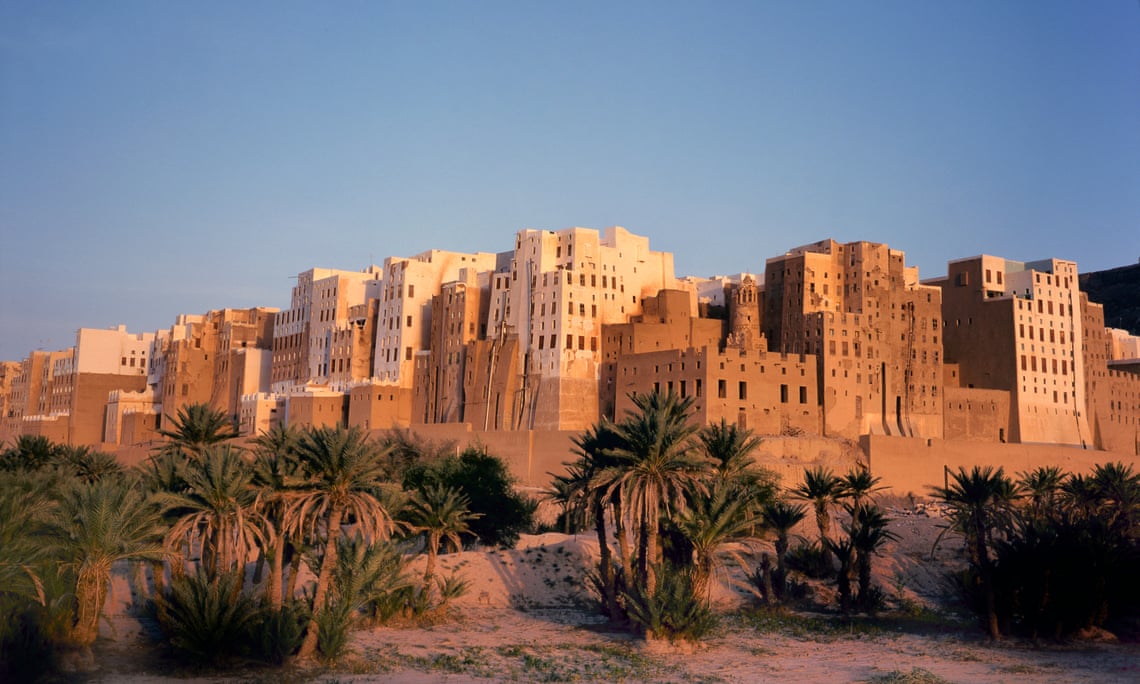
Bethan McKernan writes at the Guardian, “On the edge of the vast Empty Quarter desert that dominates the Arabian peninsula, white and brown towers rise together out of the valley floor like tall sandcastles. Once they welcomed weary caravans traversing the Silk Roads: now they stand as testimony to the ingenuity of a lost civilisation.

“This is the ancient walled city of Shibam, nicknamed the ‘Manhattan of the desert’ by the British explorer Freya Stark in the 1930s, in modern-day Yemen, a country also home to an untold number of other archeological treasures. The kingdom of Saba, ruled by the legendary Queen of Sheba, and many other dynasties of the ancient world rose and fell here, their fortunes linked to Yemen’s position at the crossroads of early frankincense and spice trades between Africa and Asia.

“Today, as a result of Yemen’s complex civil war – now in its fifth year – many of the country’s wonders have been damaged or are under threat. While the destruction pales in comparison to the human cost of the conflict, the country’s rich cultural heritage has also been ravaged. …

“Shibam, a 1,700-year-old settlement in the valley of Hadramawt, has largely escaped direct violence, but is still suffering from years of neglect, despite being a Unesco world heritage site.

“Named for King Shibam Bin Harith Ibn Saba, it is one of the oldest – and still one of the best – examples of vertical construction in the world. In the 16th century, Shibam’s inhabitants found they had run out of space to expand. To compensate, they began to build carefully on a rectangular street grid, and instead of spreading out, they built up …

“The city’s 3,000 residents still largely follow the traditional living pattern, with in some cases up to 40 family members in the same tower. Animals and tools are kept on the ground floor and food is stored on the second. Elderly people live on the third and the fourth is used for entertaining. Higher levels are occupied by more nimble families, with childless newlyweds on the roof. …

“Shibam is largely self-sustaining: its farmers and shopkeepers cater to the small population and many men are employed baking the straw and mud bricks used in construction. As in many Yemeni cities, goats and chickens roam the streets.

“ ‘Lots of young people have left,’ said Ali Abdullah, 28, who was looking after his family’s goats along with his 10-year-old brother, Majid.

‘Shibam is beautiful but there is no reliable money to make here unless they start preserving the buildings again.’ …

“Since Yemen’s Arab Spring revolt in 2011, funding to help preserve the city has dried up, as has the once steady flow of tourists, said Salim Rubiyah, the head of the local association responsible for looking after the public buildings inside Shibam’s walls. …

“Said Rubiyah, ‘I worry that this will be the last generation who are able to make a life here and appreciate the city’s beauty.’

“Elsewhere in Yemen, the story repeats itself. … In Sana’a, one of the oldest continuously inhabited cities in the world, ancient sites have been razed by Saudi-led coalition bombing [paid for, sadly, by the US]. … Despite Unesco having provided the coalition with a no-strike list of historical sites when the campaign began in 2015, sites such as the Castle of Taiz have been targeted, as well as the Dhamar Museum.

“ ‘We are nervous about the politicisation of heritage and the militarisation of archaeology during the conflict,’ said Sama’a al-Hamdani, director of the Yemen Cultural Institute for Heritage and the Arts. … ‘You can’t be the destroyer and the saviour at the same time.’ ”

More here.

Read Full Post »


Photo: Catskill Mountain Foundation
Catskill Mountain Foundation’s Doctorow Center for the Arts provides cultural opportunities in a rural area.

The arts are important everywhere, not just in cities. But sometimes it’s a challenge to attract to rural areas the kind of philanthropy that keeps urban cultural institutions alive.

Through the lens of a rural New York foundation, Mike Scutari of Inside Philanthropy considers the issue.

“In 1998, [Peter and Sarah Finn] founded the Hunter, New York-based Catskill Mountain Foundation, an organization committed to transforming rural communities through the arts. …

“The genesis of the CMF dates back to the early 1990s, when the Finns took over a family property in the town of Hunter. ‘The community had gone through a long decline,’ Peter said, and ‘many buildings on Main Street were for sale, and some buildings were in a serious state of disrepair and collapsing.’ …

“Peter and Sarah grew up in families that were very involved with the arts and had read stories about communities that were transformed through arts-based economic revitalization. …

“In 2018, the CMF will celebrate its 20th anniversary. Its program offerings include over 20 performances and 200 films a year, artist residencies, education programs, a piano performance museum, gallery and bookstore, and, for good measure, an operating farm.

“Its success is all the more startling when you realize that Hunter, New York has 2,732 residents.

“The problems facing rural communities are deep and complex. Yet we generally don’t see rural areas receive a proportionate amount of support from large institutional funders. … Funders, quite understandably, want the most bang for their buck, and more people live in urban areas. …

“Finn’s smaller-is-more-impactful approach flips conventional wisdom on its head: Funders can move the dial more effectively by operating in more concentrated communities. …

“[One] important form of engagement is ‘attracting others to invest in the community. Others who have invested significant amounts into the community have stated outright that they were inspired to do so by the work of the Catskill Mountain Foundation.’ …

” ‘Historically,’ Finn said, ‘the Town of Hunter was once known as a bar town. Today, it is known as a family arts community.’ ”

Read more at Inside Philanthropy, here.

Read Full Post »