Map: Jacob Turcotte/CSM Staff.
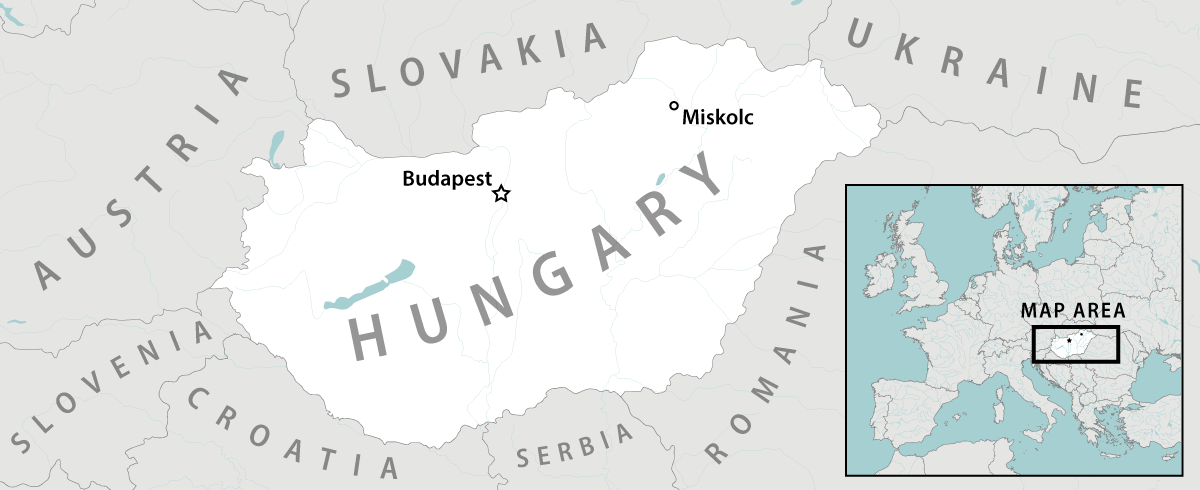
Map showing the location of the Roma school that borrows from Buddhism.
Oppressed people have many things in common even when they live on opposite sides of the world. So the wonder is that they don’t learn from each other more often, as the Roma in today’s article have learned from the “untouchables” of India.
Marc Loustau has the story at the Christian Science Monitor.
In Miskolc, Hungary, “Classes begin with a gong, not a bell, at the Dr. Ambedkar School. Each morning, 125 students in grades nine through 12, all from the local Romani community, enter the school grounds beneath a brass plaque embossed in both Hungarian and Hindi. The text marks the life of the school’s namesake, Bhimrao Ramji Ambedkar, India’s first post-independence minister for law and justice.
“The inscription finishes by invoking the school’s religious mission: ‘[Dr. Ambedkar] is a Buddhist saint,’ it reads.
“Dr. Ambedkar never set foot in Hungary, much less in the provincial northwestern city of Miskolc where the school was established in 2006. But members of Hungary’s Roma community learned about Dr. Ambedkar’s transformative work, in which he helped outlaw India’s caste system last century and improved the lives of his fellow Dalits in India. And they recognized a kindred spirit.
“The Dr. Ambedkar School is working to empower intellectual and political leaders from within Hungary’s Roma community, based on the Indian social reformer’s example. And while his neo-Buddhist worldview may seem like an odd bedfellow for Roma activism, the two are finding remarkable synchronicity among the school’s students.
“ ‘The role of the school is more than that of an educational institution, but rather a community institution that treats students with respect and dignity, providing a sense of hope and respect to Roma who are otherwise treated as outcasts by the mainstream society,’ says Jekatyerina Dunajeva, a political scientist with Central European University’s Romani Studies Program. ‘What permeates the culture of the school is a keen awareness of justice, fairness, and opposition to oppression.’
“Dr. Ambedkar was a leader in India’s independence movement in the 1930s as well as a member of the country’s oppressed Dalit group. In 1956, he founded the neo-Buddhist movement, also known as Ambedkarite Buddhism, which looked at Buddhism as a vehicle for social reform. In particular, neo-Buddhism turned into a means for Dalits – who face rampant discrimination at the bottom of Hinduism’s caste ladder – to leave the system that was oppressing them.
“Romani activist János Orsós learned about neo-Buddhism in the late 1990s by reading a biography of Dr. Ambedkar.
Then in 2005, he traveled to India, from which the Roma ethnic minority originally emigrated nearly 1,000 years ago. There he saw that both members of the Roma community and Indian Dalits struggle with problems like racism, discrimination, and segregation.
“In his memoir about finding Buddhism, Mr. Orsós noted he was most impressed by his visits to Dalit Buddhists’ schools.
“ ‘The Dalit people run these institutions themselves, not white people,’ he wrote, ‘I saw people like me take their destiny into their own hands through Buddhism and that is what I wanted to do.’
“Hungary’s educational system is highly segregated. Many Romani children attend Roma-only schools that are often underfunded and staffed by poorly trained teachers who do not understand Roma’s distinctive culture and history. Today, 60% of Romani children drop out of school, compared with 8.9% of the general population.
“Mr. Orsós believed that his Roma community could be empowered and emboldened by Ambedkarite Buddhism’s basic principles: educate, agitate, organize. So he founded the Dr. Ambedkar School in 2006.
“The school draws its 125 students from Miskolc, which has a population of around 161,000, and its surrounding villages, of which around 58,000 are Romani, according to Hungary’s 2012 census. Teachers prepare students for Hungary’s national graduation exams in areas like mathematics, literature, and history. But students also learn lessons drawn from Dr. Ambedkar’s life of activism.
“ ‘I would call myself an activist, too,’ student János Kun says. Like Dr. Ambedkar, Mr. Kun has grown up in extreme poverty and struggles against racism.
“ ‘There are eight of us in my family,’ the 20-year-old says. ‘Six of us children live in one room.’ His parents have only a sixth grade education, and he will be the first of his family to graduate from high school. He is the eldest child and helps care for his younger siblings in a house without running water.
“Romanis and the Dalits are the same, Mr. Kun says, down to their social status. ‘We are a caste,’ he declares. ‘We are at the very bottom level of society. But I’m not embarrassed to be poor.’ …
“The biggest threat to the school’s future [is the government’s] ‘work-based society’ program. Under this scheme, the government lowered the mandated school attendance age from 18 to 16, and expanded government work programs to provide employment to young people. [Prime Minister Viktor Orbán] has promoted the idea that those who aren’t succeeding in school should be diverted into the workplace where they can practice practical trades.
“But the work-based society program creates problematic incentives for Romani students, who are already struggling against discrimination in hostile school environments, to leave and seek out an easy and immediate paycheck.”
Find out why at the Monitor, here. No paywall.

 Suzanne's Mom's Blog