
Feeds:
Posts
Comments

Posts Tagged ‘Dallas’

Photo: Amy O’Neil.
Amy O’Neil, the Digital Content Marketing Manager for the Dallas Opera, has earned the organization a new following thanks to her quirky, fun, and innovative videos that explain everything.

Many people adore opera, but there are also many who are sure they wouldn’t like it, even though they’ve never tried. So how is Dallas Opera attracting new, younger audiences?

Bethany Erickson at D magazine interviews the brains behind the change.

A few of the Dallas Opera orchestra’s musicians were ready to leave after practice, but a handful were still milling around their rehearsal space in the Winspear Opera House. Some of them were gathered around a machete-wielding percussionist as he attempted to mimic the sound a guillotine makes as the blade descends to chop off someone’s head. 

“After tries with other instrument combinations yield OK but not spectacular results, he stands next to a metal pole, then slides the machete against it, the metal-against-metal action creating a ‘snick’ and then a long, slicing ‘hiss’ as the machete descends, followed by a heavy thunk at the end. …

“On hand to capture the behind-the-scenes work for the season’s second production, Dialogues of the Carmelites, [Dallas Opera social media guru Amy O’Neil] says she’s not sure exactly what she’ll use the footage for, but she wasn’t going to miss filming it.

“That sort of infectious creativity has made O’Neil’s work for the Dallas Opera a must-watch. From her fun, punchy synopses of upcoming productions to her award-nominated series ‘Don’t Look Under the Wig,’ she says her work is aimed at making the opera feel more accessible. …

“O’Neil has been with the Dallas Opera for more than six years, starting in group sales before convincing her employer that her talents might just attract a new wave of opera buffs. A UNT graduate, she studied business, music, and communications, and then spent time abroad studying, among other things, classical music and opera history in Vienna. She also does improv and is a musician. …

“O’Neil and I sat down at a table overlooking the Winspear’s expansive lobby to talk about her work. What follows has been edited for clarity and brevity.

Bethany Erickson
“I told my coworkers to check out the Dallas Opera social media feed because it was so fun.

Amy O’Neil
“Oh my god, I have so many more things about to come out that are more me, just telling our audience things, because time and time again, that’s what performs well. Like, they just want to see me as a goofy regular person, going, ‘Can you believe this? She’s cursed and on a random island,’ and whatever.

Erickson
“So take me back in time to when you first started.

O’Neil
“I started in ticketing, and then I did group sales, and then I was social media, and now I’m, like, all things digital. … They were coming to me and saying, ‘We want you to do a program or whatever you want where you’re doing makeup stuff,’ and that’s where ‘Don’t Look Under the Wig’ came in. And that really opened the door to not only show the company, ‘Oh, hey, I can do all these other crazy things,’ but also to test how I did with the people out there. …

“The first time I did a synopsis, it was because we didn’t have any ready-to-go assets, and I was like, ‘I’ll come up with something.’ … I wrote it, filmed it, and edited it all within like 2 1/2 hours. And I mean that’s, like, my shortest synopsis, like a minute and a half, so it’s not like impressive or anything. It took off, and then it was like, ‘Oh, well, maybe I should do this for the next opera.’ …

Erikson
“I don’t envy you having to figure out the tone for the Dialogues of the Carmelites synopsis. …

O’Neil
“It’s interesting because we were talking about this recently. I wanted it to be unbelievably clear that Dialogues of the Carmelites is based on a real story about real nuns who were really beheaded and persecuted for their religion and died martyrs. … I can make housewife jokes about Don Carlo, but not about Dialogues of the Carmelites. … I want to do the Dialogues of Carmelites and still have it be a fun video, but not at the cost of disrespecting the art. It’s just a fine line. …

“One of my favorite things that happened last season was when I was just walking around before a show in the hall, taking pictures and whatever. And these two girls ran up to me. And they were like, ‘Oh my god, you’re the reason we’re here.  We just had to tell you because you’re the reason we’re here. When we saw you, we had to tell you.’ ”

More at D Magazine, here. Note that long before Dallas explained opera, both Looney Tunes and Disney took it on. Check out Bugs Bunny, here, and Willie the Whale, here.

Read Full Post »

Photo: NiemanLab.
A late private equity bid to disrupt the sale of the Dallas Morning News to Hearst was foiled by a fourth-generation newspaper owner turning down more money.

Some days journalism and free speech seem threatened on every hand. Whether its officials trying to control what is said or hedge funds buying up newspapers to wring them dry, a girl could get depressed.

Today’s story is about how one newspaper escaped disaster at the eleventh hour.

Joshua Benton at NiemanLab gives his views on what happened. As a former employee of the paper he’s writing about, he gets pretty worked up, but his take is interesting. It reminds me that not all shareholders are greedy. It also reminds that usually they are.

“By now, it’s a familiar move to watchers of Alden Global Capital, the ravenous hedge fund with the unusual hobby of sucking the lifeblood out of newspapers.

“See, Alden likes to wait until a newspaper merger or acquisition is juuuuust about consummated. Then, right before the final papers get signed, it swoops in with a late bid that promises the seller a bigger payday. Respectable newspaper owners don’t love the idea of selling to Alden, whose relish for laying off journalists is well known. They’ve sometimes built entire strategies around selling to anyone but Alden. But in the tense final hours of a deal, it can be difficult to explain to shareholders why, exactly, they should turn down a few extra million.

“It’s smart: wait until some other buyer has kicked the tires and run the numbers to come up with a valuation. If Random Newspaper Company thinks it can profitably run a paper at the price of $𝑥 million, surely Alden can run it profitably at $(𝑥 × 1.2) million. All it’ll take is 20% more cuts — and that’s Alden’s specialty.

“Sometimes it works. In 2018, just before a bankruptcy auction for the Boston Herald, Alden announced its intentions to bid, offering more than double the stalking horse bid made by rival GateHouse. Alden got what it wanted. …

“After a few comparatively quiet years, Alden opened up its playbook again six days ago when it announced a bid for the Dallas Morning News, offering $88 million. This came 12 days after the Morning News had taken itself off the market by announcing it would be acquired by Hearst for $75 million. …

“This time Alden won’t get the prize — because of one particular shareholder. This morning, the DallasNews Corporation (formerly A.H. Belo) announced that its board had “reviewed and rejected” Alden’s offer. …

” ‘DallasNews Corporation controlling shareholder Robert W. Decherd, a great-grandson of co-founder George Bannerman Dealey, sent a letter Friday to his former company’s board emphatically stating his complete commitment to the Hearst merger.’ …

“The Morning News was objectively one of the most appealing solo newspapers left for a chain to snare. For one thing, North Texas continues to boom in population. The Metroplex’s population has grown by 2.9 million people since I started there 25 years ago. (For context, that’s equivalent to adding the entire Denver metro area to a place that already had 5.2 million people.)

“But the DMN is also appealing because it hasn’t been gutted as much as most other metro newspapers in its weight class. To be clear: It’s been cut — a lot. When I started there, the newsroom had more than 600 people and bureaus around the world. Today, newsroom headcount is at 157 people. That’s not 600, of course. But 157 is significantly larger than Alden’s (roughly) 70 at the Orange County Register50 at the Denver Post, or 50 at the Orlando Sentinel.

“For a chain thinking for the long term — like still family–controlled Hearst — that relative strength makes the Morning News an asset worth investing in. But it also makes the DMN appealing to a raider like Alden, for a very different reason: Taking over a bigger newsroom means more opportunities for cuts. …

“It’s easy to over-romanticize the days of family ownership of newspapers. The Dealey–Decherd family has been running the Dallas Morning News, in one way or another, since 1885. Over that century-plus, there’s plenty to complain about. … But there’s a simple grace to how that era of stewardship is ending. Robert Decherd turned down several million dollars to keep his family’s newspaper out of Alden’s hands. I’m not sure how many newspaper owners would do that today — but I’m glad the number is at least one.”

More at NiemanLab, here.

Read Full Post »

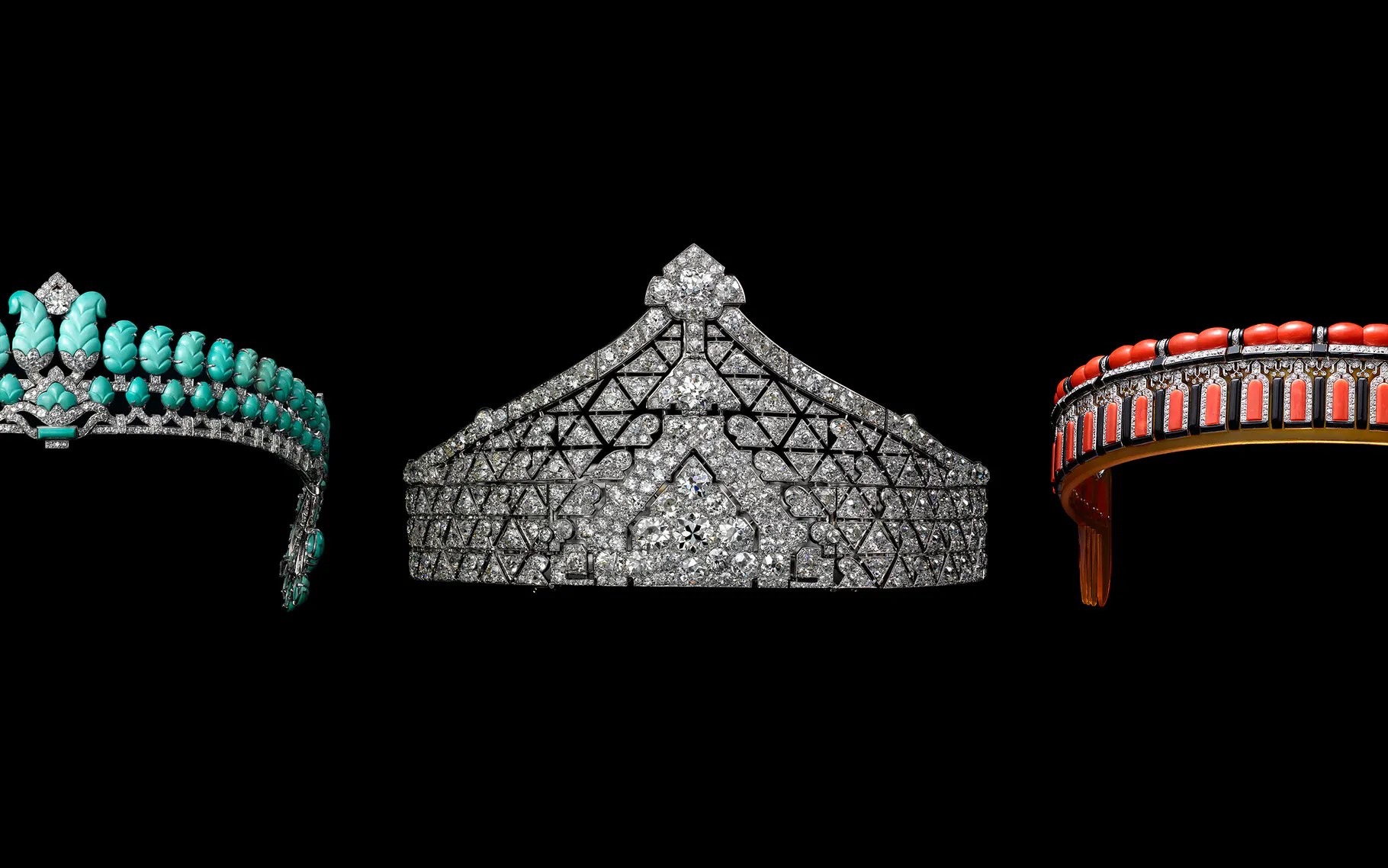
Photo: Nils Herrmann, Cartier Collection via Dallas Museum of Art.
From the Dallas exhibition: Tiara, Cartier London, special order, 1936; Bandeau, Cartier Paris, special order, 1923; Bandeau, Cartier Paris, 1922.

Even though this blog is based at my daughter’s jewelry company (where it’s been known to reassure an anxious online shopper that Luna & Stella is “good people”), I was encouraged to be eclectic, and I don’t write about jewelry that often.

But today I want to tell you about a jewelry exhibit in Dallas that’s unusual. It’s all about how designs in Islamic art influenced the renowned jewelry company Cartier.

Shirin Jaafari reports at Public Radio International’s the World, “The name Cartier has been synonymous with opulence and luxury going back nearly two centuries. British King Edward VII described Cartier as the ‘jeweler of kings and king of jewelers,’ according to Francesca Cartier Brickell, whose ancestors founded the company in 1847.

“Now, a new exhibition at the Dallas Museum of Art [DMA] called ‘Cartier and Islamic Art: In Search of Modernity,’ tells the story of how some Cartier pieces were inspired by Islamic art. …

“The family business was started in Paris by Louis-François Cartier and later, his son and grandsons took over. They expanded the company and found inspiration from the art and designs of places such as Russia, India and the Middle East.

In 1903, Louis-François Cartier visited the Musée des Arts Décoratifs in Paris, which was running an exhibition on Islamic art.

“That was the beginning of Louis-François Cartier’s fascination with the format, shapes and techniques used in Islamic art.

“ ‘There were a series of major exhibitions that were happening in Europe at the beginning of the 20th century, and of course, with things like the Ballets Russes and “Scheherazade.” … So, there becomes this big zeitgeist, synergistic sort of moment of interest, and that really spurs this as a sort of source of a modern expression,’ said Sarah Schleuning, senior curator of decorative arts and design at the Dallas Museum of Art.

“Louis-François Cartier collected pieces from those exhibitions — Persian miniatures, cigar boxes with geometric designs and photos of Islamic architecture. And slowly, those designs were incorporated into Cartier pieces.

“ ‘It looks like this colonnade of arches, and we were able to trace back this connection with a mosque in Cairo and these photographs that were in the Cartier archives,’ she said. ‘It was something that was exhibited at the 1903 exhibition of Islamic art at the Musée des Arts Décoratifs.’

“Cartier clients would often have their own gemstones and asked Cartier to design around them, Schleuning explained. But the company also sourced its own material from different parts of the world.

“For example, in the fall of 1911, Jacques Cartier, the youngest son of Alfred Cartier and grandson of the company’s founder Louis-Francoise Cartier, set off on a trip to India. Along the way, he visited the Gulf country of Bahrain, where pearl diving was popular. …

“Schleuning pointed out that we know a lot about how Cartier pieces came together because the family meticulously documented everything.

“ ‘These books and portfolios and resources were available to the designers as was the fact that the works of art that Louis privately collected, he photographed,’ she said.

“One diamond and turquoise tiara has the Persian motif boteh or what’s become known in the West as paisley, as the main part of its design. …

“Schleuning said that a part of the project at the Dallas museum is to connect Cartier’s designs with the sources that inspired them. The bandeau is just one example.

“ ‘[It’s] to say, “Hey this wasn’t just a phenomenal colonnade of arches but this came probably from this mosque in Cairo and here, we can trace that and so now, we’re broadening that understanding,” ‘ she said.

“The exhibition is a collaboration between the Dallas Museum of Art, the Musée des Arts Décoratifs in Paris and Maison Cartier. It runs until Sept. 18.”

Jean Scheidnes at Texas Monthly adds a thought: “I found myself wrestling with the question of appropriation, because we must. My assessment after absorbing the show is that no single tradition could have given rise to Cartier style. Only Cartier, with its unique alchemy of inputs and individual creativity, could give us Cartier. This show is here to recognize and honor the Islamic influence, and it taught me a lot.”

More at Texas Monthly, here, and the World, here. (No firewall. Great journalism.)

Read Full Post »

Although many food shops have struggled in the pandemic or even had to close, Howdy Homemade, an ice cream parlor in Dallas, is doing just fine. That’s because all sorts of people who believe in its mission stepped up to support a GoFundMe.

Jake Lourim writes at the Washingoton Post, “Tom Landis was 46 when he gave all he had to open a business he felt called to run. On Dec. 26, 2015, the ice cream store Howdy Homemade opened in Dallas, employing mostly people with special needs, from servers to cashiers to managers. ‘Howdy,’ as Landis calls it, thrived as locals praised the store’s mission and liked the ice cream, too.

“And then the consequences of the novel coronavirus pandemic almost wiped out Landis’s creation.

“The store began operating at a loss in March, when stay-at-home orders decimated sales, and it continued that way through the hot summer. By September, Howdy faced the possibility of closure, so Landis closed the original location and moved to a nearby, cheaper spot.

“On Sept. 1, a supporter named Jaxie Alt set up a GoFundMe page to save the shop. Within six weeks, the page raised $100,000 and kept Howdy in business. As a bonus, Landis acquired a truck so that Howdy could serve ice cream more safely.

“The store is now open again and appears poised to become a national operation. Potential franchisers have popped up in Asheville, N.C., El Paso and Las Cruces, N.M. Landis and his vice president, Coleman Jones, who has Down syndrome, took a road trip last week for meetings in San Antonio about putting Howdy ice cream in the massive H-E-B grocery chain and in Austin about opening a Howdy store on campus at the University of Texas, Landis’s alma mater.

“Landis grew up in Bethesda, Md., with a mother who battled polio. … He said he felt moved to serve the special-needs community in part because of his ailing mother, in part because of inspiration from a former football coach and in part because of a calling from God.

“Landis spoke [admiringly] about the work of former Alabama coach Gene Stallings, who had a son with Down syndrome and became a vocal advocate for those with special needs.

“Landis’s store became one of Texas’s top employers of special-needs workers, and his hope was that Howdy’s success would change the way companies thought about hiring people with special needs. But when the pandemic sparked an unemployment crisis, Landis saw his cause pushed to the back of the line. …

“[He] was undeterred. He remains proud of five years in business with zero employee turnover and knows his employees with Down syndrome and autism have a place in the economy, in any industry. …

“ ‘[Most people] don’t want to do the same thing over and over and over and over again. And then God designs people with special needs, and they actually thrive on it,’ [he says].

In 2015, … Landis told Jones about possible hiring opportunities, and the next day Jones called Landis to follow up. Jones, now 24, started as a bus boy at one of Landis’s Texadelphia restaurants and said he ‘started at the bottom and worked up to the top’ — he’s now the vice president of Howdy Homemade.”

More at the Washington Post, here.

Read Full Post »