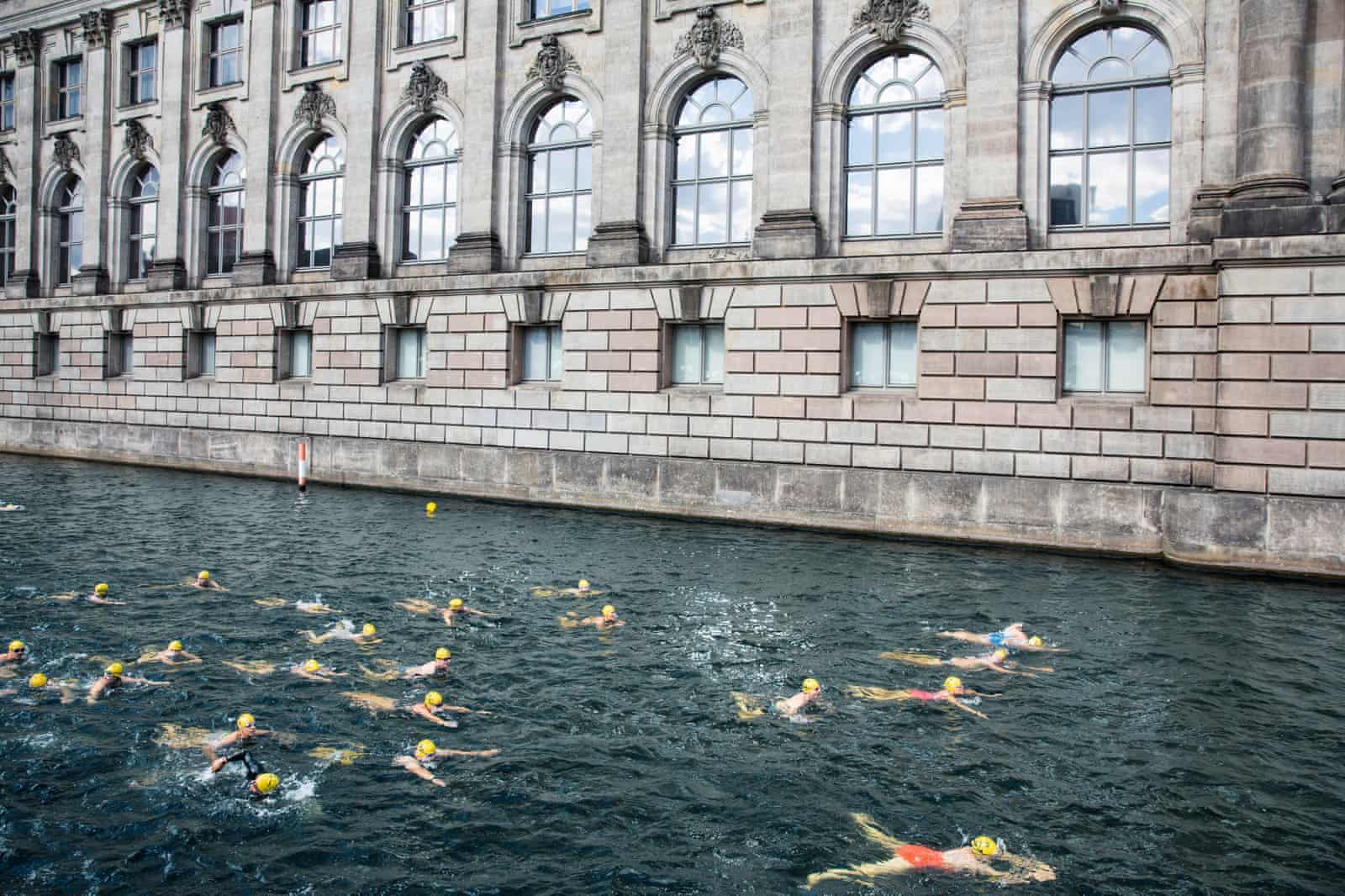
Photo: Axel Schmidt.
The Fluss Bad swim in the Spree canal, Berlin, is part of a campaign to change bylaws against swimming.
How many lovely, tinkling waterways have we forced through metal pipes and covered over with roads and buildings?
For some years now, cities have started daylighting them. And in the countryside, dams have been removed to bring back fish, often in collaboration with the tribes that always knew better. (See the Penobscot report.)
Last summer, it was touch ‘n go about what days the Seine would be clean enough for Olympic meets, bringing renewed attention to the issue.
At the Guardian, Oliver Wainright writes. “After a century of ignoring the very arteries that allowed them to grow in the first place, cities are learning to love their rivers again. Around the world, as global heating causes summer temperatures to soar, people are flocking to urban waterways and reclaiming these once polluted, poisoned gutters as indispensable places to cool off and unwind.
“[In the summer] the urban swimming movement made its biggest splash yet, when 110 athletes dived into the River Seine for the Olympic triathlon. The televised spectacle of swimmers front-crawling their way through Paris, flanked by beaux-arts bridges, offered a glimpse of what all our urban waterways could look like. Might these dangerous arteries of cargo and sewage be reborn as the great free public spaces that they could be? …
“ ‘What’s happening in Paris represents a generational baton change,’ says Matt Sykes, an Australian landscape architect and the convener of the Swimmable Cities Alliance, a global network of urban swimming campaigners pushing to make the scenes in the Seine an everyday reality for us all. …
“To coincide with this summer’s Olympics, the alliance published a charter, signed by a host of municipalities, government agencies, community groups and cultural institutions from 31 cities around the world, in a bid to create safe, healthy and swimmable waterways, accessible to all. The hope is to have 300 new cities starting their journey towards ‘swimmability’ by 2030.
“The alliance is already making headway. In the Dutch city of Rotterdam, a masterplan for the Rijnhaven dock includes a new permanent beach and a tidal park. In Sydney, the Urban Plunge program has plans that include floating pools, and riverside ladders and lockers. By next summer, if all goes according to plan, New Yorkers will be swimming beneath skyscrapers in the safe surrounds of a floating, filtered pool in the East River.
“ ‘This is going to be the cleanest water anyone ever swims in,’ says Kara Meyer, the managing director of Plus Pool, a project which began in 2010 as a Kickstarter campaign by four young designers. Fourteen years on, New York State and New York City have announced changes to regulations that finally make the project possible, and committed [$16m] to see a prototype pool realized by 2025.
“ ‘The original idea was: “What if you just dropped a big strainer in the river?” ‘ says Meyer. ‘Now, we’re essentially building a floating wastewater treatment facility.’ Engineered by Arup, the pool will pass the river water through a series of filtration membranes and blast it with UV disinfectant, in order to meet stringent water quality standards. …
“The Clean Water Act, passed in 1972 with the ambitious goal of making all US rivers and lakes swimmable by 1983, set the wheels in motion, but that target is still a way off.
“ ‘The pandemic was a real catalyst,’ says Meyer. ‘There’s been a realization that we need far more public space, and much better access to our natural environment.’ She says a recent rise in drowning deaths, after decades of decline, underlines the importance of access to water and basic swimming skills – a need exacerbated by a shortage of lifeguards, after decades of pool closures. …
“Along with Switzerland – where Rheinschwimmen has been a tradition since the 1980s, after wastewater treatment reforms – Denmark is leading the way. Thirty years ago, Copenhagen’s harbor was a polluted mess of sewage and industrial waste. Now Danes are spoilt for choice of architect-designed bathing structures, and water quality is constantly monitored on a dedicated app. …
“Elsewhere in Europe, the Fluss Bad campaign in Berlin organizes an annual swim in the Spree canal, seeing swimmers splashing past the cultural palaces of museum island. The group is pushing for local bylaws to be changed to permit swimming, and has launched a water quality monitoring website to show the canal is clean enough to swim in 90% of the time. In Brussels, a city without a single outdoor swimming pool, the Pool Is Cool campaign operates a temporary pool each summer, as a prelude to future plans for swimming in the canal. In the bathing capital of Budapest, the Valyo group wants to see the city’s history of floating wooden pools return to the Danube. Swim fever is rampaging across the continent.”
More at the Guardian, here. No firewall.

 Suzanne's Mom's Blog