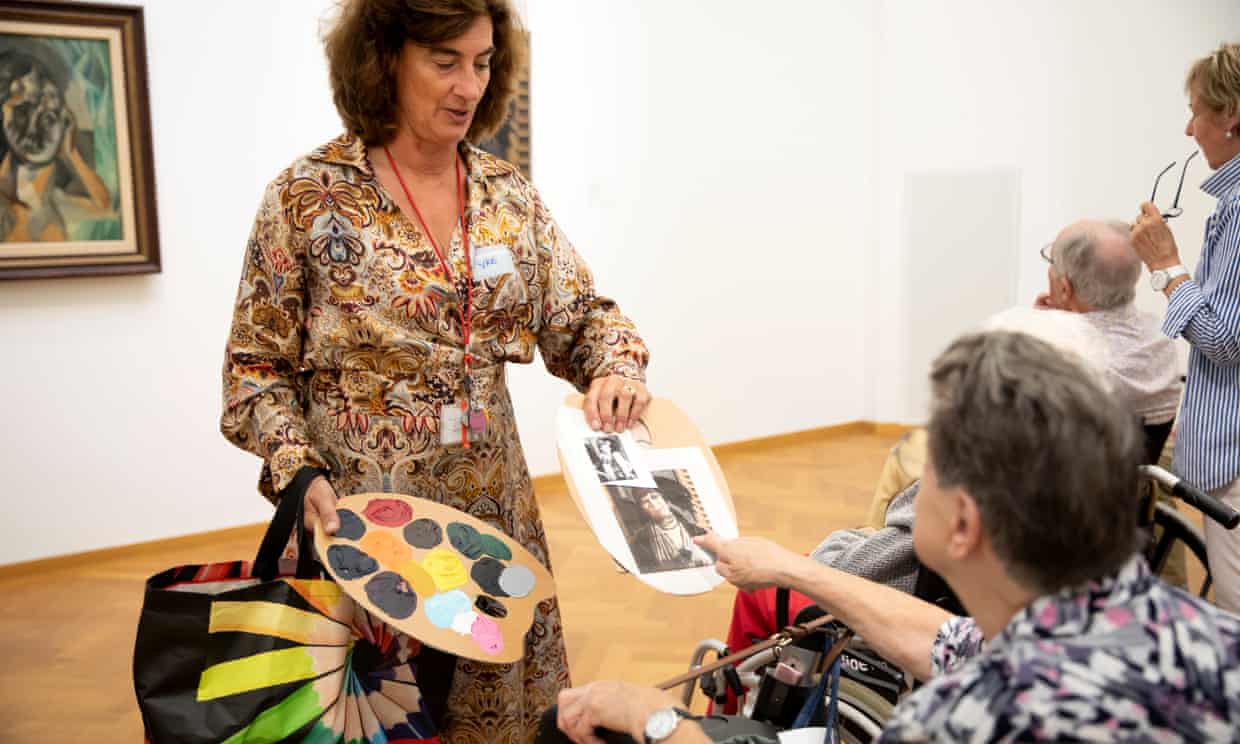
Photo: Judith Jockel/The Guardian.
As part of outreach to people in the Netherlands with dementia, Yke Prins uses a paint palette and spinning tops for a demonstration about colors.
About a year ago, I saw a meditation and breathing exercise that involves focusing on one’s five senses. Very interesting. (Click here.) Just as we don’t think about our breathing all the time, we don’t always think about how important each of our five senses is either.
Now I’m reading that one approach to reaching people with dementia also taps into the five senses. That is happening in the Netherlands, which is generally ahead of the curve on senior care. It’s from there that Senay Boztas reported today’s story for the Guardian.
“Eight people approached a fragrant carpet of lavender in the Kunstmuseum Den Haag gallery,” she writes. “Four of them had dementia and four were their relatives and carers. ‘Put your nose nearer the ground and smell it, it’s wonderful!’ called Annie Versteeg, 88, to Bwieuwkje Bruinenberg-Haisma, 90, in her wheelchair nearby.
“ ‘This tour is about color and here we have a color and it goes with a smell,’ said Yke Prins, the museum guide. ‘Do you know what it is? It is lavender. What does it make you think about?’
“This was no ordinary gallery tour, but a dedicated effort to welcome visitors with dementia and their carers. The new Art Connection tour ran for the first time [in June] and is scheduled for the last Friday afternoon of every month.
“ ‘The heart does not get dementia,’ said Maaike Staffhorst, the museum’s spokesperson. ‘People with dementia still have feelings [that] can give a sense of fulfillment. For the carer, this brings a level of equality. You can talk about the same thing.’ …
“On the inaugural tour, the residents of the Nebo care home and their carers looked at four artworks. … Prins opened up a bag of tricks: she whipped spinning tops to demonstrate how dots of color blend in front of the eye; pulled out palettes of color and, at the last work, coloring-in sheets.
“Bruinenberg-Haisma, who, her son Harry said, had been in the care home for four months after it became too difficult for him to look after her, wore a constant smile. ‘Beautiful!’ she said, several times.
“Another visitor, Jeroen Smit, 74, who was diagnosed with dementia after falling from his bicycle two years ago, said over tea before the tour that he struggled with daily life. ‘I can’t do it any more – I’m rudderless,’ he said. As the afternoon progressed, he visibly relaxed.
“The free art tours in The Hague– organized thanks to a bequest – were inspired by the Museum of Modern Art in New York’s Alzheimer’s Project. They are part of a larger push to adapt Dutch society as the population ages and one in three women and one in seven men will be diagnosed with dementia.
“This was a priority for Conny Helder, the last minister of long-term care. ‘It’s vital that we keep working to ensure that people with dementia are treated as valued members of society,’ she told the Guardian. … ‘Science shows that this can enhance cognitive functioning in many people with dementia, effectively giving them their lives back. All this requires a major change in thinking.’
“One driving force towards a ‘dementia-friendly‘ society is Alzheimer Nederland. The charity has helped create free, online training videos so everyone can recognize and respond correctly to signs of Alzheimer’s. …
“ ‘This is hugely urgent,’ said the director, Gerjoke Wilmink. ‘Right now, about 300,000 people are living with dementia in the Netherlands and this number will rise explosively to around half a million in 2040. But care and carers are not growing in tandem. It is essential that people with dementia can continue to participate … and this needs to be systematically embedded in our society.’ …
“Rotterdam’s deputy mayor for care, Ronald Buijt, described initiatives such as multilingual awareness programs for city workers and taxi drivers, and Alzheimer’s cafes for old and young. ‘The most important thing is for us to learn that these people should live as good a life as possible, and as normal a life,’ he said. ‘Let them do what they can still do.’ …
“Elsewhere in the Netherlands, a ‘participation choir‘ initiative matches singers with dementia with two supportive buddies, who pick them up and help them find their way in the songbook. ‘The musical memory stays intact for the longest time,’ said the choir’s founder, Erik Zwiers. ‘Caregivers, the audience, musicians all see that people with dementia can reach a higher artistic level than they often think. It gives a completely new view on how to deal with people with dementia – and it’s fun.’ ”
More at the Guardian, here.

 Suzanne's Mom's Blog