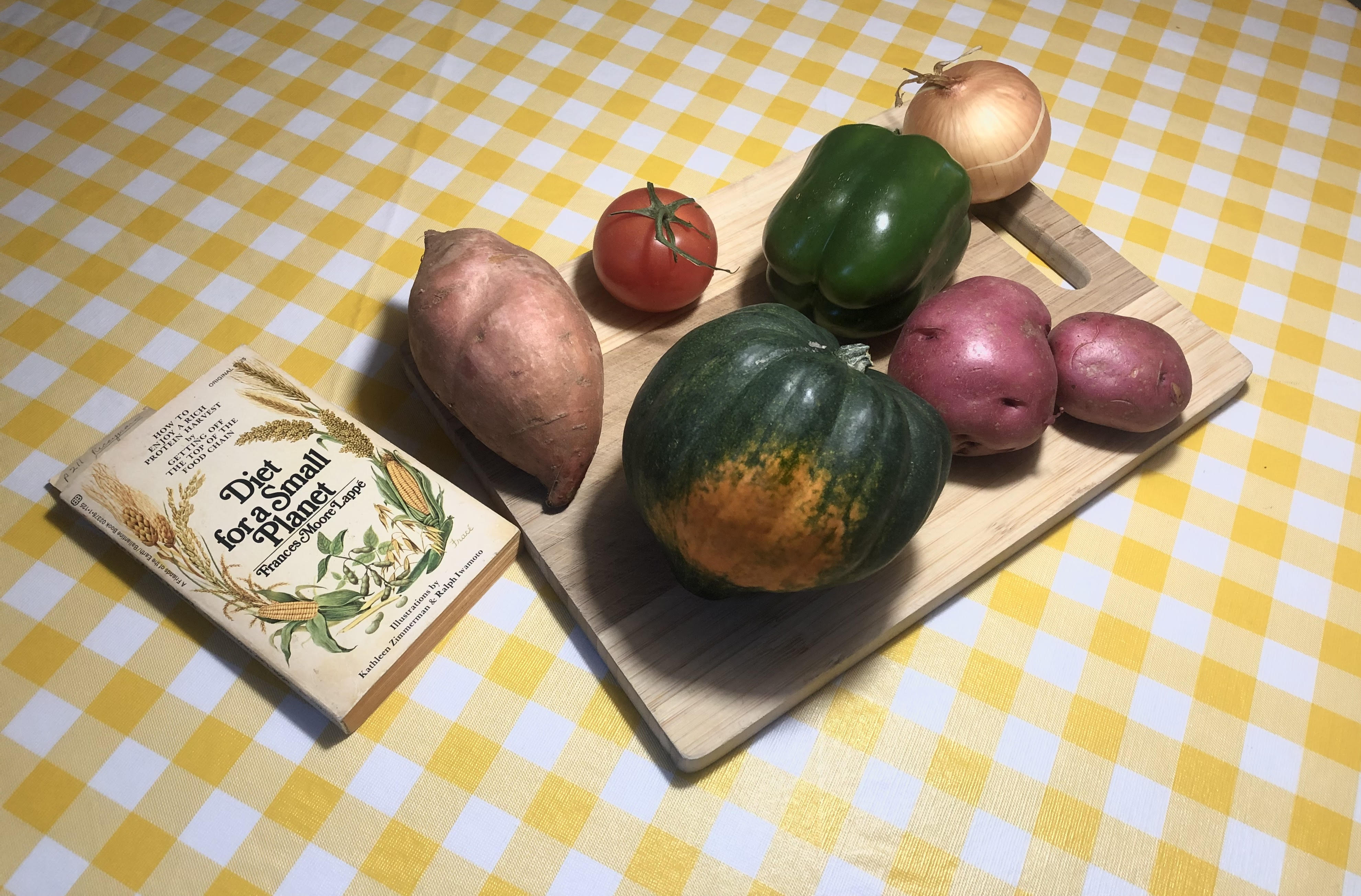
Photo: Suzanne and John’s Mom.
Frances Moore Lappé, author of Diet for a Small Planet, founded the Small Planet Institute, which focuses on social solutions to environmental, hunger, and political challenges.
The environmental radio show Living on Earth is staying on top of concerns about our global food system and the role it plays in “environmental crises like global warming and water pollution even as it fails to adequately feed billions of people.” Diet for a Small Planet author Frances Moore Lappé recently joined host Steve Curwood to discuss how “embracing the plant world in our diets connects to climate, health, and democracy.”
“STEVE CURWOOD: Our present food system is polluting and wasteful. For starters, about a third is thrown away, tossed from kitchens and plates in rich places and spoiled where people can’t afford to refrigerate. And many industrial growing systems pollute and waste as well, using too much water, land and chemicals in ways that also add to climate disaster. Yet around the world more than 2 billion people are food insecure.
“Fifty years ago Frances Moore Lappé wrote the bestselling Diet for a Small Planet in a bid to address the hunger crisis, and along the way she seeded a plant-centered food revolution in the kitchens of America. She joins me now from Belmont, Massachusetts. … Frankie, just to be clear, what is a plant-centered diet?
“FRANCES MOORE: Well, it’s embracing the plant world. When I moved from meat, you know I grew up in Texas cow town, right. So people said oh you’re giving up so much and I said, no, no, no, it’s the plant world that has all the taste differences, the color, the shapes, the textures, you know, it’s where all the yummy stuff is. And so for me being plant centered is I don’t follow recipes a lot but going into the kitchen and looking, you know, seeing what’s there and finding out spices and herbs I love and for example, I turned a basic beans and rice dish into an Italian dish by just changing the herbs that are used in it. It’s called Roman Rice and Beans in Diet for a Small Planet. …
“CURWOOD: So what’s changed in the last 50 years since you wrote Diet for a Small Planet? …
“MOORE: We’re sort of moving in two directions at once because we’ve got it now we know what to do and all over the world, people are aligning with nature to grow our food [but] the dominant extractive approach that is so dangerous and so unnecessary is still going strong. …
“Our food system globally contributes about 37% of greenhouse gas emissions and about 40% of that is from the livestock sector. So that’s a huge contribution. And now I’m calling it a plant- and planet-centered diet because if we really addressed this crisis and grew a healthy plant-centered diet, that would cut the agricultural greenhouse gas emissions by about two-thirds. A professor at the University of Minnesota calculated that it would be the equivalent to removing basically all the vehicles off the planet.
“CURWOOD: Now, people listening to us need to be reassured that you’re not saying you can never eat meat, you’re just telling us to make it a rare occasion. …
“MOORE: I really want to be big tent and to welcome people if they are eager to align with their body because there’s a lot of evidence that this plant-centered stuff is really good for us. … Any step we can take, I celebrate.
“CURWOOD: Now, the meat production industry has gone to great lengths to concentrate operations. …
“MOORE: What woke me up at age 26 [was] that I saw meat production as a protein factory in reverse. Consider this, we use about 80% of our agricultural land to produce livestock, but they give to us only 18% of our calories. So right there, that is pretty darn inefficient and for beef, one estimate says that of the grains fed to livestock we get about 3% to 5% of the calories and protein that we eat from all of that grain that gets fed to livestock in this country. So it’s really hard to imagine anything less efficient. …
“CURWOOD: Tell me a little bit more about the the health risk of red meat.
“MOORE: Well, I was actually shocked to learn recently that the WHO, the World Health Organization, has deemed red meat a probable carcinogen. And when I looked into it a bit that has to do with heme iron in red meat. … And then on processed meat, the WHO has deemed processed meat a carcinogen. …
“CURWOOD: Why [is] the food we eat is also linked to the health of our democracy in your view? …
“MOORE: Our democracy [is] the taproot crisis and we also have a living-planet crisis and we also have an economic crisis [of] concentration of wealth, but the taproot is democracy, because that is the way that we make decisions together to solve problems. [If] we’re going to solve these huge problems of our environment and the impact of farming on climate change, which is quite significant, we have to have democracy. And what we have now I think of as a very corrupted form because private interests those who are benefiting very much from fossil fuels and from the meat-production industry and [they] have tremendous power in Washington. There are now 20 corporate lobbyists in Washington for every single person that you and I elect to represent us in Washington. That is problematic, that is what I call a corrupted system, and that’s why I think it’s so important, Steve, we’ve got to solve these problems, and we’ve got to have democracy to solve them.”
More on that at Living on Earth, here. No firewall.


 Suzanne's Mom's Blog
