Feeds:
Posts
Comments

Posts Tagged ‘digitize’

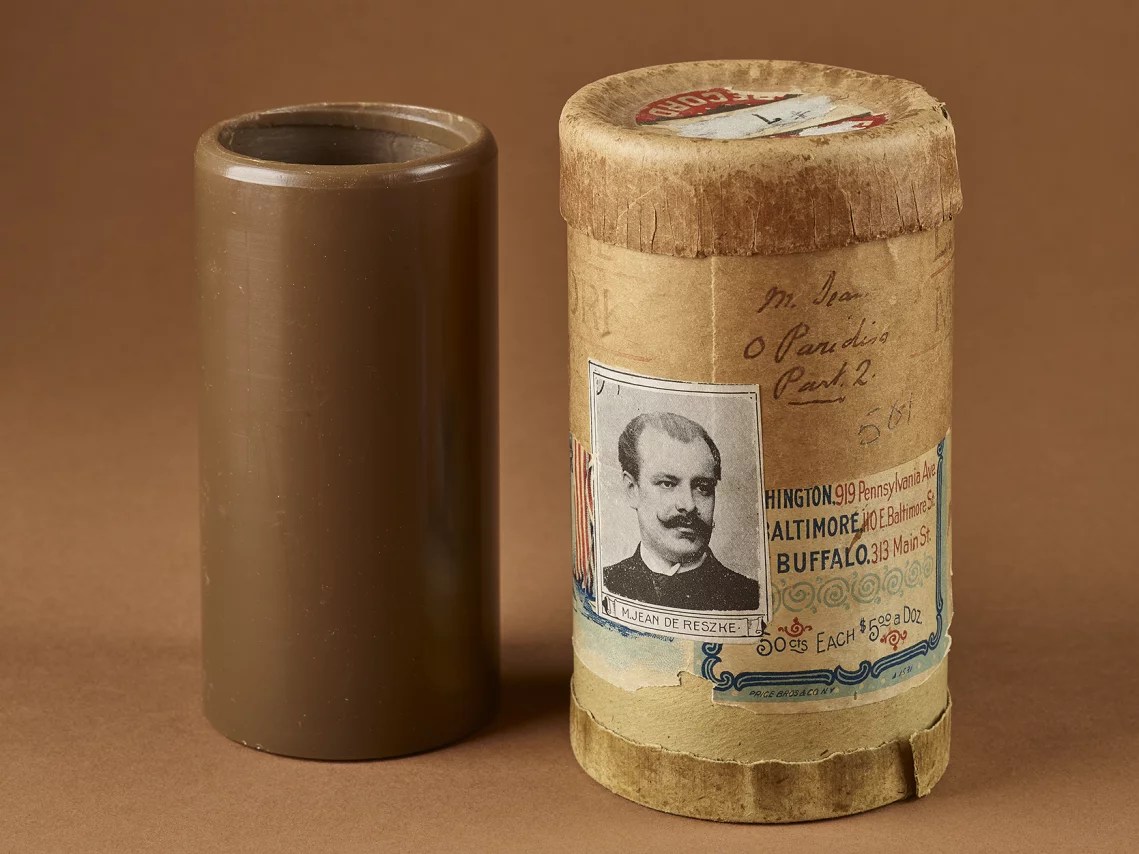
Photo: Robert Kato Lionel/New York Public Library.
Early opera recordings on wax cylinders 1900–1904, recorded by Lionel Mapleson.

I recently finished reading an excellent biography of Margaret Wise Brown, the author of Goodnight, Moon and many other delightful children’s titles you probably would recognize. At the end of a life cut short by a blood clot in a foreign hospital (her dates are 1910 to 1952), she was experimenting with a wire recorder to make records of her stories and poems.

That took me back, for sure, as my father also was experimenting with a wire recorder around that time. All I have left of his experiments is a record, transferred years later to a cassette tape, called “The Birth of Willie” — me with a squeaky voice and an unfamiliar accent and my first brother, also squeaky, responding to the news of a new sibling. What a miracle that wire recorder once seemed!

It wasn’t the first such device, though. In today’s story we learn about recordings once made on wax.

Jennifer Vanasco reports at National Public Radio, “Before audio playlists, before cassette tapes and even before records, there were wax cylinders — the earliest, mass-produced way people could both listen to commercial music and record themselves.

“In the 1890s, they were a revolution. People slid blank cylinders onto their Edison phonographs (or shaved down the wax on commercial cylinders) and recorded their families, their environments, themselves.

“When I first started here, it was a format I didn’t know much about,’ said Jessica Wood, assistant curator for music and recorded sound at the New York Public Library for the Performing Arts. …

‘It became my favorite format, because there’s so many unknowns and it’s possible to discover things that haven’t been heard since they were recorded.’

“They haven’t been heard because the wax is so fragile. The earliest, putty-colored cylinders deteriorate after only a few dozen listens if played on the Edison machines; they crack if you hold them too long in your hand. And because the wax tubes themselves were unlabeled, many of them remain mysteries. …

” ‘They could be people’s birthday parties,’ Wood said. … ‘I really hope for people’s birthday parties.’

“She’s particularly curious about a box of unlabeled cylinders she found on a storage shelf in 2016. All she knows about them is what was on the inside of the box: Gift of Mary Dana to the New York Public Library in 1935.

“Enter the Endpoint Cylinder and Dictabelt Machine, invented by Californian Nicholas Bergh, which recently was acquired by the library. Thanks to the combination of its laser and needle, it can digitize even broken or cracked wax cylinders — and there are a lot of those. But Bergh said, the design of the cylinder, which makes it fragile, is also its strength.

” ‘Edison thought of this format as a recording format, almost like like a cassette machine,’ Bergh said. ‘That’s why the format is a [cylinder]. It’s very, very hard to do on a disc. And that’s also why there’s so much great material on wax cylinder that doesn’t exist on disc, like field recorded cylinders, ethnographic material, home recordings, things like that.’

“One of those important collections owned by the library is … a collection recorded by Lionel Mapleson, the Metropolitan Opera’s librarian at the turn of the last century. Mapleson recorded rehearsals and performances — it’s the only way listeners can hear pre-World War I opera singers with a full orchestra. …

“[Bob Kosovsky, a librarian in the music and recorded sound division] said that some of the stars sing in ways no contemporary opera singer would sing. ‘And that gives us a sort of a keyhole into what things were like then. … It’s a way of opening our minds to hear what other possibilities exist.’

“It will take the library a couple years to digitize all its cylinders. But when they’re through, listeners all over the country should be able to access them from their home computers, opening a window to what people sounded like and thought about over 100 years ago.”

More at NPR, here.
Read Full Post »

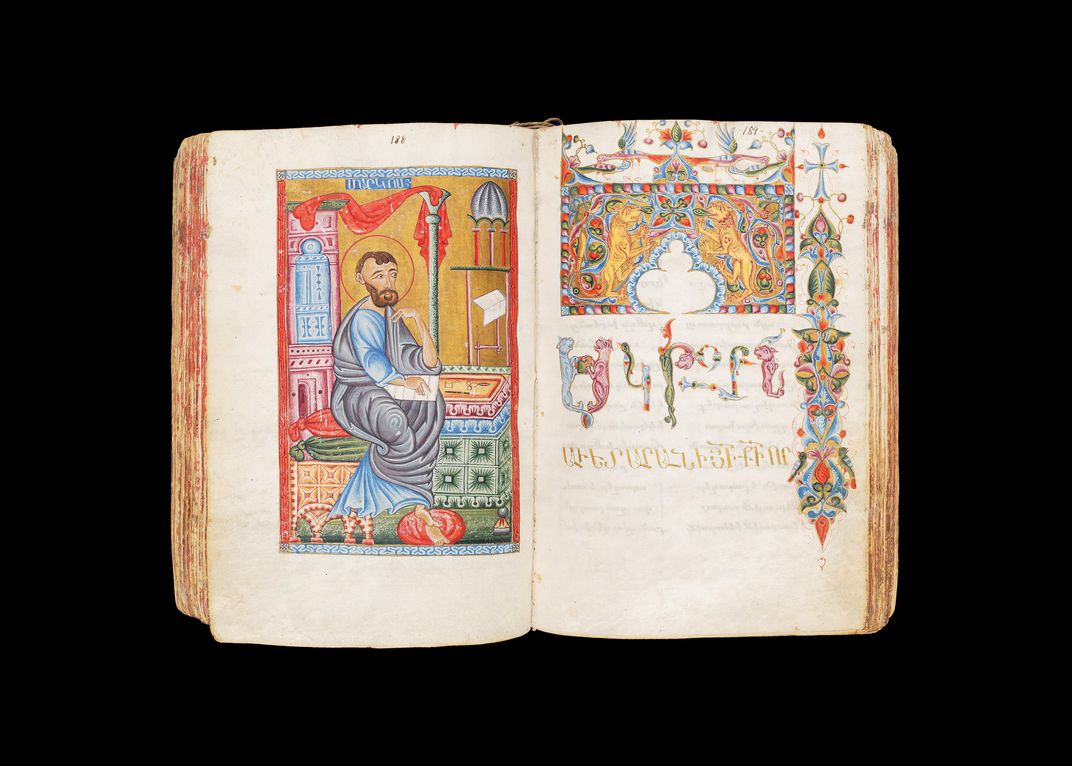
Photo: Hill Museum & Manuscript Library.
A 1600s Armenian Gospel, with a depiction of the evangelist Mark, has been digitized by Benedictine monk Columba Stewart’s project.

I love learning about the many unusual careers and pursuits out there. In today’s story, a monk who was working on preserving old manuscripts by digitizing them, accidentally became a sleuth in dangerous regions.

Joshua Hammer writes at the Smithsonian, “When Columba Stewart, a 63-year-old Benedictine monkbased in Minnesota, arrived at the Kaiser Library, a government-affiliated archive in Kathmandu, Nepal, he stared up at the three-story building — wobbly, riven by cracks, too unsafe to use.

“It was three years after the massive Nepalese earthquake of 2015 that had killed 9,000 and laid flat much of the Kathmandu Valley. Rain leaked through holes in the roof, inundating broken masonry and congealing into gray mud on the floor. Many of the library’s manuscripts, some dating to the ninth century and written in Devanagari script (an ancient orthography system still used across the Indian subcontinent) on birch bark and palm leaves rolled up and held by clay seals, had been moved downstairs. The scrolls were stacked in bags and shoved into old glass cabinets on the ground floor. Exposed to the dust of an ongoing construction project to shore up the building’s weakened structure, as well as occasional seismic vibrations, the works were at risk of rapid disintegration.

“Stewart had flown to the Himalayas at the behest of Bidur Bhattarai, a Nepalese scholar at the Centre for the Studies of Manuscript Cultures at the University of Hamburg, who had traveled to his homeland after the quake to assess the damage. Library employees recounted their panic as books crashed to the floor and chunks of bricks and rocks came hurtling down: For months they had been forced to work outside under a tarp. …

“Stewart made three trips to Nepal in 2018 and 2019 (a spring 2020 visit was called off at the start of the Covid-19 worldwide lockdown), continuing discussions to begin digitizing the Kaiser Library’s collection, while initiating a pilot project at a nearby private institution: the Asha Archives. Its collection of 7,000 richly ornamented manuscripts on bound paper and rolled palm leaves was built up by Prem Bahadur Kansakar, and named after his father, Asha Man Singh Kansakar, a prominent early 20th-century social activist and writer from the Newari ethnic group — the historical inhabitants of the Kathmandu Valley and the dominating force in Nepali politics and culture — and donated to the public in 1987. …

“Working remotely from his stateside base, Stewart supported Bhattarai in training a team of four Nepalese staffers to begin digitizing 1,000 manuscripts newly donated to the archives. Almost all were written on traditional Nepalese paper by Newari scribes. The works treat subjects including Buddhist and Hindu philosophy, religious rituals, Ayurvedic medicine (a holistic approach based on ancient Hindu writings) and grammar, along with poetry, written in Sanskrit, Newari and Nepali and dating to the 15th through early 20th centuries. Most had been wrapped in red- or yellow-dyed cotton for centuries, and recently have been rewrapped in undyed muslin or locally produced paper for conservation. …

” ‘Everybody knows Nepal because of Tibetan Buddhist monasteries,’ Stewart says, ‘but there’s also strong Hindu presence. The manuscript tradition witnesses that mix, in a variety of languages. Nepal is a meeting place; that’s what makes it so interesting.’

“Stewart lives and works at St. John’s Abbey in Collegeville, Minnesota, where he is a professor of theology at the affiliated St. John’s University and the executive director of the Hill Museum and Manuscript Library (HMML). …

Over the past 20 years his work has taken him from the Balkans to the Himalayas, from the Sahel region of Africa to the Middle East, injecting him into the heart of conflict zones and resulting in several narrow escapes from rebel movements and religious extremists. …

“ ‘Sometimes I feel like a war correspondent. Other times I’m cast in a religious role. In northern Iraq, I’ll be in my habit at Mass with 1,500 worshipers chanting in Aramaic. Then I’ll be going around in a tank.’ …

“Stewart has built up an extensive rare-book collection for the library. On a virtual tour using his iPad, he takes me down to the basement, and removes from a shelf one of his favorite recent additions: a four-volume Old and New Testament, bound in oak, and printed in Nuremberg in 1480, twenty-five years after the Gutenberg Bible rolled off the world’s first printing press. … ‘The paper looks like it was made yesterday,’ he tells me. ‘The ink is black as can be, mixed with linseed oil to take the bite out of the type,’ he says. ‘Every piece of type was set by hand, backwards. They had to do that for every single page. That’s an extraordinary achievement in the service of knowledge.’ …

“Stewart’s work represents a high-tech evolution of the Benedictine mission. He conducted his first digitization project in 2003, in Lebanon, and went on to the rest of the Middle East and the Balkans, where Christian minorities have grown increasingly vulnerable, their cultural patrimony put at risk. Word of his deeds spread. Malian librarians who had rescued 250,000 Islamic and secular manuscripts from Al Qaeda in Timbuktu by smuggling them to Bamako enlisted his aid. Muslim communities in India, threatened by the Hindu extremist rhetoric of Prime Minister Narendra Modi, have turned to him for help digitizing their archives.”

Stewart’s life path emerged accidentally after he “joined the St. John’s faculty. He was prepared, he said, for a life of teaching and religious devotion. That bucolic vision was disrupted when the university president, aware of Stewart’s knowledge of early Christian sites in the Middle East, asked him to take on a manuscript preservation project for the Orthodox Christian church in northern Lebanon.”

At the Smithsonian, here, you can read what happened next.

Read Full Post »