Feeds:
Posts
Comments

Posts Tagged ‘disease’

Photo: Bennett Whitnell / Hakai Institute.
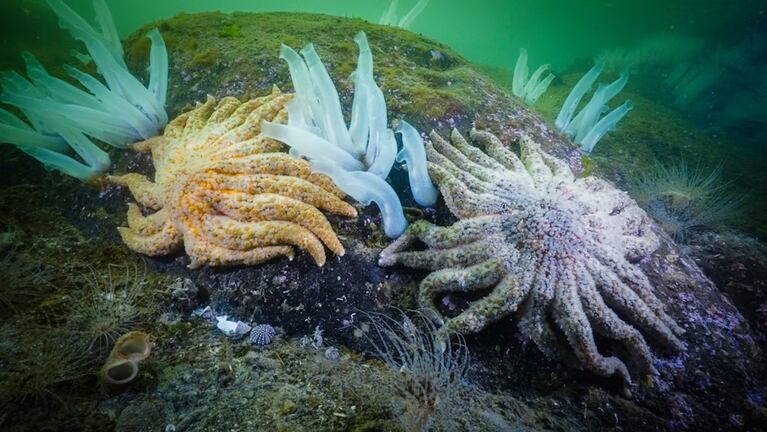
Sunflower stars and vase tunicates grow on the sea floor of Rivers Inlet, British Columbia, in 2023.

There have always been voters who care more about knocking a few cents off the gas they put in their SUVs than researching what’s going on with some small creature in the natural world.

But many of us do care about the natural world and believe that a dieoff in any one area can have repercussions for humanity. Everything is connected.

John Ryan reports at OPB (Oregon Public Broadcasting) about how scientists worked to “crack the case” of melting sea stars.

He writes, “Researchers in Washington and British Columbia say they have solved a deadly mystery that has stumped scientists for more than a decade. They have identified the pathogen behind one of the world’s biggest disease outbreaks: a wasting disease that has turned billions of sea stars into goo – from Alaska to California.

“A mass dieoff of ocean-shaking proportions began among sea stars along North America’s West Coast in 2013. Of 20 species affected, the pizza-sized sunflower star was hardest hit. More than 5 billion sunflower stars, or 90% of their global population, wasted away.

“With key predators of sea urchins largely wiped out, the spiny little grazers proliferated and chewed their way through kelp forests, leading to widespread losses of that productive ocean habitat.

“For 12 years, the cause of the wasting disease was either unknown or, mistakenly, thought to be a virus. Instead, the new study says, it is a strain of bacteria known as Vibrio pectenicida. Other Vibrio bacteria sicken corals and shellfish. One species, Vibrio cholera, causes cholera in humans.

“ ‘It is not surprising that it is a Vibrio,’ said biologist Alyssa-Lois Gehman of British Columbia’s Hakai Institute. ‘It was surprising because it took us so long to find out that it was a Vibrio.’

“Gehman and her coauthors are not the first scientists to claim to have found the culprit behind the worst underwater wildlife pandemic on record. …

“Gehman said the new study, published in the journal Nature Ecology & Evolution, avoids a key oversight of the earlier work by focusing on the sea stars’ blood-like internal fluid and not just its external tissues, where many other microbes live. …

“Gehman’s research team not only found much more Vibrio pectenicida in sick stars than in healthy ones. They were able to isolate the Vibrio, grow it in the lab, and give the wasting disease to healthy sunflower stars by injecting them with the Vibrio, steps the earlier researchers had not achieved. …

“The current study grew out of four summers of experiments at the U.S. Geological Survey’s Marrowstone Marine Field Station, a beachfront facility on Marrowstone Island, near Port Townsend, Washington. Avoiding microbial contamination was a top priority.

“ ‘There’s a lot of ethanol and bleach and betadine,’ Gehman said. …

“Researchers stepped in foot baths when entering and leaving the facility. Each sunflower star, after enduring a two-week quarantine, lived in its own tank with its own supply of sand-filtered, ultraviolet-treated seawater. Researchers avoided touching the stars, even with gloves on.

“In January 2024, after analyzing the previous summer’s data, the researchers found large amounts of Vibrio pectenicida in sick sunflower stars and hardly any in healthy stars. …

“Sunflower stars have become so rare that taking any from the wild is both difficult and potentially harmful to the species.

“ ‘We ran at sort of the bare minimum necessary to get robust and strong evidence,’ Gehman said.”

Continued research is under threat. The administration in DC proposes to cut the key U.S. Geological Survey budget 38% in 2026 and eliminate its biological research arm, which environmental advocates call “the backbone of environmental and ecological monitoring.”

More at OPB, here.

Read Full Post »

Photo: West Virginia University.
Mannon Gallegly, WVU plant pathology professor emeritus, has created four tomato varieties, including his last, “Mannon’s Majesty,” free to West Virginians.

For a short time in my childhood, I was a member of a 4-H club and won a $0.75 check for a tomato that my father really grew — a check I failed to cash before it expired!

I still love tomatoes. This is the time of year for gorgeous tomatoes. Ashley Stimpson writes at the Washington Post about the 101-year-old West Virginia professor who brought four special varieties into the world, including one he made free to West Virginians.

“You may not have heard of Mannon Gallegly, but chances are you’ve eaten one of his tomatoes, and perhaps even grown one in your garden. More than 60 years ago, Gallegly bred the first tomato that could stand up to Phytophthora infestans, otherwise known as tomato blight. The West Virginia ’63, sometimes called ‘the people’s tomato,’ is still a seed-catalogue superstar and beloved around the world, gracing gardens from Alabama to Africa.

“This year marks the first time since 1949 that Gallegly, who moved into a nursing home after falling ill in the spring, has missed the annual planting. … This morning’s planters are a mix of graduate students from WVU’s Davis College of Agriculture — where Gallegly worked for 38 years — and volunteers who have known the plant pathologist for decades. Gallegly developed three more hardy tomato varieties since 1963, each of which has claimed a spot in this year’s field, including his latest and likely his last.

“After the college publicized the release of the tomato, called Mannon’s Majesty, earlier this year — noting that it was free for any West Virginian who wanted seeds, per Gallegly’s insistence — WVU’s greenhouse manager Whitney Dudding came to work the next Monday morning to find 2,000 email orders waiting in her inbox, a number that far outstripped availability. …

“Until very recently, Dudding held out hope Gallegly might make it to the organic farm for the occasion. … ‘Every year, even last year, he’s been out there on the soft soil, out there in the heat, walking around, right there with us,’ she says. ‘I really don’t know how he does it.’

“The son of a carpenter and a school dietitian, Gallegly grew up in the rural southwest corner of Arkansas. ‘We were pretty poor people,’ he says. During the Great Depression, his parents grew cotton on rented land, where Gallegly logged the first of many hours spent walking between crop rows.

“A teacher from Future Farmers of America inspired Gallegly to attend college, and a Sears Roebuck scholarship made it financially feasible. After graduating from the University of Arkansas with a degree in agriculture, Gallegly went to the University of Wisconsin to get his master’s in plant pathology, working on a rice disease called white tip.

“In June 1949, Gallegly arrived in Morgantown. … ‘That was my favorite month,’ he recalls. ‘I had a new job, I had a new wife, I had a new baby.’ He also had a new three-acre research farm on the grounds of the nearby medium-security prison, where he could conduct trials on plant diseases, including tomato blight.

“By the following summer, Gallegly’s fields swayed with potato and tomato plants of all different varieties. Then disaster struck. ‘The disease farmers and gardeners feared most’ arrived, he says: late blight. The pathogen leaves ugly brown bruises stretching across the leaves, stem and fruit until the plant looks like it’s been blasted with a blow torch.

“That year, Gallegly lost nearly his entire crop of tomatoes to late blight — except for a few wild varieties with tiny fruit that showed a curious resistance to the disease.

“In the 1950s, late blight was more than just an annoyance for the home gardener. In the right conditions, Phytophthora infestans, which is Greek for ‘plant destroyer,’ can wipe out entire food supplies, as it did during the 1840s, when about 1 million people starved during the Irish Potato Famine. …

“For 13 years, Gallegly worked on developing an indestructible tomato, crossing those initial wild varieties that showed genetic resistance to blight with popular commercial tomatoes. …

“Finally, he stumbled upon a variety that was both blight-resistant and delicious. ‘Good things happen sometimes,’ he says.

“Gallegly, who primarily views himself as a public servant, called his creation ‘the people’s tomato.’ When it was released to the public in 1963 as part of the state’s centennial celebration it was given a new name: the West Virginia ’63. …

“Gallegly retired in 1986, but that didn’t stop him from coming into work every day. …

“In addition to writing books and breeding tomatoes, Gallegly has mentored countless plant pathologists getting their start in Morgantown. Dudding, who has helped Gallegly with cultivating diseases (to test for resistance in plants) and crossbreeding, ‘because my hands were smaller and steadier than his,’ says the scientist ‘is never in a hurry. He has always had time to talk to me and teach me.’

“WVU graduate student Inty Hernández, who’s been working with Gallegly on breeding new tomatoes, agrees, saying: ‘He’s very supportive all the time. It has been very inspiring to work with him. Sometimes you feel tired, you know, and then you arrive to the greenhouse and there’s a 100-year-old man hard at work.’ ”

More at the Post, here. Is your garden producing tomatoes right now?

Read Full Post »

Photo: Arian Zwegers/Flickr.
The monumental statues of Easter Island. 

Imagine all the work that has gone into figuring out how dead civilizations died! Even now it often feels like guesswork. But I like how new research provides new details on how people lived.

Consider this report at YaleEnvironment360.

“A new study casts doubt on the narrative often told about Easter Island, of an ancient society that plundered its forests to the point of collapse. Researchers have found fresh evidence for another [story] that the islanders learned to live within the bounds set by nature.

“When Europeans first arrived to the remote South Pacific island in 1722, they found hundreds of massive statues, evidence of considerable manpower, but only around 3,000 people, too few to easily explain the monuments. Historians inferred that the Polynesians who settled Easter Island must have seen their population grow to a large and unsustainable level, at which point they destroyed their forests, exhausted their soils, and hunted seabirds to oblivion before seeing their own numbers collapse.

“But in recent years a competing narrative has taken hold. It posits that the population never exploded, but that instead a small number of people learned to sustain themselves on the arid and relatively barren island. Researchers found evidence for this view in the remains of ‘rock gardens,’ where islanders grew sweet potatoes, their staple crop.

“To protect crops from sea winds and supply minerals to the soil, islanders grew potatoes among densely packed rocks. It has been difficult to determine, however, how much of the island was composed of rock gardens, which would indicate how many people farming sustained. Prior research found that rock gardens potentially covered more than 12 percent of Easter Island, which, scientists estimate, could have supported as many as 25,000 people.

“For the new study, researchers aimed to improve on previous inventories of rock gardens by studying gardens on the ground and then training artificial intelligence to identify them in satellite imagery. To better distinguish between rock gardens and rocky outcroppings, they also gathered satellite data on the levels of moisture and nitrogen in the soil, markers of cultivation.

“With this additional data, researchers determined that rock gardens covered less that 0.5 percent of the island. Accounting for other potential sources of food, such as fish, bananas, taro, and sugar cane, they estimated that Easter Island would have supported around 3,000 people, the number first recorded by Europeans. The findings were published in Science Advances.

“ ‘The population could never have been as big as some of the previous estimates,’ said lead author Dylan Davis, a postdoctoral researcher at Columbia University. ‘The lesson is the opposite of the collapse theory. People were able to be very resilient in the face of limited resources by modifying the environment in a way that helped.’

“History will show that the islanders did ultimately face collapse, but after Europeans arrived.” Europeans, alas, brought disease and slavery. No wonder the population died out!

More at YaleEnvironment360, here.

Read Full Post »

Photo: Vivek Doshi/Unsplash.
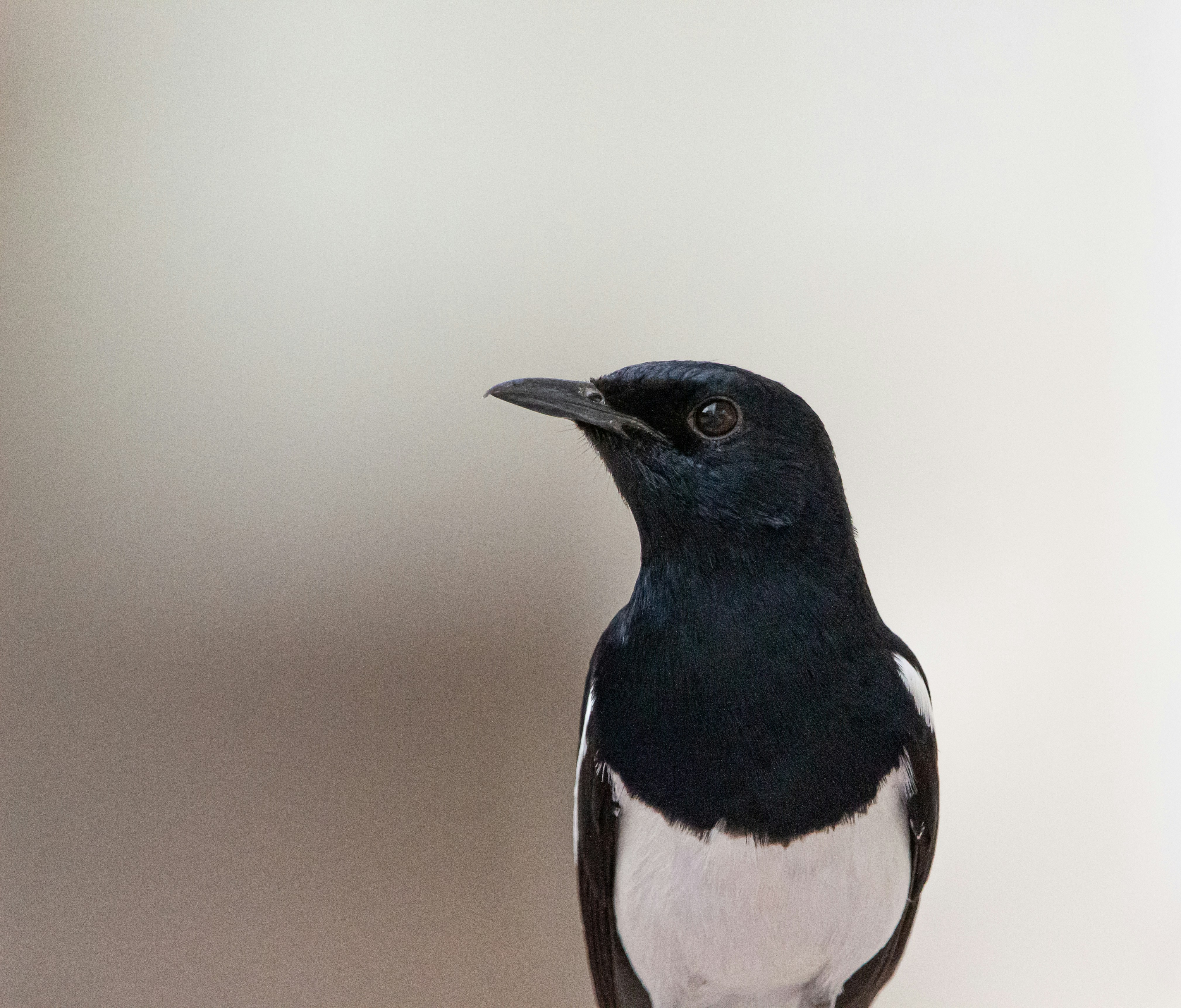
A magpie. Magpies in Australia are part of the Artamidae family. 

Covid may have made us more nervous about the interaction between humans and wild animals, but who can resist all the adorable videos suggesting it can work? Here’s what happened when a magpie in Australia got a bit too much attention on social media.

Annabelle Timsit writes at the Washington Post, “Peggy and Molly are typical best friends. They hang out. Play. Sunbathe. But in one important way, they are an unusual pair: Peggy is a dog, and Molly is a magpie.

“A couple in Queensland, Australia, rescued Molly in 2020 after she fell from a nest. The magpie bonded with their Staffordshire terrier, Peggy, and became somewhat of a social media celebrity.

“Through their Instagram account @peggyandmolly, the couple, Juliette Wells and Reece Mortensen, chronicle the dog and magpie’s daily adventures for 813,000 followers. …

“But Peggy and Molly’s rising popularity also attracted the attention of wildlife authorities. The Department of Environment, Science and Innovation (DESI) successfully demanded that Molly be surrendered into its care after receiving complaints from members of the public, saying that Wells and Mortensen did not have the proper permits to look after a wild bird.

“Now, Peggy and Molly could soon be reunited — after fans called for Molly to be sent back, and Queensland Premier Steven Miles said Tuesday that Wells and Mortensen can ‘secure the appropriate license’ to care for the magpie. … The update from Miles, who is the head of government in the northeastern Australian state, comes after Wells and Mortensen mounted a public campaign to regain care of Molly. …

“After the public outcry, Miles had said that wildlife authorities stood ‘ready to train Molly’s parents to be wildlife caregivers, to get them the right certification, so Molly can be reunited with her family.’ …

“Peggy and Molly are the latest animals to get caught up in tensions between pet owners and wildlife authorities. Social media videos of animals exhibiting unusual or humanlike behavior are growing in popularity, but experts say many wild animals are not meant to live in domesticated settings, and they have warned about risks to the animals and their owners because of the spread of disease.

“Wells said she was walking outside in the fall of 2020 when she came across a baby magpie that had fallen from its nest. She rescued it from ‘certain death,’ she said, and brought the magpie home.

“ ‘Peggy needed something to nurture and Molly needed nurturing,’ says a website about their story, and the duo became ‘besties.’

“About a year later, Peggy had five puppies. Molly ‘became very close to all’ of them, and ‘now has an incredible bond’ with one of them, named Ruby, according to the website.

“In the past 3½ years, near-daily videos posted on the @peggyandmolly Instagram account have shown Molly, Peggy and Ruby sharing toys and napping next to each other in the sun — and suggest that the magpie even learned to imitate Peggy and Ruby’s bark. In another video, Molly puts a wing over its friend on a dog bed. …

“Australian authorities have warned the public that some magpies can be ‘aggressive towards people’ when defending their nests, particularly during what’s known as ‘magpie swooping season,’ typically between July and November. Videos of Australians being chased by magpies have gone viral, and the Queensland government has warned the public to ‘stay safe from swooping magpies.’ ”

Molly the Magpie returned home on April 15, according to @SevenJMiles on the bird site.

More at the Post, here.

PS. If you see two Blue-Throated Piping Guans on the loose (Monster and Chip), they escaped from Roger Williams Park Zoo in Providence during a recent storm. Read here.

Read Full Post »

110620ebola_congo20nurse

Photo: Kudra Maliro
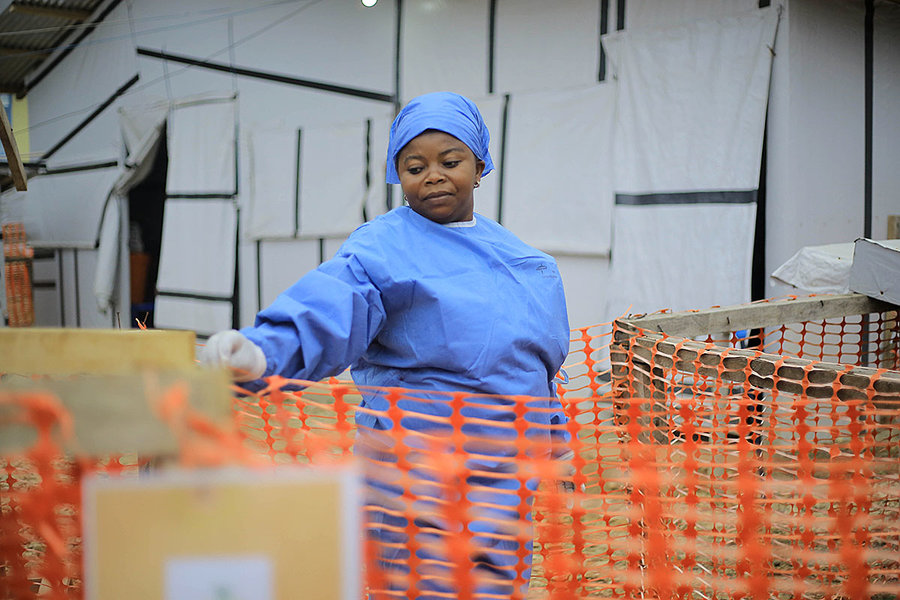
Regina works at the Ebola treatment center in Beni, Congo, where she was once a patient. She often tells other patients, “I had this horrible thing, too, and look at me now. You can’t give up.”

When people recover from a natural disaster or a disease that loved ones did not survive, rather than feeling elated to be alive, they may feel only darkness about their losses. Some have learned to try healing their spirits a bit by helping others in similar situations.

Ryan Lenora Brown writes at the Christian Science Monitor, “When Regina Kavira Mbangamuke’s toddler son fell sick late last year, she did what any mother would. She pressed his feverish body to hers. She wiped away his tears and his sweat. She whispered tiny comforts in his ear. Don’t be afraid, my baby.

“And when he died, she fell into a sadness so deep and physical it took a week for her to realize there might be something else wrong.

“Ebola can be like that, Ms. Mbangamuke knows now. First it tries to take the people you love most in the world. And then it tries to kill you too.

“But as she tells her story to her patients at the Ebola treatment center in this city in eastern Congo, where she now works as a nursing assistant, it has a more hopeful postscript.

‘I say, my brother, my sister, I had this horrible thing too, and look at me now,’ she says. ‘You cannot give up.’

“Like nearly every one of the 1,000 people who have survived Ebola in eastern Congo in the past 15 months, Ms. Mbangamuke’s survival is interlaced with profound loss.

“But Ebola also affords les guéris – the cured – with an unusual opportunity. They are considered likely immune to the disease, and so also to the cruel distance it demands. They don’t need to wear the spacesuit-like protective gear that other Ebola responders don to avoid touching the sick. They can hold hands and rock babies. They can hug and clean and console. And in a place where trust in outsiders is in short supply, the hundreds of survivors who now work in the Ebola response provide something else: familiarity.

“ ‘This work helps the response, but it also helps the people doing it,’ says Solange Kahambu Kamuha, a psychologist with UNICEF, the U.N. children’s agency, in Beni. …

“[A] young man in bed shakes his head weakly. No, he says, he won’t go. He heard that everyone who goes into an Ebola treatment center dies. From the outside, rumors like this can sound fanciful. The disease was invented by the rich to make money. The disease was brought in to kill the political opposition. Hospitals inject their patients with Ebola to keep the outbreak going.

“But each outlandish-seeming rumor contains a kernel of truth. … Even the idea that patients are being infected in hospitals is rooted in the truth that many have gotten sick after visiting one. …

“There is simply little reason to believe that outsiders ever have their best interests at heart, says [Dr. Maurice Kakule Mutsunga, the chair of the local Ebola survivors organization]. ‘All around, people see tanks and U.N. soldiers, and still our war doesn’t end,’ he points out, referring to the decades of civil war that have roiled this part of Congo. Why should Ebola, and its new army of outsiders, be any different?

“Ms. Mbangamuke sees the skepticism, and to her too, it makes sense. Ebola has broken all of society’s rules.

“ ‘Here in the Congo, to take care of people is the normal thing, but in times of Ebola people cannot do the normal thing’ for their own families, she says.

“For her, it is still nearly impossible to make sense of a world that would take her child and spare her. The camaraderie she feels with her colleagues, their unspoken understanding, the easy laughter that passes between them as they mix sugary cups of tea in the break area, none of it gives meaning to her son’s death. But it is a way for her to try to restore some measure of balance.

“ ‘Every old woman I see [in the treatment center], she becomes like my own mother. Every baby, it’s like my own baby.’ ”

More at the Christian Science Monitor, here.

Read Full Post »