Feeds:
Posts
Comments

Posts Tagged ‘do it yourself’

Photo: Jenna Garrett/The Guardian.
Eric Haas in his backyard in Oakland, California. The California professor had a rainwater and greywater capture system installed at his highly efficient urban home to conserve water. 

I like reading about people who are handy at fixing or making things. Probably because I’m not. Other than sewing on a button or baking cookies, I don’t do much in the do-it-yourself line, but I know some of you do, and I’d love to hear about it.

Today’s article is part of a Guardian series on people who figure out ways to limit their impact on the environment. Sometimes that means working with companies specializing in sustainable building practices. Eric Haas told his story to Victoria Namkung.

“I joined the Peace Corps after college in 1985,” Haas explains, “and was a math and science teacher in Buchanan, Liberia. There, I started to realize that large parts of the world don’t live with all the energy consumption and materialism that we do in the US.

“I started seeing people’s innovative ways of keeping their houses warm or cool and how they would get their water. I had to carry my own water at times and be very conscious where it came from. These experiences started cementing this idea that life could take into account the environment you lived in.

Relatively simple ideas could make a huge difference in the comfort and quality of your house. You adapt and your lifestyle can adapt. …

“When our family settled in Oakland, California, in 2007, part of the decision in buying a house was whether it was somewhere I could finally focus on water conservation and other low-carbon-footprint projects like installing solar panels, insulation and high-efficiency appliances.

“I hired Dig Cooperative Inc, a local contractor known for pioneering water-conservation systems across the greater Bay Area, to install a rainwater and greywater collection system at our home. I have about 4,000 gallons of water I can collect, which translates to about 7inches of rain coming off the roof. Filtered rainwater is used to fill the toilets and washing machine and water most of our plants. It can also be saved on site for emergency use in case of a fire or an earthquake.

“The greywater system takes our ‘used’ shower, bathroom sink and washing machine water and diverts it to the backyard to water our vegetable gardens and six fruit trees. …

“During 2024, the typical household in our area used an average of 124 gallons of water a day. We used an average of 39 gallons of water a day, less than a third.

“It wasn’t hard and the whole project took about a week. Rain barrels needed to be purchased and set up and the ground had to be leveled. I have a relatively small and simple house and connecting the rainwater and greywater system into the existing plumbing just took a day or two.

“The whole project cost about $15,000. We still have a water bill because the shower, sink and dishwasher water use regular city water, but it’s a fraction of what it used to be. … Compared to the average water user, I save about $220 a year on my water bill. So, my rainwater and greywater systems do more for my local environment than they do for my wallet.

“Since moving to Oakland, I’ve noticed a lot of climate-related changes. Before, nobody had air-conditioning, and I never even thought about it. Now it’s almost a necessity on select days. When I first put in the system, there was enough rain periodically in California’s dry season to fill up the tanks enough that I never had to go back to city water for the first several years. Now it only lasts for about 10 months. The dry season is so dry and when we’ve got extra rain in the rainy season my tanks overflow and drain into the sewer because they’re full.

“We have to approach our water use differently in California. … Our overuse of water now impacts our quality of life. We have water-restriction days where they ask you not to use as much water, including not flushing our toilets every time, and we’re encouraged not to have a lawn. … You can still have a really nice garden. We have a hot tub, we have a regular shower, but because those things are connected into this larger system, we have a much smaller impact.

“I feel like I’m doing something real and concrete, and every time I hear the greywater pump go on or when I hear the pump from our rainwater system go on to fill up the washing machine or  toilet, that’s water that I’m not taking from the system and that matters.

“Every time it rains, I love to go out and look at the gutters and see how much it’s pouring into the system. It brings me joy to interact with the natural environment in this small way in my urban house.”

More at the Guardian, here. My DIY climate hack is a Guardian series about everyday people across the US using their own ingenuity to tackle the climate crisis in their neighborhoods, homes and backyards.
Read Full Post »

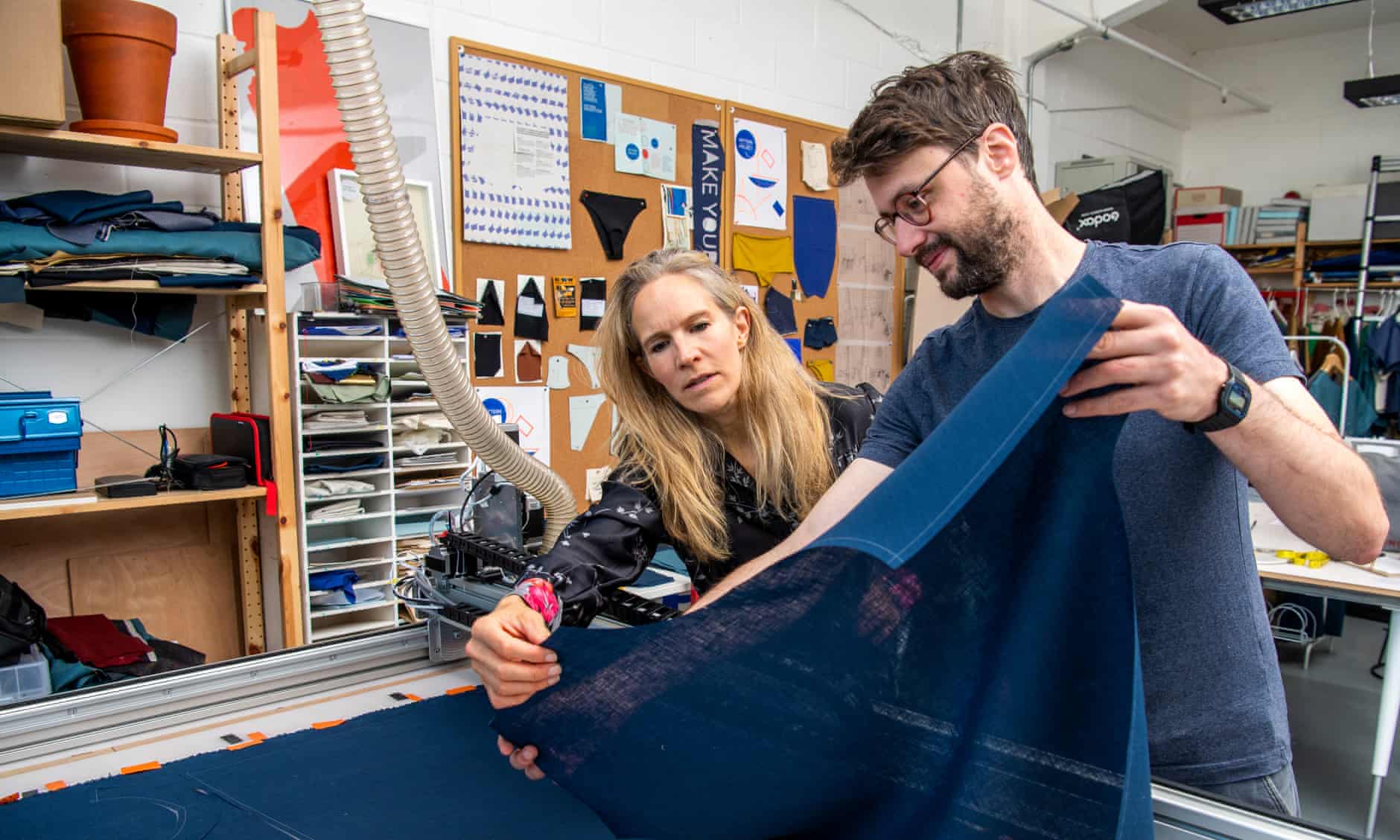
Photo: Jill Mead/The Guardian.
Fleur Britten with Simon Johnson at Pattern Project in south London. Covid got people going with sewing their own clothes. Sustainability concerns could make them continue.

Unlike me, not everyone is OK with wearing the same clothes for 30 years. But even fashionistas are starting to worry about how much clothing ends up in landfills or is sourced from factories paying slave wages.

Fleur Britten has an article at the Guardian about being mindful while having fun making her own clothes.

She writes, “My foot hovers nervously over the sewing machine pedal. I am cautiously working my way through a sew-it-yourself kit produced by Pattern Project, a ‘microfactory’ startup in south London. It has pioneered a laser-cutting machine that can cut patterns on demand, with minimal waste. The pieces for the dropped-sleeve dress that I am sewing have been snipped to my precise measurements by a zippy little laser, which whizzes over the crisp Irish linen, scorching faint seam guides into the fabric so I know exactly where to sew.

“Pattern Project’s founders, Shruti Grover, 34, and Simon Johnson, 35 – partners in life and in business – are seeking funding for their first shop. A ’22nd-century’ vision of fashion, says Grover, it will hold no stock, but will sell custom-fit clothing that is laser-cut in front of you within minutes, out of local, ethical and sustainable fabrics – and then sewn by you.

“They have already collaborated on a zero-waste pattern for the latest collection by the fashion designer Phoebe English, while last weekend they exhibited at the V&A in west London as part of the London Design festival. …

“The sew-it-yourself (SIY) movement has become something more modern, sustainably minded and social. For starters, sewers have been rebranded as ‘sewists’ – because who would want to be mistaken for a waste pipe? Plus, thanks to a new wave of independent pattern-makers, it is not hard to find on-trend designs, downloadable in pdf format anywhere in the world. …

“According to Jones, the new customers are ‘young and mostly female, against fast fashion and much more switched on about environmental issues.’ Many are motivated to sew because it enables them to avoid sweatshop production. …

“There is plenty of support available for newbie sewists, too. The Fashion District festival, a five-day celebration of sustainable fashion that took place last week in Stratford, east London, dedicated a third of this year’s programme to maker workshops, including a tutorial on upcycling scarves into kimonos, hosted by the community interest company Trashion Factory.

‘There’s a huge appetite for people to be involved in their own fashion,’ says Helen Lax, the festival’s founder. ‘This is a different incarnation of the good life. Rather than just following a pattern, the maker community is going off-grid and having a go. …

“For many sewists, the face mask was a gateway drug. After spotting a callout for 500 cloth masks from a homeless charity, Lydia Higginson, the founder of Made My Wardrobe sewing kits, rallied her followers to help. ‘It was a quick win – the perfect small challenge to get people back on their machines,’ she says. ‘And then they were like: “What else can I make?” ‘ …

“While you will find only British and European organic fabrics at Pattern Project (as well as an Italian polyamide that they claim will biodegrade about five years after disposal), the bigger fashion problem it wants to solve is overstock. It is estimated that 20% of the 100bn items of clothing produced each year are not sold; they are then usually buried, shredded or burned. ‘Brands always over-order,’ says Grover. ‘It’s cheaper to produce more and sell at mad discounts later than it is to produce less, but higher-quality, stuff.’ Pattern Project’s ultimate goal is to see its zero-waste laser in fashion stores and haberdasheries across the country, so clothes can be cut and sewn on demand, affordably and quickly.

“In the meantime, the sewists are playing what they call ‘pattern Tetris – making patterns fit into a smaller amount of fabric,’ says Atia Azmi, 38, a GP and a host of un:CUT: The Makers’ Podcast. According to the government’s 2019 report Fixing Fashion, ‘as much as 15% of fabric can end up on the cutting room floor … Hundreds of thousands of tonnes of fabric are wasted at the design and production stage before clothing reaches the customer.’ Within the sewing community, downloadable zero-waste patterns have blown up online.

“Reducing ‘fashion miles’ – the distance a garment and its component parts travel through the supply chain – is also on the sewists’ agenda. The starting point for the newly opened Mend Assembly in Totnes, Devon – a two‑storey centre offering a makers’ space, dressmaking workshops, repairs and upcycling – was ‘clothing localism,’ says its co-founder, Joss Whipple.

“As well as utilising ‘existing waste streams’ (upcycling old sweatshirts into kids’ leggings, say), Mend Assembly hopes to work with the regenerative ‘farm-to-clothing’ concept of the non-profit group Fibershed, whereby local demand for clothing is met by using local, natural fibres in a closed loop. ‘We believe that when clothing becomes aligned with local practice, so many of the problematic elements of the global commercial model fall away, from reduced carbon and transport to deeper connection, respect and care for the clothes that we own and wear,’ says Mend Assembly’s website.”

More at the Guardian, here.

Read Full Post »

Maybe this is the way cities are meant to operate — with residents taking charge to make sure the work gets done.

In April, Frances D’Emilio wrote at the Associated Press that the people of Rome, fed up with their dysfunctional government, had started filling potholes and tackling other maintenance chores themselves.

“Armed with shovels and sacks of cold asphalt, Rome’s residents fill potholes. Defying rats, they yank weeds and bag trash along the Tiber’s banks and in urban parks. Tired of waiting years for the city to replace distressed trees, neighbors dig into their own pockets to pay for new ones for their block.

“Romans are starting to take back their city, which for years was neglected and even plundered by City Hall officials and cronies so conniving that some of them are on trial as alleged mobsters.

“In doing the work, Romans are experimenting with what for many Italians is a novel and alien concept: a sense of civic duty.

“One recent windy Sunday morning, Manuela Di Santo slathered paint over graffiti defacing a wall on Via Ludovico di Monreale, a residential block in Rome’s middle-class Monteverde neighborhood. …

” ‘Either I help the city, or we’re all brought to our knees,” said Di Santo.

“Splotches of paint stained a blue bib identifying her as a volunteer for Retake Roma, a pioneer in an expanding array of citizen-created organizations in the past few years aimed at encouraging Romans to take the initiative in cleaning and repairing their city. …

“Calls and text messages pour into Cristiano Davoli’s cellphone from citizens alerting him to ominously widening potholes on their block or routes to work. On weekends, Davoli and four helpers – an off-duty doorman, a graphic artist, a government worker and a retiree – who call themselves ‘Tappami’ (Fill Me Up) load their car trunks with donated bags of cold asphalt and fan out.

” ‘Sometimes it’s the municipal traffic police who call me,’ said Davoli, a shopkeeper.” Imagine that!

Read more here.

Photo: Alessandra Tarantino
Retake Roma volunteers do the jobs that a dysfunctional government has failed to do.

Read Full Post »