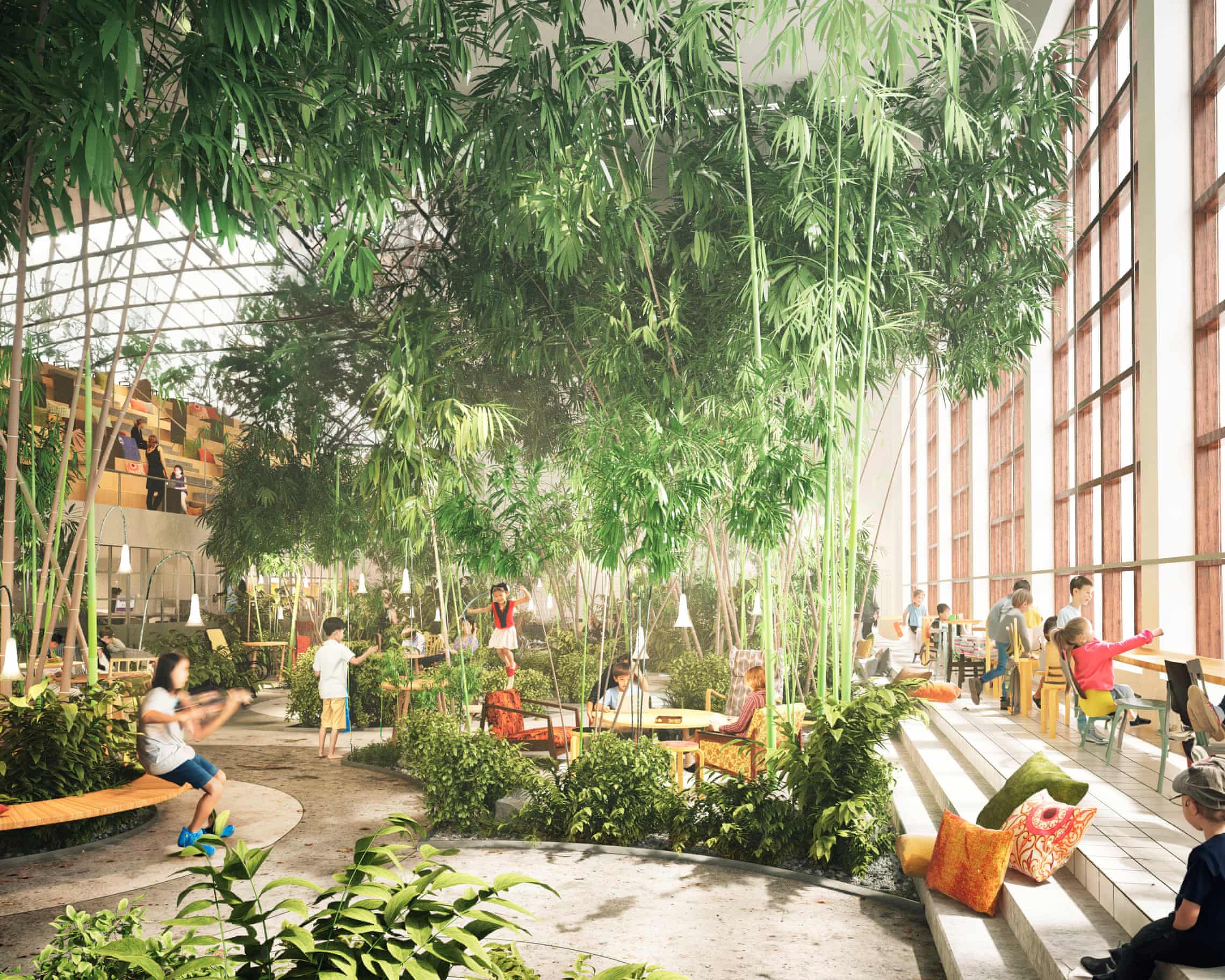
Illustration: Wingårdhs.
Tomelilla, a town in southeast Sweden, is focused on sustainability and has plans to build a school with reused materials.
With half of my family in Sweden for the fall semester, I am interested in Swedish stories. Here is one about residents in the Skåne district determined to live sustainably.
Abigail Sykes reports at the Guardian, “In a small town in Sweden, the local authority is carrying out an unusual experiment.
“In 2021 one of the team had been reading an article about the concept of doughnut economics – a circular way of thinking about the way we use resources – and he brought it up. ‘I just mentioned it casually at a meeting, as a tool to evaluate our new quality of life program, and it grew from there,’ says Stefan Persson, Tomelilla’s organizational development manager.
“The concept, developed by British economist Kate Raworth is fairly straightforward. The outer ring or ecological ceiling of the doughnut consists of the nine ‘planetary’ boundaries. These are the environmental limits that humans are at risk of passing – we’ve already crossed the safety thresholds on climate change, ocean acidification and biogeochemical flows, for example, but remain within safe limits on our atmospheric aerosol loading. The inner ring forms a social foundation of life’s essentials, and the ‘dough’ in between corresponds to a safe and just space for humanity, which meets the needs of people and planet. …
“ ‘Doughnut economics is like running a farm. Using an excess of resources, like nutrients, on your crops is a mistake. Not using enough is a mistake too,’ says Persson’s colleague Per-Martin Svensson, who is a farmer when he is not doing council work. …
“Doughnut economics is being used in Tomelilla, in Sweden’s southern Skåne region, in several ways. It has been integrated into financial planning and decision support, so that rather than building a new ice rink, the plan is now to revamp an existing building.
“The local government produces an annual portrait of how well it is doing at meeting doughnut economics targets. The best results in the latest diagram were on air quality, housing and social equality. Air quality in the area was good to begin with, but in order to keep improving it, young people at lower and upper secondary school have been given a free travel card for public transport. It is hoped the measure will also improve social equality in terms of access to education and health. Overcrowding and income disparities have both decreased, but it’s hard to link that directly to any of the council’s work.
“Education is a priority, but targets such as carbon emissions, biodiversity and health are more difficult to meet. Emissions have not been decreasing, but in 2023 the town council adopted a climate program to achieve net zero by 2045. …
“Tomelilla’s flagship doughnut economics project, though, is planning a new school. The council hasn’t built a school – or any other big development – since the 1990s. The project is still at an early stage so no decisions have been made about the final construction.
“Last year, a consultant report made recommendations for the project. These included using existing and carbon-neutral materials as far as possible, growing hemp as a building material on the current site; building the school around a greenhouse for growing vegetables as well as for educational and social activities; and making the school an off-grid energy producer using solar power and batteries. …
“This vision has carried over into the council’s procurement requirements, although budget constraints and other considerations have meant it is still unclear whether all of these ideas will come to fruition. …
“It has certainly been demanding. Is it even possible to use the resources needed for a large construction project and stay within the doughnut? Persson thinks it may not be possible but he is focusing on the bigger picture, with a more holistic view of social change. ‘In individual projects, there are always trade-offs. But we’re also looking at how the local community as a whole can move towards the doughnut model. I think that if we’re going to build anything, it should be democratic meeting places and schools.’ …
“Tomelilla is the first local government to attempt to deliver infrastructure and education using doughnut economics. … With a population of about 7,000, it is certainly one of the smallest towns in the international network of the Doughnut Economics Action Lab, dwarfed by Barcelona, Glasgow and Mexico City, which are all putting Raworth’s theories into practice in local governments. …
“The people of Tomelilla welcome the challenge and are extremely proud of the way their town is forging a path. As Jonna Olsson, one of the staff at the council says: ‘Doughnut economics is a really interesting way to work with sustainability. It feels cool to be a cog in international change.’ ”
More at the Guardian, here. No firewall.

 Suzanne's Mom's Blog